Alexis de Castillon followed one of the familiar trajectories for a 19th century musician. From an aristocratic family, he was intended for law or the military but resisted and went into music instead. He studied at the Paris Conservatoire under Massé and Franck; among his friends was Saint-Saëns. Generally in poor health, he died young.
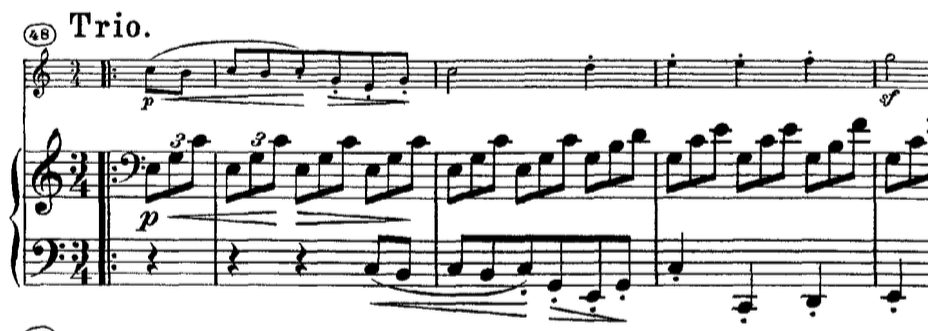
In de Castillon's 6 Valses humoristiques (1871) the first number is of interest. Its principal strain offers the rising line from ^5 in stark simplicity, including V9:
(Note that the second strain drills in the upper tetrachord, now with a descending scale figure--boxed.)
The design is ABCDAE, where E is a coda whose final phrase is recalls the opening with the melody in the left hand:
Showing posts with label waltz ninth. Show all posts
Tuesday, August 13, 2019
Wednesday, October 17, 2018
Post no. 300
It is four years to the day that I started this blog (introductory post), and this post is the 300th in the series. The blog has provided material for over twenty essays published on the Texas ScholarWorks platform (link to my author page).
The focus has been quite narrow throughout: ascending cadence gestures in traditional European tonal music. Though my work on these figures has its roots in Schenkerian analysis—an article I published thirty-one years ago ("The Ascending Urlinie," in Journal of Music Theory)—I use those particular constructions only some of the time, because of problems with the figure of the focal tone (Kopfton), which I see as defined too narrowly to be generally useful. I opt more often (1) for the model of proto-backgrounds (link; see also Neumeyer 2009), (2) for style historical methods in connection with the dominant ninth chord and what I call the “waltz ninth,” (3) for similar methods and speculative modes for improvisatory practices, especially in the later 18th and early 19th centuries, and (4) for historical narratives of music for social dance, of music for the stage through the nineteenth century, and of composition in general in the later decades of that century, both narratives continuing to be relevant in the first half of the 20th century, as well.
The great majority of the traditional tonal music preserved in scores and manuscript makes use of form-defining cadences in which the principal melody line descends the scale to end on the tonic note. A significant minority, however, follow an upward path to end on scale degree eight (^8), a “circling” path around ^8, or a “mirror” path down from ^8 to ^5 and returning. An early surprise in my work was to find a considerably larger than average percentage of rising lines in the country dances preserved in John Playford's Dancing Master (first edition 1651; link to essay), which fact suggested to me that the figures were relatively common in dance-performance practice, including improvisation. It must be remembered that music for social dance was predominantly music for the violin (secondarily, flute) and that the instrument’s fifths mapping made it as easy to rise from the middle of the scale to ^8 as it did to descend to ^1.
I later found considerable corroborating evidence in Scottish and Irish dances and dance-songs, these coming largely from the later 18th century (link; link; link), and in the Germanophone Laendler, one of the waltz ancestors and especially closely associated with the violin, later in the 18th century with an ensemble of two violins and bass.
In the example below, the four open strings are depicted at the left in (a) and (b). From the open A-string, one moves with the greatest ease down the D-major scale, as in (a), or up the D-major scale, as in (b). In counterpoint, supposing for example, one violin improvises a descant to the other, the work is almost as easy, one of the simplest versions shown in (c). Another version with a bit more melodic complexity is shown in (d). Register play, in other words, offered a simple device to "do something different," specifically to do something different for an ending/articulation that didn’t run afoul of the traditional cadenza, where ^2 goes down to ^1 while ^7 goes up to ^8, making intervals of the major sixth and the octave (or minor third and unison). Not coincidentally, the alternative higher-register cadence offered a sound that was "bright" or "brilliant."
Additional corroboration of early practices came from 17th-century Germany and Austria; these included repertoires across the entire spectrum of genres, excluding only sacred choral music: link to essay.
The history and practice of rising cadence gestures quickly became more complicated in the early 19th century. Broadly, though, cadences can be heard as prominent expressive gestures and a turn toward less common cadences fits nicely with our familiar nostrums about Romantic rebellion against eighteenth-century conventions—and it aligns well with music theorists' recent revelations about a kind of shadow tonality of hexatonic relations that arise from the exploitation of chromatic mediants, early on especially by Schubert, whose Laendler and Deutscher ("German dance," the other ancestor of the waltz) made significant use of rising figures. This is music, incidentally, we know passed back and forth between music for dance and music for performance, not only in Schubert’s case but in the pragmatic circumstances of music publishing and (especially) domestic use.
Strangely, perhaps, I have found so far that straightforward expressive motivations for rising gestures—exhilaration, release, etc.—seem to have been far less prevalent than generic, topical, or formal-design considerations. The few coincidences of text and cadence, predictably, were found in the 19th century, after the clichéd cadence figures derived from earlier Italian practice had been largely abandoned (or, at least, their authority undermined). Examples: Grieg, Morgenstimmung (the analogy of musical ascent and the rising sun; link); Schubert, "Die Nonne" (the religious-utopian; link); Strauss, jr., Die Fledermaus n2 (increasing energy, demand, insistence: "Hinaus!”; link); Wolf, "Trunken müssen wir alle sein!” (as in Strauss; link).
As I have already noted, the rising cadence gesture was part of the toolkit of the waltz, and from there it went directly to the polka by no later than 1840. When an aria or other song used a waltz topic, the gesture went along with it. The floodgates were opened in French comic opera by no later than 1834 (see my essay on Adolphe Adam's Le Châlet: link), and rising cadences remained a factor in the opera bouffe and operettas of Offenbach, Lecocq, and others before finding a niche in the American operetta (Herbert) and the musical (notably those by Richard Rodgers).
The formal figure of the rising gesture in the coda of an aria or instrumental movement became firmly established in the last quarter of the 18th century. In some pieces, though, the boundary line between the "structural cadence" and coda figures became blurry—a process already underway earlier in the ensemble finales of Galuppi, with their many repetitions of cadential phrases, a dramatic device adopted by many composers, notably Mozart and Rossini. The process accelerated in the 19th century, more vigorously and consequentially in music for the stage than in instrumental concert music.
As I have already noted, the rising cadence gesture was part of the toolkit of the waltz, and from there it went directly to the polka by no later than 1840. When an aria or other song used a waltz topic, the gesture went along with it. The floodgates were opened in French comic opera by no later than 1834 (see my essay on Adolphe Adam's Le Châlet: link), and rising cadences remained a factor in the opera bouffe and operettas of Offenbach, Lecocq, and others before finding a niche in the American operetta (Herbert) and the musical (notably those by Richard Rodgers).
The formal figure of the rising gesture in the coda of an aria or instrumental movement became firmly established in the last quarter of the 18th century. In some pieces, though, the boundary line between the "structural cadence" and coda figures became blurry—a process already underway earlier in the ensemble finales of Galuppi, with their many repetitions of cadential phrases, a dramatic device adopted by many composers, notably Mozart and Rossini. The process accelerated in the 19th century, more vigorously and consequentially in music for the stage than in instrumental concert music.
An important outlier in all this is Beethoven, for whom transcendence, as a philosophical-religious category, could mean striving to move not just to the top of the voice leading, but outside or beyond it. For my only comments on this to date, see my post on Op119n7: link. My plan is to do more with this eventually, engaging work by David Lewin, Robert Fink, and, more recently, Malcolm Miller.
Monday, June 18, 2018
Czerny, Praktische Studien des Generalbasses, Op. 838: ninth chords
Czerny introduces the dominant with a minor ninth relatively early in his harmony exercise book. Much later he has a section titled "Der Nonen-Accord." It consists of one two-page composition, a 43-bar agitato that begins in C minor but ends triumphantly in C major.
With only three exceptions, the ninth chords are again dominants with a minor ninth--as at the first arrow below--and those ninths are resolved within the chord--as at the second arrow. Only over pedal point basses are the ninths allowed to resolve directly. In other words, Czerny's treatment of ninth chords is very conservative for the 1850s.
Two of the three dominants with major ninth are close together--see arrows below--and both resolve their ninths within the chord. (Chords with minor ninth are boxed.)
All this being the case, the primary closing cadence is a surprise: not only does it have a chord with major ninth (boxed) but that chord is treated in the manner I call the "waltz ninth," where 9 moves upward, the result being an emphatic ascending cadence gesture (beamed at (a)). (At (b) is an example of the minor ninths over a pedal point.) Here it is Beethovenian heroic transcendence we are hearing, definitely not a lilting upward turn to end a waltz or polka.
With only three exceptions, the ninth chords are again dominants with a minor ninth--as at the first arrow below--and those ninths are resolved within the chord--as at the second arrow. Only over pedal point basses are the ninths allowed to resolve directly. In other words, Czerny's treatment of ninth chords is very conservative for the 1850s.
Two of the three dominants with major ninth are close together--see arrows below--and both resolve their ninths within the chord. (Chords with minor ninth are boxed.)
All this being the case, the primary closing cadence is a surprise: not only does it have a chord with major ninth (boxed) but that chord is treated in the manner I call the "waltz ninth," where 9 moves upward, the result being an emphatic ascending cadence gesture (beamed at (a)). (At (b) is an example of the minor ninths over a pedal point.) Here it is Beethovenian heroic transcendence we are hearing, definitely not a lilting upward turn to end a waltz or polka.
Thursday, March 15, 2018
The blog's new subtitle
Today's post is no. 250. In celebration, I have added a descriptive subtitle to the blog's banner.
[I removed it again in June but have left the post as is.]
I made the assertion contained in the subtitle in connection with the waltz ninth. The post (link) was the last (before a postscript) in the "JMT Notes" series; a post announcing an essay gathered from the series is here: link.
It is worth reproducing my comment on the waltz ninth, with its related graphic:
I hesitated before adding the subtitle insofar as it suggested that the ascending cadence gesture was proper to the nineteenth century, not other eras. That is, of course, incorrect: to date the largest number of rising lines—here defined as those easily understood as lines with focal notes, or as Urlinien—came from John Playford's English Dancing Master and the manuscript collection of contredanses compiled under the direction of Johann Bülow for the Danish court, or from the seventeenth and eighteenth centuries, respectively. On the other hand, the burden of numbers has been inexorably moving to the nineteenth century—virtually all new "discoveries" have been there, including a large number in the works of Chaminade. I hope to write about these as time goes on.
In addition to fitting nicely with our familiar nostrums about Romantic rebellion against eighteenth-century conventions, etc., putting the focus on the rising line in the nineteenth century aligns well with theorists' revelations about a kind of shadow tonality of hexatonic relations that arise from the exploitation of chromatic mediants.
Reference
Yust, Jason. 2015. "Voice-Leading Transformation and Generative Theories of Tonal Structure." Music Theory Online 21/4: link.
[I removed it again in June but have left the post as is.]
I made the assertion contained in the subtitle in connection with the waltz ninth. The post (link) was the last (before a postscript) in the "JMT Notes" series; a post announcing an essay gathered from the series is here: link.
It is worth reproducing my comment on the waltz ninth, with its related graphic:
"Neumeyer ([JMT] 1987) . . . considers G [as ^6 in Bb major] to be an ascending passing tone rather than an upper neighbor. According to his interpretation, the G and A at the end of m. 7 [in Beethoven, Op. 22, III] are successive notes in a single voice, even though they both are sustained as part of the dominant ninth harmony over all of mm. 5–7" (Yust 2015, n33). I have written about the "waltz ninth" many times by now. . . . Yust's criticism is the same as the one I've just made with respect to proto-backgrounds and does tend to undermine the registral variant [which I claimed as the Schenkerian solution to the background in this piece]. The waltz ninth is another matter. Nineteenth-century practice is broader--more creative and expressive--than eighteenth-century proscriptions. At (a), the ninth as neighbor note; at (b), the directly resolving ninth, a cliché in the waltz repertoire by no later than 1830. Note that the essential Schenkerian melodic note, C, is nowhere to be seen (or heard) -- in four-part writing of ninth chords, one leaves out the fifth. At (c), the figure that applies to all three "extended" chords: keep the seventh below the newly added top note in ninth, eleventh, and thirteenth chords. At (d), the voice leading for the rising line with waltz ninth, understood as at (e) splitting the ninth in two; the same at (f) in Schenkerian notation.
I hesitated before adding the subtitle insofar as it suggested that the ascending cadence gesture was proper to the nineteenth century, not other eras. That is, of course, incorrect: to date the largest number of rising lines—here defined as those easily understood as lines with focal notes, or as Urlinien—came from John Playford's English Dancing Master and the manuscript collection of contredanses compiled under the direction of Johann Bülow for the Danish court, or from the seventeenth and eighteenth centuries, respectively. On the other hand, the burden of numbers has been inexorably moving to the nineteenth century—virtually all new "discoveries" have been there, including a large number in the works of Chaminade. I hope to write about these as time goes on.
In addition to fitting nicely with our familiar nostrums about Romantic rebellion against eighteenth-century conventions, etc., putting the focus on the rising line in the nineteenth century aligns well with theorists' revelations about a kind of shadow tonality of hexatonic relations that arise from the exploitation of chromatic mediants.
Reference
Yust, Jason. 2015. "Voice-Leading Transformation and Generative Theories of Tonal Structure." Music Theory Online 21/4: link.
Friday, September 29, 2017
JMT series, part 10 (Beethoven, Op. 22, III)
I intended this originally as a response to an article by Jason Yust; the menuet movement from the Piano Sonata, Op. 22, is the author's main example: link. There is, however, little to be said from the standpoint of traditional Schenkerian analysis, as Yust's goal is to rationalize the orthodox form of the theory, and therefore the analysis of Op, 22, III, assumes a priori Schenker's analysis from Free Composition and seeks to formalize it. Broadly, his position is similar to Matthew Brown's rationalization of Schenkerian theory (2005). Brown rejects the ascending Urlinie with a bit of circular reasoning; Yust doesn't engage it at all. The closest he comes is a critical note on the waltz ninth in this menuet's Urlinie: "Neumeyer (1987) . . . considers G to be an ascending passing tone rather than an upper neighbor. According to his interpretation, the G and A at the end of m. 7 are successive notes in a single voice, even though they both are sustained as part of the dominant ninth harmony over all of mm. 5–7" (2015, n33). More on that at the end of this post.
Yust does mention my article on proto-backgrounds (2009). As I noted above, he belongs among the "rationalizers" of Schenkerian theory (and so do I--in Neumeyer 2009, at least); he summarizes the earlier history very well (in paragraphs 0.1.1 & 0.1.2, and introductory paragraphs to subsequent sections). Although I can hardly claim to have offered a formalized theory in Neumeyer 2009, I did focus on a generative model (that is, building out from the background through transformations), which Yust also favors. Here is a sample, his Example 15; I have removed its analysis of the bass to show only the reading of the treble parts. The specific aim of the work is to portray contrapuntal melody (2 or more part-writing "voices") in a single diagram or figure (which presumably can then be subject to computerized comparisons). Level 0 is the "chord of nature" and is indistinguishable from one of my proto-backgrounds. At Level 1 the passing tone C is represented as a digression from the interval; then a second voice appears--as a hierarchically subordinate voice it is shown below the primary voice. Level 2, so to speak, harmonizes the two voices, drawing them together into a single diagram. The only comparison I can possibly make is to say that, in my view, Level 0 could just as easily have had the fourth F5-Bb5 instead of the third Bb4-D5.
In the details of his analysis, Yust brings out motivic thirds, beginning with the pick-up gesture. In my view, the fourth is more prominent, tying together accented notes at the beginning, F4-Bb4, and then being repeated. Stretched to a fifth -- one can hear the stretching in Enat5 -- the fourth can still be heard as a shadow within the compressed thirds that follow and continue throughout the continuation phrase. This theme, incidentally, is in the antecedent + continuation design, which Caplin regards as a hybrid but which I have found to be fundamental to 18th century galant style and have re-named the "galant theme" (link).
A reading using proto-backgrounds is not kind to my JMT analysis of the theme as using the registral variant, ^5-^6-(reg.) ^7-^8, since the stable interval would strongly imply/imagine ^5 (as F5) at the end. See below.
Thinking of the proto-background more abstractly, the initial fourth could be recovered -- circled notes below -- but the registral variant of the Urlinie would be undercut by this version, as well.
I still do think that a registral variant (link) is not difficult to hear in this theme and in the reprise (below), but it is obviously not compatible with a reading based on proto-backgrounds, which are after all biased in favor of registral definition and stability.
Note on the note: "Neumeyer (1987) . . . considers G to be an ascending passing tone rather than an upper neighbor. According to his interpretation, the G and A at the end of m. 7 are successive notes in a single voice, even though they both are sustained as part of the dominant ninth harmony over all of mm. 5–7" (Yust 2015, n33). I have written about the "waltz ninth" many times by now--here's a (link) to a recent post in this JMT series. Yust's criticism is the same as the one I've just made with respect to proto-backgrounds and does tend to undermine the registral variant. The waltz ninth is another matter. Nineteenth-century practice is broader--more creative and expressive--than eighteenth-century proscriptions. At (a), the ninth as neighbor note; at (b), the directly resolving ninth, a cliché in the waltz repertoire by no later than 1830. Note that the essential Schenkerian melodic note, C, is nowhere to be seen (or heard) -- in four-part writing of ninth chords, one leaves out the fifth. At (c), the figure that applies to all three "extended" chords: keep the seventh below the newly added top note in ninth, eleventh, and thirteenth chords. At (d), the voiceleading for the rising line with waltz ninth, understood as at (e) splitting the ninth in two; the same at (f) in Schenkerian notation.
References:
Brown, Matthew. 2005. Explaining Tonality: Schenkerian Theory and Beyond. Rochester: University of Rochester Press.
Neumeyer, David. 2009. “Thematic Reading, Proto-Backgrounds, and Registral Transformations.” Music Theory Spectrum 31 (2): 284–324.
Yust, Jason. 2015. "Voice-Leading Transformation and Generative Theories of Tonal Structure." Music Theory Online 21/4: link
Yust does mention my article on proto-backgrounds (2009). As I noted above, he belongs among the "rationalizers" of Schenkerian theory (and so do I--in Neumeyer 2009, at least); he summarizes the earlier history very well (in paragraphs 0.1.1 & 0.1.2, and introductory paragraphs to subsequent sections). Although I can hardly claim to have offered a formalized theory in Neumeyer 2009, I did focus on a generative model (that is, building out from the background through transformations), which Yust also favors. Here is a sample, his Example 15; I have removed its analysis of the bass to show only the reading of the treble parts. The specific aim of the work is to portray contrapuntal melody (2 or more part-writing "voices") in a single diagram or figure (which presumably can then be subject to computerized comparisons). Level 0 is the "chord of nature" and is indistinguishable from one of my proto-backgrounds. At Level 1 the passing tone C is represented as a digression from the interval; then a second voice appears--as a hierarchically subordinate voice it is shown below the primary voice. Level 2, so to speak, harmonizes the two voices, drawing them together into a single diagram. The only comparison I can possibly make is to say that, in my view, Level 0 could just as easily have had the fourth F5-Bb5 instead of the third Bb4-D5.
In the details of his analysis, Yust brings out motivic thirds, beginning with the pick-up gesture. In my view, the fourth is more prominent, tying together accented notes at the beginning, F4-Bb4, and then being repeated. Stretched to a fifth -- one can hear the stretching in Enat5 -- the fourth can still be heard as a shadow within the compressed thirds that follow and continue throughout the continuation phrase. This theme, incidentally, is in the antecedent + continuation design, which Caplin regards as a hybrid but which I have found to be fundamental to 18th century galant style and have re-named the "galant theme" (link).
A reading using proto-backgrounds is not kind to my JMT analysis of the theme as using the registral variant, ^5-^6-(reg.) ^7-^8, since the stable interval would strongly imply/imagine ^5 (as F5) at the end. See below.
Thinking of the proto-background more abstractly, the initial fourth could be recovered -- circled notes below -- but the registral variant of the Urlinie would be undercut by this version, as well.
I still do think that a registral variant (link) is not difficult to hear in this theme and in the reprise (below), but it is obviously not compatible with a reading based on proto-backgrounds, which are after all biased in favor of registral definition and stability.
Note on the note: "Neumeyer (1987) . . . considers G to be an ascending passing tone rather than an upper neighbor. According to his interpretation, the G and A at the end of m. 7 are successive notes in a single voice, even though they both are sustained as part of the dominant ninth harmony over all of mm. 5–7" (Yust 2015, n33). I have written about the "waltz ninth" many times by now--here's a (link) to a recent post in this JMT series. Yust's criticism is the same as the one I've just made with respect to proto-backgrounds and does tend to undermine the registral variant. The waltz ninth is another matter. Nineteenth-century practice is broader--more creative and expressive--than eighteenth-century proscriptions. At (a), the ninth as neighbor note; at (b), the directly resolving ninth, a cliché in the waltz repertoire by no later than 1830. Note that the essential Schenkerian melodic note, C, is nowhere to be seen (or heard) -- in four-part writing of ninth chords, one leaves out the fifth. At (c), the figure that applies to all three "extended" chords: keep the seventh below the newly added top note in ninth, eleventh, and thirteenth chords. At (d), the voiceleading for the rising line with waltz ninth, understood as at (e) splitting the ninth in two; the same at (f) in Schenkerian notation.
References:
Brown, Matthew. 2005. Explaining Tonality: Schenkerian Theory and Beyond. Rochester: University of Rochester Press.
Neumeyer, David. 2009. “Thematic Reading, Proto-Backgrounds, and Registral Transformations.” Music Theory Spectrum 31 (2): 284–324.
Yust, Jason. 2015. "Voice-Leading Transformation and Generative Theories of Tonal Structure." Music Theory Online 21/4: link
Wednesday, September 27, 2017
JMT series, part 6c (note 31, the waltz ninth)
By the mid 1850s, when Jacques Offenbach began his prolific career as a composer of operetta and opera bouffe, rising cadence gestures were already well embedded in musical practice. (See my essay on Adolphe Adam's Le Châlet [1834]: link. The essay was based on posts to this blog; follow the labels for "Adam" or go to the first post in the series: link.)
The composition and production history of Offenbach's final work, Les contes de Hoffmann [The Tales of Hoffmann] is complicated, but there is no ambiguity about its most famous number, the Barcarolle "Belle nuit, ô nuit d'amour," number 13 in the four-act version of published French editions from the two decades after the composer's death. A duet for two sopranos, Giuletta, female lead of Act 3, and Nicklausse, Hoffmann's muse (a pants role), the soloists are joined by a chorus in the second half of the piece.
My comment in note 31: "^5 is prominent in the upper octave as a cover tone, also." Alas, here I was a bit optimistic about the status of the rising line. It is a distinctive figure to be sure--in fact, it is Giuletta's cadence line, and therefore ought to be given priority over the orchestra's plodding descent at that same place in the music. The orchestra's role in the gestures and topical expression of this particular number, however, is so strong that nowadays I have to regard the voice and orchestra as equals. That being the case, Giuletta's rising line is an inner voice, a "structural alto" to the orchestra's descending line from ^5. Details below.
I have shown just two systems from the vocal score. In the first, see the prominent A5 (^5), which of course has sounded many times before.
At (a) is the orchestra's descending line in the fifth octave (the keyboard reduction is corroborated by the full orchestral score, btw). At (b): Giuletta's ascending line, with ^6 (*) as the waltz ninth. At (c) Niklausse copies part of the orchestra's descent in the fourth octave. At (d) the curious detail of the second chorus alto repeated ^4-^3.
The composition and production history of Offenbach's final work, Les contes de Hoffmann [The Tales of Hoffmann] is complicated, but there is no ambiguity about its most famous number, the Barcarolle "Belle nuit, ô nuit d'amour," number 13 in the four-act version of published French editions from the two decades after the composer's death. A duet for two sopranos, Giuletta, female lead of Act 3, and Nicklausse, Hoffmann's muse (a pants role), the soloists are joined by a chorus in the second half of the piece.
My comment in note 31: "^5 is prominent in the upper octave as a cover tone, also." Alas, here I was a bit optimistic about the status of the rising line. It is a distinctive figure to be sure--in fact, it is Giuletta's cadence line, and therefore ought to be given priority over the orchestra's plodding descent at that same place in the music. The orchestra's role in the gestures and topical expression of this particular number, however, is so strong that nowadays I have to regard the voice and orchestra as equals. That being the case, Giuletta's rising line is an inner voice, a "structural alto" to the orchestra's descending line from ^5. Details below.
I have shown just two systems from the vocal score. In the first, see the prominent A5 (^5), which of course has sounded many times before.
At (a) is the orchestra's descending line in the fifth octave (the keyboard reduction is corroborated by the full orchestral score, btw). At (b): Giuletta's ascending line, with ^6 (*) as the waltz ninth. At (c) Niklausse copies part of the orchestra's descent in the fourth octave. At (d) the curious detail of the second chorus alto repeated ^4-^3.
Tuesday, September 26, 2017
JMT series, part 6b-3
This continues from yesterday's post to examine linear analyses of Beethoven, Symphony no. 1, III, and also to discuss its pervasive figure of the rising fourth.
In the previous post, I noted that Schachter's analysis of tonal structure was "bizarre, in my view radically un-Schenkerian." The sense of this assessment is apparent enough in the background/first middleground (63), which I have reproduced and annotated:
Far more (on traditional terms) mechanically and (in my view) musically plausible readings are shown below.
One can, of course, always read from ^3. This analysis takes the E5 in bar 3 as its focal tone--not unreasonable as it is the endpoint of the tonic prolongation in the opening phrase. The reading positions the "flat-key" area within a dominant prolongation, which matches our expectations about tonal design and formal functions. And the ending is conventional too, though ^2 must be implied (not shown that way, here) if one is taking the first violins, first oboe, and first flute as the line. There is a simple ^3-^2-^1 in the first horn and viola. Details of this reading may be found on my Google Drive page: link.
The traditional reading from ^5 fits the music as well as the one from ^3, with the exception that ^5 appears in the first obviously non-tonic moment (I've whisked that away in the graph, but you can see it in the score -- top of the previous post). This graph also shows more clearly that V in the retransition has been replaced by iii (as iii6/4).
A descending line from ^8 is not possible, but one can hear a stable ^8 -- surrounded by neighbor notes -- if one takes the strongest shape of the opening, the rising fourth motive, and chooses its goal tone as a long range focal tone. Details of this reading may be found on my Google Drive page: link.
The rising fourth motive and the persistent register play make a reading with a proto-background quite convincing. For more on proto-backgrounds, see my essay on Texas Scholar Works: link.
Finally, a reading meant to support the previous two, but I think also quite strong on its own. The fourth motive is stated three times, as three 2 bar ideas, in the first strain. A cadential gesture finishes. In the B section, the motive is continually present, as an obvious inverse, then expanded to a sixth in the approach to the cadence on bII. After that, the original and inverse are combined in the "codetta" to the Db cadence. A distorted version in the retransition is followed by the 14-bar expansion of the main theme in the reprise (bars 45-58), where the motivic idea is heard six times before the cadence formula. In the second half of the coda the rising motive and the falling melodic formula are opposed.
References:
Schachter, Carl. 2000. “Playing What the Composer Didn’t Write: Analysis and Rhythmic Aspects of Performance.” In Essays in Honor of Jacob Lateiner, edited by Bruce Brubaker and Jane Gottlieb, 47-68. Pendragon.
In the previous post, I noted that Schachter's analysis of tonal structure was "bizarre, in my view radically un-Schenkerian." The sense of this assessment is apparent enough in the background/first middleground (63), which I have reproduced and annotated:
Far more (on traditional terms) mechanically and (in my view) musically plausible readings are shown below.
One can, of course, always read from ^3. This analysis takes the E5 in bar 3 as its focal tone--not unreasonable as it is the endpoint of the tonic prolongation in the opening phrase. The reading positions the "flat-key" area within a dominant prolongation, which matches our expectations about tonal design and formal functions. And the ending is conventional too, though ^2 must be implied (not shown that way, here) if one is taking the first violins, first oboe, and first flute as the line. There is a simple ^3-^2-^1 in the first horn and viola. Details of this reading may be found on my Google Drive page: link.
The traditional reading from ^5 fits the music as well as the one from ^3, with the exception that ^5 appears in the first obviously non-tonic moment (I've whisked that away in the graph, but you can see it in the score -- top of the previous post). This graph also shows more clearly that V in the retransition has been replaced by iii (as iii6/4).
A descending line from ^8 is not possible, but one can hear a stable ^8 -- surrounded by neighbor notes -- if one takes the strongest shape of the opening, the rising fourth motive, and chooses its goal tone as a long range focal tone. Details of this reading may be found on my Google Drive page: link.
The rising fourth motive and the persistent register play make a reading with a proto-background quite convincing. For more on proto-backgrounds, see my essay on Texas Scholar Works: link.
Finally, a reading meant to support the previous two, but I think also quite strong on its own. The fourth motive is stated three times, as three 2 bar ideas, in the first strain. A cadential gesture finishes. In the B section, the motive is continually present, as an obvious inverse, then expanded to a sixth in the approach to the cadence on bII. After that, the original and inverse are combined in the "codetta" to the Db cadence. A distorted version in the retransition is followed by the 14-bar expansion of the main theme in the reprise (bars 45-58), where the motivic idea is heard six times before the cadence formula. In the second half of the coda the rising motive and the falling melodic formula are opposed.
The three main cadences (not counting the one in Db major or bars 67-76) have versions of the same rhythmic figure and falling shape. At (a), the accented bar is on V/V. At (b), it is on the cadential dominant 6/4, but at (c) it is on the tonic -- the cadence came before it this time. It is this motivically driven dramatic plan that allows us to hear the final bars and not the earlier formula as the proper end of this menuetto/scherzo.
References:
Schachter, Carl. 2000. “Playing What the Composer Didn’t Write: Analysis and Rhythmic Aspects of Performance.” In Essays in Honor of Jacob Lateiner, edited by Bruce Brubaker and Jane Gottlieb, 47-68. Pendragon.
Monday, September 25, 2017
JMT series, part 6b-2 (note 31, the waltz ninth)
Beethoven, Symphony no. 1, Scherzo. As we saw in the earlier post, part 6a-1, the scherzo of the Second Symphony clearly draws on the "waltz ninth" device -- that is, positioning both ^6 and ^7 over the dominant. The Menuetto in the First Symphony is equally clear in its final cadence—see below—but the analysis of the background will not be as simple.
My comment in the note: "if the structural cadence is taken to be at the end and not in mm. 57-58." That was a somewhat risky statement, as the usual formal functions would certainly point to bars 57-58. In an essay on analysis and performance (that is, recordings), Carl Schachter predictably took me to task on that point: "The phrase that begins with m. 52 represents the Menuet’s structural cadence, closing into the final structural tonic in m. 58. The emphasis on ^1 starting in m. 58 is so unremitting that we must regard the closing measures as a coda; David Neumeyer's suggestion that the structural close might be at the very end, with an ascending Urlinie ^5-^6-^7-^8 is not very plausible, at least to my ear." On the face of it--thinking of it in terms of 18th century formal function clichés--he is right. Here is the reprise (in Singer's transcription) with annotations following Caplin. Everything is "textbook": the reprise offers a complete theme (a 14-bar sentence) with a PAC in the tonic at the end, after which a pedal point tonic runs along for several bars before giving way to accelerated V-I figures culminating in one last emphatic cadence. The two cadences are boxed.
Nevertheless, this menuet/scherzo strikes me as an early instance in which the rising gesture, common to codas in this period, begins to contest priority with the standard structural cadence that complies with the expected formal functions. As I have written elsewhere in this blog and in essays, this change was in part due to the historical shift away from partimento practices; that is to say, from the Italian models that had dominated European music for well over a century. The muddling of the formal functions themselves was the principal route for a changed role for rising gestures, including the rising line, as we saw in the scherzo of the Second Symphony. Beethoven doesn't rethink cadence and coda so fundamentally in the First Symphony—basically, I agree with Schachter's objection as based on routine formal functions—but I will argue for the final bars as the culmination of a developmental process that bypasses—skips over—the structural cadence.
I am, however, obliged to disagree almost entirely with Schachter's Schenkerian analysis, which is, to put it mildly, bizarre, with chromatic parallels in the first middleground, notes plucked out of the bass when they don't need to be, and an imagined ^3 and ^2 in the background descent.
Schachter describes his essay as a study in “how an awareness of large-scale connections can help one in working out appropriate strategies for pacing, accentuation, and other rhythmic details of performance. I shall be concentrating on a few small details, but they are details whose shaping depends upon a conception of the work as a whole, for these details—far from having a simple location in their immediate environments—reverberate throughout the entire piece. . . . These intimations of the whole suggest to me ways of playing that one might not adopt if the detail were of purely local significance” (48).
He looks at three pieces on these terms, the last of them being the scherzo in the First Symphony. A “Menuetto” in name only, this movement is in a tempo fast enough to push it well out of the realm of dance music—the topical basis of the third movement in 18th century symphonies, including Mozart’s and (most of) Haydn’s—toward autonomous instrumental music. Or, better said, toward a different and largely new topical association. Had he followed 18th century conventions, Beethoven would have notated the movement in 6/8 time, as a gigue.
Beethoven, Symphony no. 1, III, opening (reduction):
Notation of the opening melody as a gigue:
As we know now, in the 18th century notation itself had strong topical associations (Allanbrook 1983; cited in Mirka 2014). Listening to the examples above, it is obvious that the "Menuetto" is no jig either, practical or stylized: it is frenetic, quixotic, sometimes dramatic, and sharply profiled in dynamics, register, and treatment of instruments. In other words, the topic is new, perhaps born out of the late symphonies of Haydn or perhaps an intensified (but also warped), stylized version of the German dance (Deutscher), the faster and usually louder alter ego of the Ländler.
We will pass through the early history of "scherzo" quickly. It apparently originated about 1600 as a verse form and therefore was linked to vocal music. When the term moved over into instrumental music later in the century and in the early 18th century, it almost always designated a movement in a multi-movement set, in duple meter (most often 2/4) and without trio. It may well have been an alternative title to the ambiguous "aria." Haydn in his string quartets, opus 33, used the term deliberately to designate movements that take the place of the menuet in a sonata cycle, and Beethoven eventually followed suit. According to Hugh McDonald, "it was Beethoven who established the scherzo as a regular alternative to the minuet and as a classic movement-type. From his earliest works the scherzo appears . . . in place of the minuet, and he took the term literally by giving the movement a light and often humorous tone." Of the pieces immediately preceding the First Symphony, which is Opus 26, four (opuses 20, 23-25) contain scherzi. Here are incipits:
From the Septet, op. 20, in Carl Czerny's reduction. As in opus 26, instrumentation, register, dynamics, and meter/accent are all in play.
From the Violin Sonata, op. 23. "Scherzoso" here is obviously a qualifier for "Andante," not a topic on its own.
From the Violin Sonata, op. 24:
From the Serenade, op. 25 in a later reduction:
And here are incipits from pieces following the First Symphony:
From the Piano Sonata, op. 28:
From the String Quintet, op. 29 in a later reduction:
From the Violin Sonata, op. 30n2:
Not surprisingly, the issue at hand for Schachter with respect to performance is hypermeter; like Beethoven’s later scherzi, the First Symphony's "Menuetto" is written in 3/4 meter but without question each bar is like a beat. Schachter focuses on the problem of the proper downbeat for the hypermeter: is it in bar 1 or bar 2? I have rewritten the opening melody in 6/4 meter to try to capture these two versions:
To Schachter, "b" is the proper meter, and "a" is a "shadow meter," maintained sufficiently that it *could* become the primary meter by means of later developments in the movement. The drama of the piece is the conflict between these two and its late resolution (in the reprise). Engaging though the account is on its own terms, it founders on two points: (a) as I said earlier, a bizarre, in my view radically un-Schenkerian reading of tonal structure; (b) in Schachter's final recommendation, small fruit from all the detailed analysis: he suggests making the accents of bars 3 & 4 roughly equal, the larger gestures of the reprise then bringing the metric conflict to resolution. Those larger gestures were going to happen anyway, the aural legacy of subtle differences in the opening measures being negligible.
The figure of the rising fourth motive, on the other hand, will remain memorable throughout.
I'll discuss point (a) in tomorrow's post.
References:
Allanbrook, Wye. 1983. Rhythmic Gesture in Mozart. University of Chicago Press.
McDonald, Hugh, and Tilden A. Russell. "Scherzo." Oxford Music Online.
Mirka, Danuta. 2014. "Topics and Meter." In The Oxford Handbook of Topic Theory, 357-380.
Schachter, Carl. 2000. “Playing What the Composer Didn’t Write: Analysis and Rhythmic Aspects of Performance.” In Essays in Honor of Jacob Lateiner, edited by Bruce Brubaker and Jane Gottlieb, 47-68. Pendragon.
My comment in the note: "if the structural cadence is taken to be at the end and not in mm. 57-58." That was a somewhat risky statement, as the usual formal functions would certainly point to bars 57-58. In an essay on analysis and performance (that is, recordings), Carl Schachter predictably took me to task on that point: "The phrase that begins with m. 52 represents the Menuet’s structural cadence, closing into the final structural tonic in m. 58. The emphasis on ^1 starting in m. 58 is so unremitting that we must regard the closing measures as a coda; David Neumeyer's suggestion that the structural close might be at the very end, with an ascending Urlinie ^5-^6-^7-^8 is not very plausible, at least to my ear." On the face of it--thinking of it in terms of 18th century formal function clichés--he is right. Here is the reprise (in Singer's transcription) with annotations following Caplin. Everything is "textbook": the reprise offers a complete theme (a 14-bar sentence) with a PAC in the tonic at the end, after which a pedal point tonic runs along for several bars before giving way to accelerated V-I figures culminating in one last emphatic cadence. The two cadences are boxed.
Nevertheless, this menuet/scherzo strikes me as an early instance in which the rising gesture, common to codas in this period, begins to contest priority with the standard structural cadence that complies with the expected formal functions. As I have written elsewhere in this blog and in essays, this change was in part due to the historical shift away from partimento practices; that is to say, from the Italian models that had dominated European music for well over a century. The muddling of the formal functions themselves was the principal route for a changed role for rising gestures, including the rising line, as we saw in the scherzo of the Second Symphony. Beethoven doesn't rethink cadence and coda so fundamentally in the First Symphony—basically, I agree with Schachter's objection as based on routine formal functions—but I will argue for the final bars as the culmination of a developmental process that bypasses—skips over—the structural cadence.
I am, however, obliged to disagree almost entirely with Schachter's Schenkerian analysis, which is, to put it mildly, bizarre, with chromatic parallels in the first middleground, notes plucked out of the bass when they don't need to be, and an imagined ^3 and ^2 in the background descent.
Schachter describes his essay as a study in “how an awareness of large-scale connections can help one in working out appropriate strategies for pacing, accentuation, and other rhythmic details of performance. I shall be concentrating on a few small details, but they are details whose shaping depends upon a conception of the work as a whole, for these details—far from having a simple location in their immediate environments—reverberate throughout the entire piece. . . . These intimations of the whole suggest to me ways of playing that one might not adopt if the detail were of purely local significance” (48).
He looks at three pieces on these terms, the last of them being the scherzo in the First Symphony. A “Menuetto” in name only, this movement is in a tempo fast enough to push it well out of the realm of dance music—the topical basis of the third movement in 18th century symphonies, including Mozart’s and (most of) Haydn’s—toward autonomous instrumental music. Or, better said, toward a different and largely new topical association. Had he followed 18th century conventions, Beethoven would have notated the movement in 6/8 time, as a gigue.
Beethoven, Symphony no. 1, III, opening (reduction):
Notation of the opening melody as a gigue:
As we know now, in the 18th century notation itself had strong topical associations (Allanbrook 1983; cited in Mirka 2014). Listening to the examples above, it is obvious that the "Menuetto" is no jig either, practical or stylized: it is frenetic, quixotic, sometimes dramatic, and sharply profiled in dynamics, register, and treatment of instruments. In other words, the topic is new, perhaps born out of the late symphonies of Haydn or perhaps an intensified (but also warped), stylized version of the German dance (Deutscher), the faster and usually louder alter ego of the Ländler.
We will pass through the early history of "scherzo" quickly. It apparently originated about 1600 as a verse form and therefore was linked to vocal music. When the term moved over into instrumental music later in the century and in the early 18th century, it almost always designated a movement in a multi-movement set, in duple meter (most often 2/4) and without trio. It may well have been an alternative title to the ambiguous "aria." Haydn in his string quartets, opus 33, used the term deliberately to designate movements that take the place of the menuet in a sonata cycle, and Beethoven eventually followed suit. According to Hugh McDonald, "it was Beethoven who established the scherzo as a regular alternative to the minuet and as a classic movement-type. From his earliest works the scherzo appears . . . in place of the minuet, and he took the term literally by giving the movement a light and often humorous tone." Of the pieces immediately preceding the First Symphony, which is Opus 26, four (opuses 20, 23-25) contain scherzi. Here are incipits:
From the Septet, op. 20, in Carl Czerny's reduction. As in opus 26, instrumentation, register, dynamics, and meter/accent are all in play.
From the Violin Sonata, op. 23. "Scherzoso" here is obviously a qualifier for "Andante," not a topic on its own.
From the Violin Sonata, op. 24:
From the Serenade, op. 25 in a later reduction:
And here are incipits from pieces following the First Symphony:
From the Piano Sonata, op. 28:
From the String Quintet, op. 29 in a later reduction:
From the Violin Sonata, op. 30n2:
Not surprisingly, the issue at hand for Schachter with respect to performance is hypermeter; like Beethoven’s later scherzi, the First Symphony's "Menuetto" is written in 3/4 meter but without question each bar is like a beat. Schachter focuses on the problem of the proper downbeat for the hypermeter: is it in bar 1 or bar 2? I have rewritten the opening melody in 6/4 meter to try to capture these two versions:
The figure of the rising fourth motive, on the other hand, will remain memorable throughout.
I'll discuss point (a) in tomorrow's post.
References:
Allanbrook, Wye. 1983. Rhythmic Gesture in Mozart. University of Chicago Press.
McDonald, Hugh, and Tilden A. Russell. "Scherzo." Oxford Music Online.
Mirka, Danuta. 2014. "Topics and Meter." In The Oxford Handbook of Topic Theory, 357-380.
Schachter, Carl. 2000. “Playing What the Composer Didn’t Write: Analysis and Rhythmic Aspects of Performance.” In Essays in Honor of Jacob Lateiner, edited by Bruce Brubaker and Jane Gottlieb, 47-68. Pendragon.
Saturday, September 16, 2017
JMT series, parts 6b2 and 6c
The two final posts for note 31 (the waltz ninth) are on Beethoven Symphony no. 1, III, and the barcarolle from Offenbach's Hoffmann. These posts are lengthy and I am still preparing them. In the meantime, I will continue with later entries in the JMT series. When the longer pieces are ready and published, I will edit this post to provide links.
Wednesday, September 13, 2017
JMT series, part 6b-1 (note 31, the waltz ninth)
In the 1987 JMT article, I introduced the term "waltz ninth," which refers to ^6 treated either as a passing tone between ^5 and ^7 over V7 or as an element of a V9 chord that, despite older rules, moves upward to ^7 rather than resolving down to ^5. Here are two additional examples from Schubert: Valses nobles, D969n1, and Valses sentimentales, D779n13 (first strain only; second strain ends the same way).
In note 31, I mention the scherzos for the first two Beethoven symphonies. Until recently I thought the scherzo in Symphony no. 2 was the simpler of the two cases, and therefore decided to talk about it first here. The problem -- which nevertheless provokes some interesting opportunities for interpretation -- arises from orchestration, register, and arrangements.
Symphony no. 2, Scherzo. Comment in the note: "a very clear case." Here it is (below) as I analyzed it in the 1980s. I didn't specify a focal tone (aka first note of the fundamental line), though obviously I was assuming ^5; the shape of the cadence, however, is unmistakable. Note that ^6 rises to ^7 over the dominant.
My source was the piano reduction made by Otto Singer and published by Peters in 1906. Below is another version published a few years earlier by Ernst Pauer (London: Augener). [These are dates given on IMSLP; whether they represent time of the original publication, I don't know.]
The full orchestral version, however, has the following at the critical moment:
Curiously enough, Franz Liszt follows the original in his pianistically enhanced reduction:
And, more tellingly, so does Beethoven himself in the trio arrangement published in 1805 (the orchestral original appeared in 1804).
Two other contemporary sources, however, treat the ending in the same way as Singer and Pauer. Hummel made some of the first published piano solo versions of symphonies by Haydn, Mozart, and Beethoven. Joel Sachs and Mark Kroll say of them that "[Hummel's] extraordinary ability to respond to the needs of the musical market place without sacrificing high musical standards is illustrated by his numerous arrangements. . . . For England [in the 1820s] he arranged symphonies by Haydn, Mozart and Beethoven, seven piano concertos by Mozart and 24 opera overtures. . . . All proved to be successful and profitable for both publisher and composer" (Oxford Music Online). Hummel's trio version is accurately described on the title page as for piano solo with accompaniment of violin and violoncello. Here is the piano's ending of the scherzo aligned with the violin part.
I've also aligned the two parts in an unattributed manuscript arrangement for piano four-hands from 1820.
What do we glean from all this? That any one of three backgrounds is plausible. Version (a) reads from ^3, with the upper octave as expressive doubling. Version (b) goes further, regarding the upper octave as consequential enough to warrant coupling [the Urlinie descends simultaneously in both octaves]. Version (c) shows my original reading, with ^5 as the focal tone and the simple ascent we have already seen above in several arrangements of the score.
Since (a) & (b) are marginally different in notation, I show only the details of (a) below.
Version (c) is below. I admit that I still prefer this one, despite its weaker claim on a firmly established focal tone at the beginning. In the graph below, note the expression of a neighbor note figure A5-B5 -- at (a) and subsequent places marked.
In note 31, I mention the scherzos for the first two Beethoven symphonies. Until recently I thought the scherzo in Symphony no. 2 was the simpler of the two cases, and therefore decided to talk about it first here. The problem -- which nevertheless provokes some interesting opportunities for interpretation -- arises from orchestration, register, and arrangements.
Symphony no. 2, Scherzo. Comment in the note: "a very clear case." Here it is (below) as I analyzed it in the 1980s. I didn't specify a focal tone (aka first note of the fundamental line), though obviously I was assuming ^5; the shape of the cadence, however, is unmistakable. Note that ^6 rises to ^7 over the dominant.
My source was the piano reduction made by Otto Singer and published by Peters in 1906. Below is another version published a few years earlier by Ernst Pauer (London: Augener). [These are dates given on IMSLP; whether they represent time of the original publication, I don't know.]
The full orchestral version, however, has the following at the critical moment:
Curiously enough, Franz Liszt follows the original in his pianistically enhanced reduction:
And, more tellingly, so does Beethoven himself in the trio arrangement published in 1805 (the orchestral original appeared in 1804).
Two other contemporary sources, however, treat the ending in the same way as Singer and Pauer. Hummel made some of the first published piano solo versions of symphonies by Haydn, Mozart, and Beethoven. Joel Sachs and Mark Kroll say of them that "[Hummel's] extraordinary ability to respond to the needs of the musical market place without sacrificing high musical standards is illustrated by his numerous arrangements. . . . For England [in the 1820s] he arranged symphonies by Haydn, Mozart and Beethoven, seven piano concertos by Mozart and 24 opera overtures. . . . All proved to be successful and profitable for both publisher and composer" (Oxford Music Online). Hummel's trio version is accurately described on the title page as for piano solo with accompaniment of violin and violoncello. Here is the piano's ending of the scherzo aligned with the violin part.
I've also aligned the two parts in an unattributed manuscript arrangement for piano four-hands from 1820.
What do we glean from all this? That any one of three backgrounds is plausible. Version (a) reads from ^3, with the upper octave as expressive doubling. Version (b) goes further, regarding the upper octave as consequential enough to warrant coupling [the Urlinie descends simultaneously in both octaves]. Version (c) shows my original reading, with ^5 as the focal tone and the simple ascent we have already seen above in several arrangements of the score.
Since (a) & (b) are marginally different in notation, I show only the details of (a) below.
Version (c) is below. I admit that I still prefer this one, despite its weaker claim on a firmly established focal tone at the beginning. In the graph below, note the expression of a neighbor note figure A5-B5 -- at (a) and subsequent places marked.
The weakness of ^5 at the beginning is that it's much easier to hear it as a one-too-far gesture. I've variously called it "one leap too far," "one note too far,"or just "one too far." Note how A5, as one-note-too-far, helps confirm ^3 (F#5), before the latter is undercut by another one-leap-too-far in the fortissimo D6. It's not hard to write off D6 as the emphatic expression of a cover tone, but it's now "two leaps," not one, which suggests a potentially different role for A5.
In the modulating consequent of this 16-bar period, the role of A5 as just described is confirmed: the figure of bar 2 continues upward in bar 4 and that register is maintained in the final phrase. The possibility of E6 as the interrupting ^2 for a focal tone ^3 is undercut by the fact that E6 is now where the undoubted cover tone was in the antecedent. The observation that things can get turned upside down in scherzos is not much of a defense.
The reprise is one of those -- common enough in Beethoven but found in others of his generation also -- that muddles the ending by introducing figures from the "development" (the B-section here). Unlike the scherzo in the first symphony, there is no possibility of hearing a structural cadence before the very end. Thus, the rising figure of the final bars attains considerable significance: not the falling resolutions in the seventh bars of antecedent and consequent above but the emphatically affirming fortissimo that follows.
Subscribe to:
Comments (Atom)