Showing posts with label one-leap-too-far. Show all posts

Wednesday, August 15, 2018

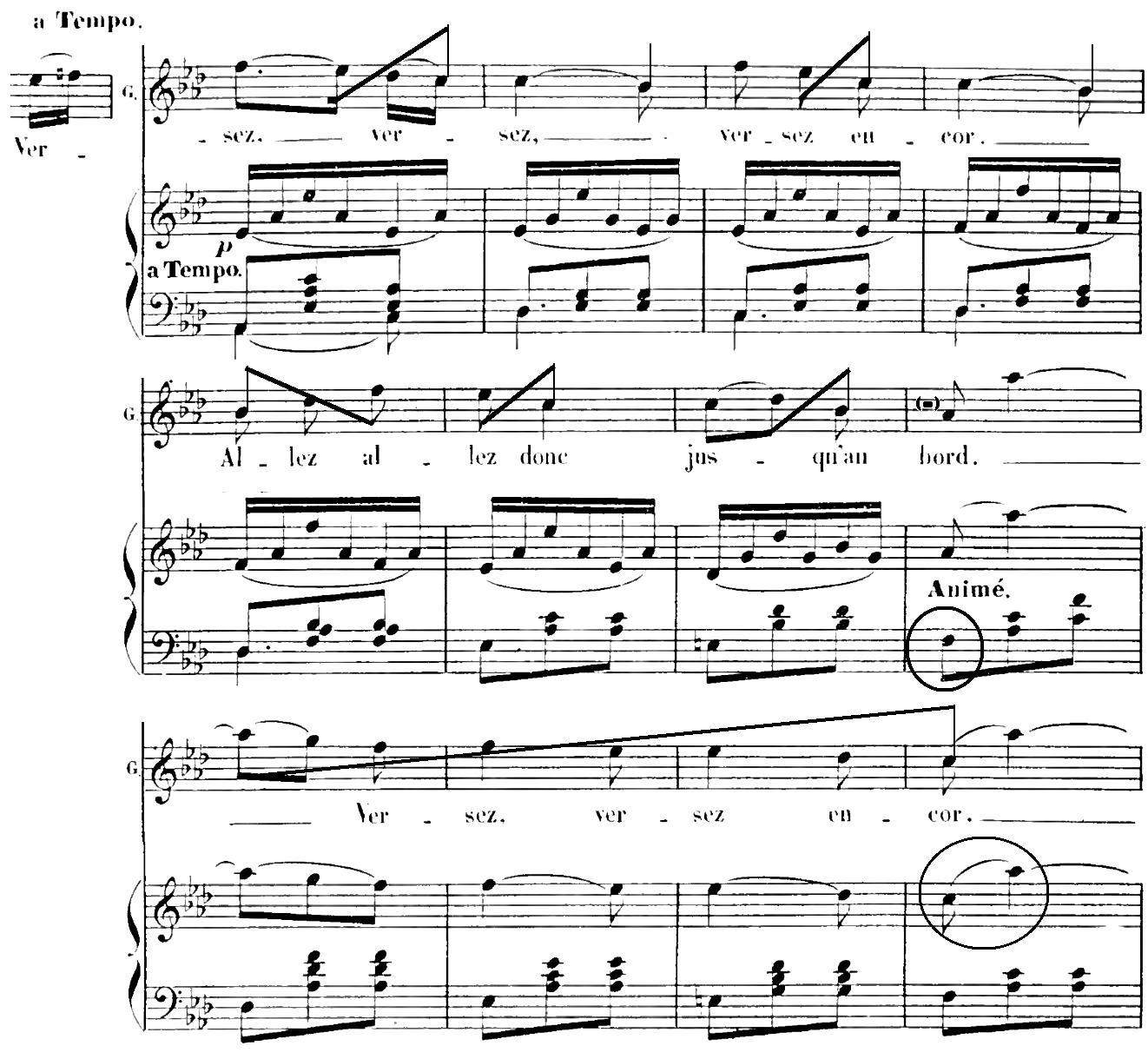
Offenbach, Pomme d'api (1873), no. 6 Chanson

The Trio (no. 6, in the operetta's Scene 12 [of 14]) opens with a short theme "A table! A table!"—(as 8+ bars), followed by Gustave's chanson "Versez, versez"; then a scena follows, "Ah! maintenant cela va mieux," and Catherine's rondeau "J’en prendrai un, deux, trois." The rondeau will be discussed in the next post. For number list and synopsis see the introduction: link.

"Versez, versez" is a small ternary form. Catherine joins Gustave during the B-section, and all three players sing the reprise. In the A-section, the cadence is a turn to the dominant, from which the B-section follows directly.

Here is the reprise, showing in the first three systems only Gustave's part, the principal melody. Catherine is singing a simple mid-range accompaniment and Rabastens follows the bass line.


For the final bars, I show all parts below. Note especially that Catherine and Gustave trade scale degrees (voice exchange) and thus Gustave is able to go one-note-too-far to Bb4 (concert or actual pitch).


Wednesday, September 13, 2017

JMT series, part 6b-1 (note 31, the waltz ninth)

In the 1987 JMT article, I introduced the term "waltz ninth," which refers to ^6 treated either as a passing tone between ^5 and ^7 over V7 or as an element of a V9 chord that, despite older rules, moves upward to ^7 rather than resolving down to ^5. Here are two additional examples from Schubert: Valses nobles, D969n1, and Valses sentimentales, D779n13 (first strain only; second strain ends the same way).


In note 31, I mention the scherzos for the first two Beethoven symphonies. Until recently I thought the scherzo in Symphony no. 2 was the simpler of the two cases, and therefore decided to talk about it first here. The problem -- which nevertheless provokes some interesting opportunities for interpretation -- arises from orchestration, register, and arrangements.

Symphony no. 2, Scherzo. Comment in the note: "a very clear case." Here it is (below) as I analyzed it in the 1980s. I didn't specify a focal tone (aka first note of the fundamental line), though obviously I was assuming ^5; the shape of the cadence, however, is unmistakable. Note that ^6 rises to ^7 over the dominant.


My source was the piano reduction made by Otto Singer and published by Peters in 1906. Below is another version published a few years earlier by Ernst Pauer (London: Augener). [These are dates given on IMSLP; whether they represent time of the original publication, I don't know.]

The full orchestral version, however, has the following at the critical moment:

Curiously enough,  Franz Liszt follows the original in his pianistically enhanced reduction:


And, more tellingly, so does Beethoven himself in the trio arrangement published in 1805 (the orchestral original appeared in 1804).
Two other contemporary sources, however, treat the ending in the same way as Singer and Pauer. Hummel made some of the first published piano solo versions of symphonies by Haydn, Mozart, and Beethoven. Joel Sachs and Mark Kroll say of them that "[Hummel's] extraordinary ability to respond to the needs of the musical market place without sacrificing high musical standards is illustrated by his numerous arrangements. . . . For England [in the 1820s] he arranged symphonies by Haydn, Mozart and Beethoven, seven piano concertos by Mozart and 24 opera overtures. . . . All proved to be successful and profitable for both publisher and composer" (Oxford Music Online). Hummel's trio version is accurately described on the title page as for piano solo with accompaniment of violin and violoncello. Here is the piano's ending of the scherzo aligned with the violin part.

I've also aligned the two parts in an unattributed manuscript arrangement for piano four-hands from 1820.

What do we glean from all this? That any one of three backgrounds is plausible. Version (a) reads from ^3, with the upper octave as expressive doubling. Version (b) goes further, regarding the upper octave as consequential enough to warrant coupling [the Urlinie descends simultaneously in both octaves]. Version (c) shows my original reading, with ^5 as the focal tone and the simple ascent we have already seen above in several arrangements of the score.


Since (a) & (b) are marginally different in notation, I show only the details of (a) below.


Version (c) is below. I admit that I still prefer this one, despite its weaker claim on a firmly established focal tone at the beginning. In the graph below, note the expression of a neighbor note figure A5-B5 -- at (a) and subsequent places marked.

The weakness of ^5 at the beginning is that it's much easier to hear it as a one-too-far gesture. I've variously called it "one leap too far," "one note too far,"or just "one too far." Note how A5, as one-note-too-far, helps confirm ^3 (F#5), before the latter is undercut by another one-leap-too-far in the fortissimo D6. It's not hard to write off D6 as the emphatic expression of a cover tone, but it's now "two leaps," not one, which suggests a potentially different role for A5.


In the modulating consequent of this 16-bar period, the role of A5 as just described is confirmed: the figure of bar 2 continues upward in bar 4 and that register is maintained in the final phrase. The possibility of E6 as the interrupting ^2 for a focal tone ^3 is undercut by the fact that E6 is now where the undoubted cover tone was in the antecedent. The observation that things can get turned upside down in scherzos is not much of a defense.

The reprise is one of those -- common enough in Beethoven but found in others of his generation also -- that muddles the ending by introducing figures from the "development" (the B-section here). Unlike the scherzo in the first symphony, there is no possibility of hearing a structural cadence before the very end. Thus, the rising figure of the final bars attains considerable significance: not the falling resolutions in the seventh bars of antecedent and consequent above but the emphatically affirming fortissimo that follows.
Wednesday, March 1, 2017

Four from the movies (2): Le Tourbillon

Four from the movies (2): "Le Tourbillon" from Jules et Jim (Truffaut, 1962). Link to YouTube clip with the scene from the film: link.

Here is my transcription of the tune. A two-part design with closely similar endings—rising figures in bars 7-8 and 17-18. Part B has a double ending, a "standard" position for the cadence in 15-16 and the ending in 17-18 that we hear as nearly the same as bars 7-8. The figure in bars 10 and 14 is particularly expressive as it carries the text "tourbillon."


Two graphs: the first divides the tune in half, with a three-part Ursatz in 1-8 and a different one in 9-18. In the latter, the background ^2 is assumed at bar 12, which I grant is not entirely satisfactory as it forces the ^1 to appear at the beginning of the repeated figure (13-14) that held ^3 the first time around (9-10). An alternative would be to imply ^2 in bar 15 and ^1 in bar 16, with the latter only sounded in retrospect in bar 18. Again, not entirely satisfactory.


The second graph draws on the common "one-too-far" figure that is often used in, for example, country dances, at the beginning of the B-section, as here. The association of "one-too-far" with the text at that moment (in one of the verses, at least) "tourbillon" seems apt. The result of isolating ^3 in this way is a reading that seems more in tune, so to speak, with the shapes of the melody.


Tuesday, May 31, 2016

Adam, Le Châlet, part 5 (ns5 & 6: ensemble-aria-ensemble)

Max finishes the aria (n4) in which he affirms his pleasure at returning to the Swiss valley that was his home (and is still for his sister Bettly). Implausibly, Daniel doesn't recognize Max, who, implausibly, doesn't reveal himself, and in fact is later not recognized by Bettly, either (sigh). And with this the plot descends irretrievably into farce—but all eventually ends well after Max pretends to be drunk, inciting Daniel to protect Bettly's honor, whereon she is impressed by Daniel's action and signs the marriage certificate, which she openly calls a ruse because it's not valid without her brother's signature, but of course unbeknownst to her he is there . . . . you see where this is going.

The central ensemble scenes are concerned with the complications created by Max's insistence that his company will stay for a fortnight and by his consequent demand for food and, especially, drink for the evening. Number 5 is a straightforward drinking song, with chorus; at the end, Max promises his own song and n6 opens with it (in the form of couplets); the remainder of n6 is a combination of Max and Bettly's back and forth with the chorus's continuation of the general topic of eating and drinking. (She is increasingly agitated; during the dialogue scene that follows n6, Daniel appears and attempts to defend her.)

The theme of the drinking song allows a good bit of enthusiastic noise with a figure that focuses on ^8, descending from it and returning to it--see below. All we're missing is a "huzzah" or two.  (Here again I am using the German edition of 1835 for examples.)


In a considerably expanded version, one can hear elements of this theme in the final section of n6, including the turn to the submediant vi—see notes in the (several pages of) score below.


Tuesday, April 19, 2016

On the "March" Prelude in Chopin's Opus 28, part 2

In part 1, I cited Carl Schachter's recent analysis of this Prelude, with its Urlinie from ^3, where ^2 had to be "supplied by the imagination of the listener" (61). I also indicated my priority in this reading of the background, having written about it twice in 1987.

In February, Emily Ahrens Yates presented a paper titled "Surface Motives in Tonal Music and Their Influence on Our Readings of Background Structures" at the TSMT conference in Belton, TX. In the well-established tradition of motive-driven Schenkerian readings, she "show[s] how ascending surface motives of 5̂ to 8̂ are composed out, are evident in the middleground and foreground levels, and are replications of an ascending Urlinie background structure resolving the conflict in readings between motivic parallelisms of rising motives and 'Ursatz parallelisms'" (from the abstract).

Emily shared her analysis with me beforehand. It was entirely convincing, and I now wonder why anyone (including me, you understand) would ever have proposed a background descent from ^3 at all: each of the march's three phrases is wholly occupied with rising stepwise gestures (and the subsequent relaxation from them), the "one-leap-too-far" quality of the Ab 6/4 chord in bar 8 is certainly accentuated/confirmed by its unstable status as a harmony, and the one truly remarkable thing in this musical context is the ending, which is the only one of the three phrases that refuses to drop away from its rising line from ^5 to ^8 (awkwardly chromatic though it is).

Additional comment: "each of the march's three phrases is wholly occupied with rising stepwise gestures (and the subsequent relaxation from them)": note that each rising phase is longer and each relaxation phase is shorter than the last. In the first phrase, ten rising beats are followed by six falling ones (numbers depend on where you place the three beats of E4). In the second phrase, twelve rising beats are countered by four falling beats. And of course in the third phrase, sixteen rising beats are not countered at all. What surely emerges as thematic in this march, then, is the withering away of descent, regardless of the dramatic surge into bar 8.

More than that is the Sisyphian struggle against a chromatic weight that bears down the already heavy diatonic chords in the second and third phrases. I have boxed those passages in the score below:


It is not difficult to "reconstruct" the diatonic version of all this, the state of the march "before" its chromatic deformation, its suppression by a half-step. (The notion of lowering to flat keys as expressive is something we've seen in Schubert, who dropped the "violin keys" of D and A to Db and Ab in his waltzes.) Here is the diatonic bass for the two chromatic passages.


What is truly remarkable -- and dramatic -- then is not the "one-leap-too-far" Ab6/4 chord, but the sudden emergence of the diatonic from the chromatic depths. The staircase down to those depths is also the way back up:


An entire slow movement of a heroic sonata is sketched in this miniature—an invitation perhaps to a skilful improvising pianist to fill it out.