Showing posts with label round. Show all posts

Thursday, December 20, 2018

New Publication: Rounds, Canons, and Catches

I have published a new essay on the Texas Scholar Works platform: Rounds, Catches and Canons: Interval Frames and Ascending FiguresLink.

Here is the abstract:
The play of register in the compact designs of vocal rounds sets up a structure that is quite amenable to rising cadence figures. Repertoire presented here comes from two general groups of sources: (1) nineteenth-century amateur and school collections, which include both traditional and contemporary rounds; (2) seventeenth-century publications by Thomas Ravenscroft, John Hilton, and Henry Purcell.

Thursday, November 1, 2018

Rounds and canons, part 2

Today's examples come from volume 22 of The Works of Henry Purcell (London: Novello, 1922). The volume gathers rounds and catches (which were edited by W. Barclay Squire), as well as two and three part songs. For the rounds and catches, n = 57. The editor mentions ten other catches in Purcell's stage works (iii). Of the 57 in volume 22, six are of interest for rising figures. I discuss them below in their numerical order, not topically, though as it happens they are all closely related in design, with a well-confirmed focal tone ^8 and return to it in the cadence.

As the editor of volume 22 notes, with implicit apology, "The work [of gathering these pieces] has been rendered more troublesome owing to the fact that in many cases the original words are so grossly indecent that later editors have reprinted the music with new words, but without indicating what was their original form" (iii). The solution: "it has been thought best in the present edition either to alter the original words as little as possible or to write entirely new words, but retaining the opening phrase of the originals and inserting some play on the words, such as always distinguishes the catch from the round or canon; which course has been pursued is indicated in the notes." The singing of rounds and catches was part of men's entertainment, and the topics are largely confined to drinking, politics, and varying but often misogynistic views of women. Acknowledging all this—and also admitting that I did not include 2 or 3 pieces that would have been appropriate otherwise but whose texts, even as editorially curated, were still too offensive—here are the six.

1. Ascending figure in the third voice.


2. Wedge figure with the lower voice 1 coming up to ^8 while the upper voice 2 descends from a strong focal note ^3, A5 (as written).


3. Unusual minor key; not ascending cadence figure in voice 3 but return to a focal note ^8 (as G5, written).


4. As in no. 37, a minor key with ^8 as focal tone, but now G5 is traded between voices: bar 2 in voice 1, bar 3 in voice 3, and bars 4-5 in the voice 2.


5. Still another minor key, with the design very like no. 42.


6. If anything, the status of the focal tone ^8 is even stronger in this, with that note beginning voice 3, reached in voice 4 in bar 2, double neighbor figure in voice 3, bars 3-5, and cadence in voice 4, bars 5-7.

Thursday, October 25, 2018

Rounds and canons, part 1

The play of register in the compact designs of vocal rounds sets up a structure that is quite amenable to rising cadence figures—although of course we have to keep in mind that what constitutes the ending depends entirely on the circumstances of performance.

In "Row, row, row your boat," the registral units (intervals) are ^1-^3, ^3-^5, ^8-^5 (expanded to ^8-^1), and ^5-^1. In "Frère Jacques," the sequence is ^1-^3, ^3-^5, ^5-^1, and ^1-^-5-^1. Any of these units that include ^1 or ^8 can act as the close. Here are some examples.

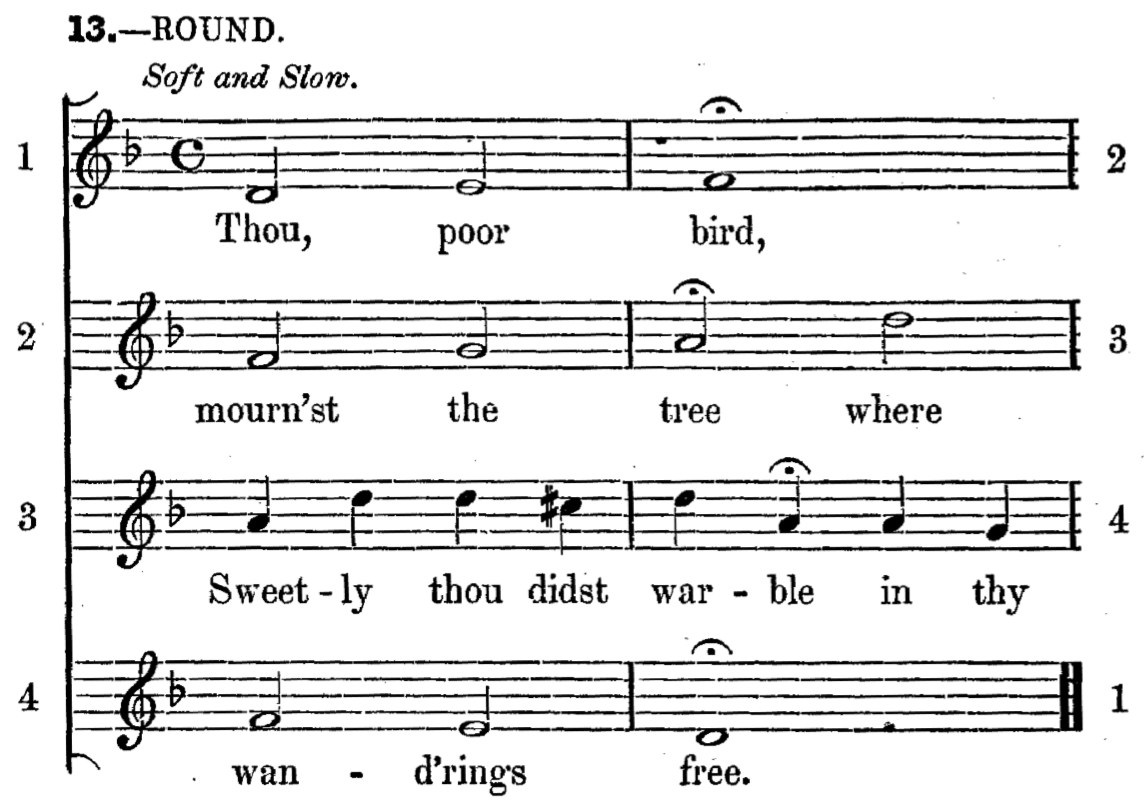
From Novello's School Round-Book, published in two volumes (1852, 1854). "Thou, poor bird" is a registral sibling of "Row, row, row your boat," the only difference being that the third unit stays on ^8-^5. If the end is taken with the fermatas (as suggested by the volumes' editor), then one easily imagine a singer repeating D5 for the second syllable of "warble."


In "The rose's age is but a day" from volume 2, the first three units are the same, but the fourth is restricted to a functional but non-melodic bass. There are no fermatas this time, but one can easily imagine four voices ending together, with the simple rising line in the uppermost register.


In "Go learn of the ant," also from volume 2, the harmonic vocabulary is a bit richer, and we can discern in the first unit the shape of an ascending Urlinie variant: ^5-^6-^8-^7-^8.


Three-voice rounds can easily dispense with the upper fourth—in fact, many do in the 19th-century collections I have examined to date—but a few are like "The rose's age is but a day." In "Come let us all a maying go," for example, the division of soprano, alto, bass is quite clear, and the soprano—after its descending octave in the first phrase—remains in the upper fourth for the second phrase.


This round from the New York Glee Book (1844) is similar in its basic design but manages to spread melodic values over the three parts.


Canons, catches, and rounds were very popular entertainments in earlier centuries, as well. Here are two from Thomas Ravenscroft's Pammelia (1609), which is subtitled "Musicks Miscellanie, or, a Mixed Varietie of Pleasant Roundelayes, and delightfull Catches." Note in "Dame lend me a loafe" that the ending (final unit) is in the upper fourth.


The first example was about food; the second is about drink. I have marked the three units and boxed their closing figures.