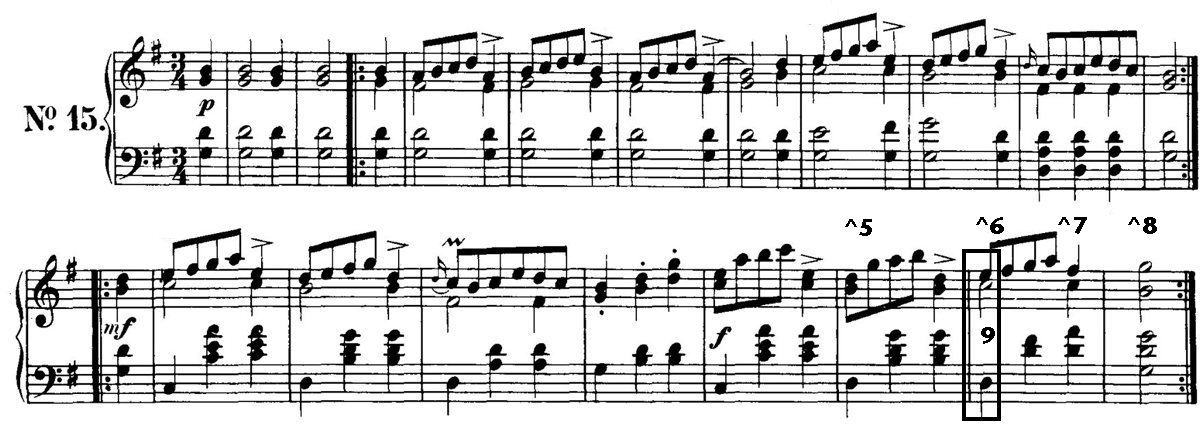
Debussy, Deux Arabesques, no. 2For reference, a simple example of the waltz ninth device: Schubert, Wiener-Damen Ländler, D734n15. The essential features are that the ninth is over the dominant and moves upward to the leading tone, not down to ^5. The freeing of the ninth from a downward "resolution" -- like the freeing of the seventh from any resolution and the stable addition of the sixth to a triad -- is a distinctive and pervasive feature of nineteenth-century music.
Grieg, “An den Frühling,” op. 43, no. 6
Lalo, “Chanson de l’Alouette”
Duparc, “Phidylé”
Debussy, Deux Arabesques, no. 2. No comment in the note. Here is the first theme period (after a short introduction) -- it's 10 bars, presented as 4 + 6. One might call it a presentation + consequent "hybrid" rather than a period if you decide that bars 3-4 are variants of the basic idea, not contrasting. Hard to say, really. Same with the focal tone, if any, in the right hand--could be either ^5 or ^3. I am inclined, therefore, to hear them both (I write at some length about complex upper voices here: link). Note the internal (?) rising cadence gesture in the final bar of the example (and close of the A-section).

Here is the approach to the structural cadence. Under normal circumstances, I would take the boxed bars as the structural cadence, but in a common nineteenth-century gambit Debussy undermines it by hollowing out the melody and forcing a long diminuendo. All this would still have been good enough but he then gives us a resounding traditional cadence later, with a steady crescendo this time, a stretched out IV-V-I -- see circled notes -- and enriched texture.
The waltz ninth figure in shown in the small box: there is a chord on the beat with ^6 but the whole thing obviously lies within an extended dominant.


Grieg, “An den Frühling,” op. 43, no. 6. No comment in the note. For many years a favorite intermediate recital piece, "To Spring" is, I would imagine, no longer so well known. The theme, which is also the A-section, is a sentence where the bar numbers have been doubled -- that is, the basic idea is in bars 3-6, the varied repeat of the basic idea in 7-10, etc. (Caplin has an expression for this but I've never found it very congenial and so rarely can remember what it is.) The circled F#: ^5 at the beginning drops to ^3 in the continuation phrase. In the cadence, boxed, the line (now from ^2) rises to ^5.

In the final statement of the theme, Grieg sounds this cadence again, but now in the tonic key. The result is a a simple rising line with the waltz ninth: note that ^6 is over the cadential V. The deceptive close with ^8 is ironed out with a pleasantly rising chromatic figure in the coda, with the I arriving at the very end -- another example of the confusion of section and coda that is so common throughout the nineteenth century, but more and more so as the decades move on.


Lalo, “Chanson de l’Alouette.” My comment in the note: "ascent occurs in the piano." The piano's introduction puts strong emphasis on ^5 and ^6 -- at (a). The voice at first, however, is concerned only with ^5 -- at (b) -- and a stepwise descent in the upper octave -- at (c1) and (c2), where the piano picks up its initial figure again -- at (d).


Intro: 1-7
verse 1 = 8-29; piano continues through 36
-- C major clearly defined throughout, diatonic except for an excursion into A minor in the third of the poem’s four lines. Deceptive close gives C+ instead of C.
verse 2 = 37-54
-- begins in Ab major; abrupt turn to A minor in the third of of the poem’s four lines, with equally abrupt “cadence” C: vi-I.
verse 3 = 55-71; piano continues in 72-73
-- as in verse 2, but in the poem’s third line the turn toward A minor (a: V) is diverted to a firm close in Ab.
verse 4 = pickup to 74-96
-- Piano in 72-73 has an odd chord, as if B7 against an Ab pedal, but this clears out shortly to E major. Could have been a strong close in E major but stalls on B7 instead. B7 --> G7.
verse 5 = 97-122
-- strong C: V7 to start and quick return to C for reprise of the verse 1 melody; we hear it all -- see below; circled notes from the first page shown again -- but in bar 118 *neither* voice nor piano has the closing ^1, though both are assiduously prepared. Instead, both voices shoot up (the nightingale of course. . . ), the singer to ^5 (G5), the pianist to ^3 (E7).

Duparc, “Phidylé.” My comment in the note: "In the piano, but quite clear." As the circled notes show, the voice participates in the rising figures for a while, but it is primarily the piano that works it out, reaching from B4 (the first circled note in the piano part) through Ab6 at the cadential arrival (very end of the example). At that same moment, the voice moves as plainly as could be down from ^3.


