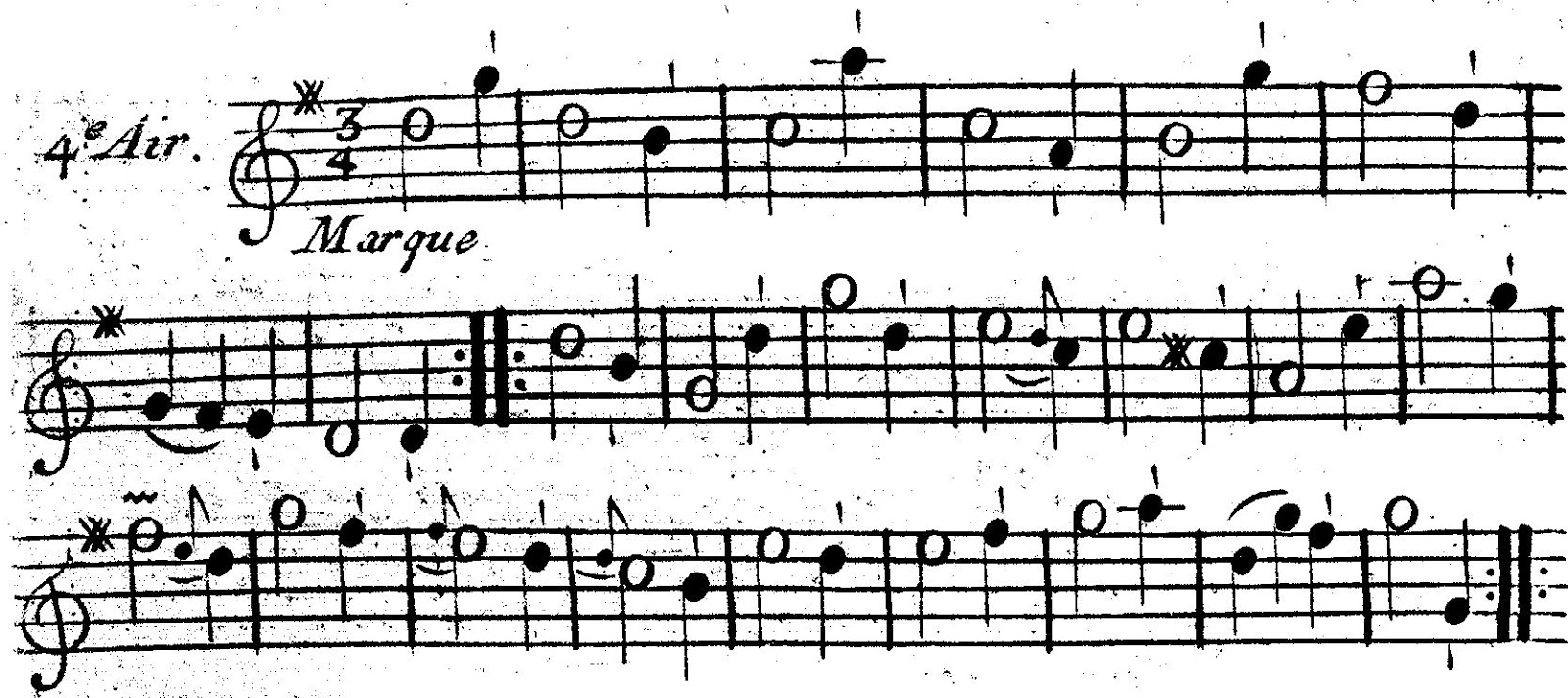
The last of the posts linked to above shows his 4th Menuet in G major, with its trio, which is the item of interest here.

The underlying figure g (simple ascent with ^#6 and i-IV-V-i) is revealed by adding a likely bass below the Urlinie:

I discussed a two-harpsichord gigue and a courante with an added contra partie by Gaspard LeRoux in the continuation post of part 3: link. Here is another piece from the same collection (1705), this time a sarabande with 11 variations. To avoid confusion in case you look at the score yourself, I will follow the numbering Fuller uses, where the sarabande (theme) is called couplet 1, the first variation couplet 2, etc. (The 1705 edition has no labels.)
In one common French design for a published suite, a larger scale piece, usually a chaconne, ends the suite of dances and character pieces. Here the design is almost that: (unmeasured) Prelude, Allemande, Courante, "La Bel-abat," Piece sans titre, Gigue, Sarabande [with variations], Menuet. As elsewhere in the collection, the sarabande itself is provided with an alternative trio arrangement, but the variations are given just a continuo bass. I am uncertain what that signifies for an actual performance option.
The first phrase of the sarabande is reproduced below in Alfred Fuller's edition. I will not cite any more of it in order to respect copyright. In the 1705 edition, however, the left hand part is written in baritone clef (like the bass clef but a third higher), and so I will present the alternate trio version of the theme instead.

The six phrases of the theme are distributed in the common asymmetrical design where A has two and B has the other 4. Section A ends in III, and midway through section B we reach V in a half cadence. What is remarkable is that in the solo version, Le Roux uses the dully repetitive figure of the first treble part in the entire B-section, not the considerably more interesting melody of the second treble part.

Phrases 5 & 6 in couplet 2 (that is, the first variation) are shown below. I have "transposed" the left hand part to the common bass clef. The cadence in the upper register is striking, but from a traditional Schenkerian viewpoint, we have to call the uppermost voice boundary play growing out of two cover tones--see the graph below the score.


Four other couplets use rising lines, three of them at the end, as in couplet 2 above. In couplet 6, almost continuous 16th-note arpeggios in the right hand are all set in the upper octave. In couplets 4 & 10, a clear descending cadence is placed in phrase 5, to which the upper octave in phrase 6 sounds like a coda flourish. The most interesting use of the rising line is the opening, not the end, of couplet 2 -- see below, where phrases 1 & 2 chart the octave from Bb4 to Bb5, step by step. (Note that I have not moved the left hand to bass clef this time.) Below the score I have marked the sources of all these steps in the trio version of the sarabande theme, demonstrating again Le Roux's quite free attitude toward his theme (these are *not* simple figural variations).

The last example comes from one of the many German composers who imitated French keyboard styles and genres in the 17th and early 18th centuries: Georg Böhm, whose Suite in F minor contains a courante with an ascending Urlinie. Volume 1 of the Sämtliche Werke edition (published in 1952) includes eleven suites, two of them in F minor. This courante is from the second of those suites. Note that it uses the Dorian signature (three flats rather than the four we would expect for F minor).

Here is an analysis showing the background..

Finally, a background/first middleground graph, with the inner voice. I chose to show the bass for i6 with a closed note rather than an open note, but the outline of figure g is still clear.