Ernst Friedrich Richter is known mainly as a very successful theory and composition textbook author. In the mid-nineteenth century, he taught at the newly founded Leipzig Conservatory. He was also a composer. "Frühlingsglaube," the first of two choral pieces for soprano voices on poems by Ludwig Uhland, is striking in its treatment of an ascending cadence gesture, a parallelism with a descending cadence formula, and the artistically sensitive expression of text achieved through the cadence parallelism.
The poem is in two verses of nearly equal length (7 lines in the first, 8 in the second), its parallelisms made clear by repetition of the final line, "Nun muss sich alles, alles wenden" ("Now everything, everything must change"). In the usual mode of Romantic irony, the poem lauds the pleasures and new life of spring—but as an escape from pain and suffering. (It's easy to make light of that now, but in an era when death was likely by the age of 50, and not uncommon by 40, and where the worst urban diseases, small pox, tuberculosis, and syphilis, were still largely not understood, such oppositions were serious and had considerable immediacy.)
The music for the two verses is very similar, the first half (with a cadence to the dominant) being essentially identical, the second half altered in the second verse as it approaches the cadence. The first phrase of this second half emphasizes ^4 over a progression that extends the dominant, and then resolves to ^3, but over C# minor harmony. After that, repeatedly rising figures considerably expand the setting of "Nun muss sich alles, alles wenden" but a cadence does finally arrive in the lower register, not the upper.
The parallel place in the second verse expands the setting even further, reaching E5 a third time (circled in the second system below).
The original cadence phrase then starts up but its rise to ^5 is continued onward to ^8 this time. Note the common substitution of ^2 (or ^9) through a voice exchange with the alto.
The expansions of the two verse endings develop the material nicely as a way to express "everything must change" but their insistence also throws off the symmetry of the verse halves and the pairing of pleasant spring imagery against what amounts to a half-despairing cry, not "Everything is changing" but "Everything must change."
Showing posts with label 19th-century practices. Show all posts
Thursday, January 3, 2019
Thursday, December 27, 2018
New publication: operettas by Offenbach
I have published a new essay on the Texas Scholar Works platform: Offenbach, two one-act operettas: Les deux aveugles (1855) and Pomme d’Api (1873). Link.
Here is the abstract:
Ascending cadence gestures are common in the repertoire of the operetta and in some early opéras comiques. Composers altered traditional dramatic cadence figures beginning in the mid-1830s, but it was multiple instances in Jacques Offenbach’s one- act stage pieces in the mid-1850s that popularized them and turned them into clichés of the musical theater. Les deux aveugles (1855) was the composer’s first undisputed success. Offenbach returned to the one-act format much later in his career with Pomme d’Api (1873). An afterword provides a table of theatrical cadences that bring attention to the upper register.
Thursday, October 25, 2018
Rounds and canons, part 1
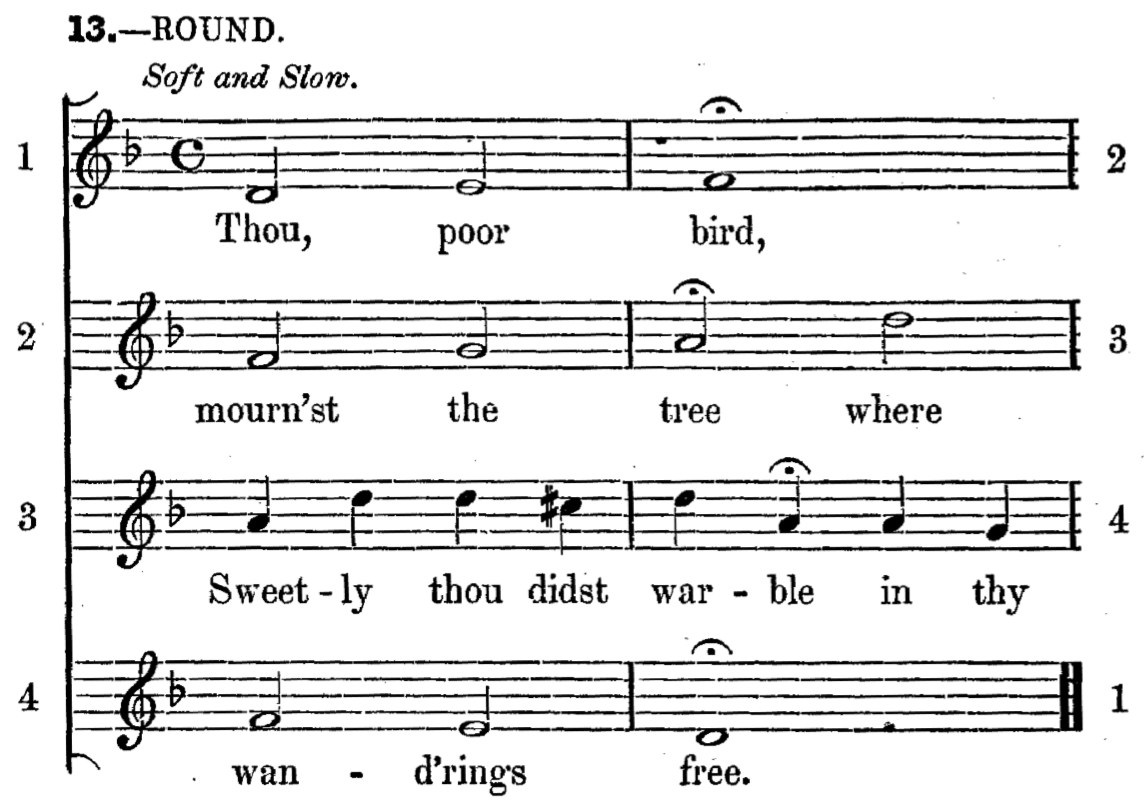
The play of register in the compact designs of vocal rounds sets up a structure that is quite amenable to rising cadence figures—although of course we have to keep in mind that what constitutes the ending depends entirely on the circumstances of performance.
In "Row, row, row your boat," the registral units (intervals) are ^1-^3, ^3-^5, ^8-^5 (expanded to ^8-^1), and ^5-^1. In "Frère Jacques," the sequence is ^1-^3, ^3-^5, ^5-^1, and ^1-^-5-^1. Any of these units that include ^1 or ^8 can act as the close. Here are some examples.
From Novello's School Round-Book, published in two volumes (1852, 1854). "Thou, poor bird" is a registral sibling of "Row, row, row your boat," the only difference being that the third unit stays on ^8-^5. If the end is taken with the fermatas (as suggested by the volumes' editor), then one easily imagine a singer repeating D5 for the second syllable of "warble."
In "The rose's age is but a day" from volume 2, the first three units are the same, but the fourth is restricted to a functional but non-melodic bass. There are no fermatas this time, but one can easily imagine four voices ending together, with the simple rising line in the uppermost register.
In "Go learn of the ant," also from volume 2, the harmonic vocabulary is a bit richer, and we can discern in the first unit the shape of an ascending Urlinie variant: ^5-^6-^8-^7-^8.
Three-voice rounds can easily dispense with the upper fourth—in fact, many do in the 19th-century collections I have examined to date—but a few are like "The rose's age is but a day." In "Come let us all a maying go," for example, the division of soprano, alto, bass is quite clear, and the soprano—after its descending octave in the first phrase—remains in the upper fourth for the second phrase.
This round from the New York Glee Book (1844) is similar in its basic design but manages to spread melodic values over the three parts.
Canons, catches, and rounds were very popular entertainments in earlier centuries, as well. Here are two from Thomas Ravenscroft's Pammelia (1609), which is subtitled "Musicks Miscellanie, or, a Mixed Varietie of Pleasant Roundelayes, and delightfull Catches." Note in "Dame lend me a loafe" that the ending (final unit) is in the upper fourth.
The first example was about food; the second is about drink. I have marked the three units and boxed their closing figures.
In "Row, row, row your boat," the registral units (intervals) are ^1-^3, ^3-^5, ^8-^5 (expanded to ^8-^1), and ^5-^1. In "Frère Jacques," the sequence is ^1-^3, ^3-^5, ^5-^1, and ^1-^-5-^1. Any of these units that include ^1 or ^8 can act as the close. Here are some examples.
From Novello's School Round-Book, published in two volumes (1852, 1854). "Thou, poor bird" is a registral sibling of "Row, row, row your boat," the only difference being that the third unit stays on ^8-^5. If the end is taken with the fermatas (as suggested by the volumes' editor), then one easily imagine a singer repeating D5 for the second syllable of "warble."
In "The rose's age is but a day" from volume 2, the first three units are the same, but the fourth is restricted to a functional but non-melodic bass. There are no fermatas this time, but one can easily imagine four voices ending together, with the simple rising line in the uppermost register.
In "Go learn of the ant," also from volume 2, the harmonic vocabulary is a bit richer, and we can discern in the first unit the shape of an ascending Urlinie variant: ^5-^6-^8-^7-^8.
Three-voice rounds can easily dispense with the upper fourth—in fact, many do in the 19th-century collections I have examined to date—but a few are like "The rose's age is but a day." In "Come let us all a maying go," for example, the division of soprano, alto, bass is quite clear, and the soprano—after its descending octave in the first phrase—remains in the upper fourth for the second phrase.
This round from the New York Glee Book (1844) is similar in its basic design but manages to spread melodic values over the three parts.
Canons, catches, and rounds were very popular entertainments in earlier centuries, as well. Here are two from Thomas Ravenscroft's Pammelia (1609), which is subtitled "Musicks Miscellanie, or, a Mixed Varietie of Pleasant Roundelayes, and delightfull Catches." Note in "Dame lend me a loafe" that the ending (final unit) is in the upper fourth.
The first example was about food; the second is about drink. I have marked the three units and boxed their closing figures.
Wednesday, October 17, 2018
Post no. 300
It is four years to the day that I started this blog (introductory post), and this post is the 300th in the series. The blog has provided material for over twenty essays published on the Texas ScholarWorks platform (link to my author page).
The focus has been quite narrow throughout: ascending cadence gestures in traditional European tonal music. Though my work on these figures has its roots in Schenkerian analysis—an article I published thirty-one years ago ("The Ascending Urlinie," in Journal of Music Theory)—I use those particular constructions only some of the time, because of problems with the figure of the focal tone (Kopfton), which I see as defined too narrowly to be generally useful. I opt more often (1) for the model of proto-backgrounds (link; see also Neumeyer 2009), (2) for style historical methods in connection with the dominant ninth chord and what I call the “waltz ninth,” (3) for similar methods and speculative modes for improvisatory practices, especially in the later 18th and early 19th centuries, and (4) for historical narratives of music for social dance, of music for the stage through the nineteenth century, and of composition in general in the later decades of that century, both narratives continuing to be relevant in the first half of the 20th century, as well.
The great majority of the traditional tonal music preserved in scores and manuscript makes use of form-defining cadences in which the principal melody line descends the scale to end on the tonic note. A significant minority, however, follow an upward path to end on scale degree eight (^8), a “circling” path around ^8, or a “mirror” path down from ^8 to ^5 and returning. An early surprise in my work was to find a considerably larger than average percentage of rising lines in the country dances preserved in John Playford's Dancing Master (first edition 1651; link to essay), which fact suggested to me that the figures were relatively common in dance-performance practice, including improvisation. It must be remembered that music for social dance was predominantly music for the violin (secondarily, flute) and that the instrument’s fifths mapping made it as easy to rise from the middle of the scale to ^8 as it did to descend to ^1.
I later found considerable corroborating evidence in Scottish and Irish dances and dance-songs, these coming largely from the later 18th century (link; link; link), and in the Germanophone Laendler, one of the waltz ancestors and especially closely associated with the violin, later in the 18th century with an ensemble of two violins and bass.
In the example below, the four open strings are depicted at the left in (a) and (b). From the open A-string, one moves with the greatest ease down the D-major scale, as in (a), or up the D-major scale, as in (b). In counterpoint, supposing for example, one violin improvises a descant to the other, the work is almost as easy, one of the simplest versions shown in (c). Another version with a bit more melodic complexity is shown in (d). Register play, in other words, offered a simple device to "do something different," specifically to do something different for an ending/articulation that didn’t run afoul of the traditional cadenza, where ^2 goes down to ^1 while ^7 goes up to ^8, making intervals of the major sixth and the octave (or minor third and unison). Not coincidentally, the alternative higher-register cadence offered a sound that was "bright" or "brilliant."
Additional corroboration of early practices came from 17th-century Germany and Austria; these included repertoires across the entire spectrum of genres, excluding only sacred choral music: link to essay.
The history and practice of rising cadence gestures quickly became more complicated in the early 19th century. Broadly, though, cadences can be heard as prominent expressive gestures and a turn toward less common cadences fits nicely with our familiar nostrums about Romantic rebellion against eighteenth-century conventions—and it aligns well with music theorists' recent revelations about a kind of shadow tonality of hexatonic relations that arise from the exploitation of chromatic mediants, early on especially by Schubert, whose Laendler and Deutscher ("German dance," the other ancestor of the waltz) made significant use of rising figures. This is music, incidentally, we know passed back and forth between music for dance and music for performance, not only in Schubert’s case but in the pragmatic circumstances of music publishing and (especially) domestic use.
Strangely, perhaps, I have found so far that straightforward expressive motivations for rising gestures—exhilaration, release, etc.—seem to have been far less prevalent than generic, topical, or formal-design considerations. The few coincidences of text and cadence, predictably, were found in the 19th century, after the clichéd cadence figures derived from earlier Italian practice had been largely abandoned (or, at least, their authority undermined). Examples: Grieg, Morgenstimmung (the analogy of musical ascent and the rising sun; link); Schubert, "Die Nonne" (the religious-utopian; link); Strauss, jr., Die Fledermaus n2 (increasing energy, demand, insistence: "Hinaus!”; link); Wolf, "Trunken müssen wir alle sein!” (as in Strauss; link).
As I have already noted, the rising cadence gesture was part of the toolkit of the waltz, and from there it went directly to the polka by no later than 1840. When an aria or other song used a waltz topic, the gesture went along with it. The floodgates were opened in French comic opera by no later than 1834 (see my essay on Adolphe Adam's Le Châlet: link), and rising cadences remained a factor in the opera bouffe and operettas of Offenbach, Lecocq, and others before finding a niche in the American operetta (Herbert) and the musical (notably those by Richard Rodgers).
The formal figure of the rising gesture in the coda of an aria or instrumental movement became firmly established in the last quarter of the 18th century. In some pieces, though, the boundary line between the "structural cadence" and coda figures became blurry—a process already underway earlier in the ensemble finales of Galuppi, with their many repetitions of cadential phrases, a dramatic device adopted by many composers, notably Mozart and Rossini. The process accelerated in the 19th century, more vigorously and consequentially in music for the stage than in instrumental concert music.
As I have already noted, the rising cadence gesture was part of the toolkit of the waltz, and from there it went directly to the polka by no later than 1840. When an aria or other song used a waltz topic, the gesture went along with it. The floodgates were opened in French comic opera by no later than 1834 (see my essay on Adolphe Adam's Le Châlet: link), and rising cadences remained a factor in the opera bouffe and operettas of Offenbach, Lecocq, and others before finding a niche in the American operetta (Herbert) and the musical (notably those by Richard Rodgers).
The formal figure of the rising gesture in the coda of an aria or instrumental movement became firmly established in the last quarter of the 18th century. In some pieces, though, the boundary line between the "structural cadence" and coda figures became blurry—a process already underway earlier in the ensemble finales of Galuppi, with their many repetitions of cadential phrases, a dramatic device adopted by many composers, notably Mozart and Rossini. The process accelerated in the 19th century, more vigorously and consequentially in music for the stage than in instrumental concert music.
An important outlier in all this is Beethoven, for whom transcendence, as a philosophical-religious category, could mean striving to move not just to the top of the voice leading, but outside or beyond it. For my only comments on this to date, see my post on Op119n7: link. My plan is to do more with this eventually, engaging work by David Lewin, Robert Fink, and, more recently, Malcolm Miller.
Thursday, September 6, 2018
Cécile Chaminade songs, Part 2
"La fiancée du soldat" was included in a two volume edition of songs published by G. Schirmer in New York (1892-93) with translations by several writers. The original French publication was in 1890. This song is in the first volume, which opens with "Ritournelle," still the best known of Chaminade's songs, which were quite popular in her lifetime but by no means to the same extent as her many piano compositions.
The music aptly expresses the woman's alternating moods of happiness and fear with minor/major contrasts between verses, but the expression isn't so simple as that sounds. Note below, for example, that the shift from minor to major is to the text "Lon lon la, je chante ma peine." The two segments of the poem, btw, become two verses in the music, each designed as A A ( = repeat) B1 B2 ( = varied repeat of the first phrase of B1). The beginning of the example also shows the importance of the fourth interval C5-F5, and of ^8 (F5) as focal tone.
The second part of B1 consists of a rising line from C5 to F5, followed by the first segment of the descending line from the beginning of B1.
The ending expresses the fourth interval in still another way.
The music aptly expresses the woman's alternating moods of happiness and fear with minor/major contrasts between verses, but the expression isn't so simple as that sounds. Note below, for example, that the shift from minor to major is to the text "Lon lon la, je chante ma peine." The two segments of the poem, btw, become two verses in the music, each designed as A A ( = repeat) B1 B2 ( = varied repeat of the first phrase of B1). The beginning of the example also shows the importance of the fourth interval C5-F5, and of ^8 (F5) as focal tone.
The second part of B1 consists of a rising line from C5 to F5, followed by the first segment of the descending line from the beginning of B1.
The ending expresses the fourth interval in still another way.
The close of the song—the repetition of B2—varies this ending slightly to draw attention equally to C5 through the chromatic neighbor note Db5.
Wednesday, August 1, 2018
Schubert, "Ruhe, schönstes Glück der Erde"
Schubert, "Ruhe, schönstes Glück der Erde," D657 (1819) is for four-part men's chorus. It is a part-song of images. At the beginning, the hushed opening apostrophe to Rest is followed by a short phrase that does indeed "rest" with a perfect authentic cadence (boxed).
Then, though it begins higher (A4 in the tenor at [b]), Rest is quietly enjoined to sink below, with a blessing, so that quiet can fill us (repeated notes at (c). An A major triad is reached as V of D minor, but then an evocative phrase entirely in A major expresses "as a grave rests in flowers."
Continuing and turning more chromatic, the music reaches Ab major (at [d]), and then a sudden return to the opening at (e) is filled out to a PAC and drooping melodic figures (first box in the second system). A codetta extension repeats the descents in chromatic form over a sustained tonic bass.
The harsh interruption at (f)—"Let the stormy heart be quieted" (pianissimo for "quieted"/"schweigen")—initiates the second half. At (g), a determined chromatic ascent for "as they grow, as they rise, grows and rises the Soul's pain" ends with stark octaves for the repetition of "Seele Pein" at (h).
Rest is then enjoined again to bring peace to the earth, so that the Soul can be healed and rise from the grave: at (j) and (k) dramatically, then following another quiet "codetta" with bass pedal at (m), dramatically again in repetition at (n). Note that is there is no PAC: the tenor rises by step from ^1 to ^3 (and all the lower voices also rise).
Rising figures that close a composition in such dramatic, expressive mode are very rare, but then the ending here is clearly at one with everything that precedes it.
Then, though it begins higher (A4 in the tenor at [b]), Rest is quietly enjoined to sink below, with a blessing, so that quiet can fill us (repeated notes at (c). An A major triad is reached as V of D minor, but then an evocative phrase entirely in A major expresses "as a grave rests in flowers."
Continuing and turning more chromatic, the music reaches Ab major (at [d]), and then a sudden return to the opening at (e) is filled out to a PAC and drooping melodic figures (first box in the second system). A codetta extension repeats the descents in chromatic form over a sustained tonic bass.
The harsh interruption at (f)—"Let the stormy heart be quieted" (pianissimo for "quieted"/"schweigen")—initiates the second half. At (g), a determined chromatic ascent for "as they grow, as they rise, grows and rises the Soul's pain" ends with stark octaves for the repetition of "Seele Pein" at (h).
Rest is then enjoined again to bring peace to the earth, so that the Soul can be healed and rise from the grave: at (j) and (k) dramatically, then following another quiet "codetta" with bass pedal at (m), dramatically again in repetition at (n). Note that is there is no PAC: the tenor rises by step from ^1 to ^3 (and all the lower voices also rise).
Rising figures that close a composition in such dramatic, expressive mode are very rare, but then the ending here is clearly at one with everything that precedes it.
Monday, July 30, 2018
Czerny, Album Elegant des Dames Pianistes, op. 804
Carl Czerny's Album Elegant des Dames Pianistes, Op. 804, is subtitled "24 Morceaux melodieux." Each of the pieces is assigned a woman's first name (these are character types, rather than actual individuals). I had volume 1 (nos. 1-12) available to me. Of those, two are of interest.
"Arabella," in Ab major, is a nocturne in the familiar Field/Chopin manner. The design fits the genre also: ternary where A is a 16-bar period with a sentence as the antecedent phase and with an embellished consequent, B is a 16-bar sentence, and the reprise of A is complete, but varied. A five-bar coda ends.
The structural cadence, ending the reprise, complicates the voice-leading in the right hand, but the motions are clear enough as outlined below. From IV6, an augmented sixth resolves outward to the octave—with Eb4 at the top—and then the parallel sixths that carry Eb4 up to G4 through the chromatic F#4 (which "might have been" ^6 otherwise), the octave doubling of C & Db (circled notes), and the traditional 6-8 close—the cantus-tenor formula—that amplifies ^7-^8 (as G4-Ab4).
"Arabella," in Ab major, is a nocturne in the familiar Field/Chopin manner. The design fits the genre also: ternary where A is a 16-bar period with a sentence as the antecedent phase and with an embellished consequent, B is a 16-bar sentence, and the reprise of A is complete, but varied. A five-bar coda ends.
The structural cadence, ending the reprise, complicates the voice-leading in the right hand, but the motions are clear enough as outlined below. From IV6, an augmented sixth resolves outward to the octave—with Eb4 at the top—and then the parallel sixths that carry Eb4 up to G4 through the chromatic F#4 (which "might have been" ^6 otherwise), the octave doubling of C & Db (circled notes), and the traditional 6-8 close—the cantus-tenor formula—that amplifies ^7-^8 (as G4-Ab4).
Here is a slightly simplified version of the right hand tracing structural soprano and alto:
Here is the passage, simplified a bit more, with scale degrees for a primitive ascending Urlinie and structural soprano and alto.
And here is a final simplification, to remove the register changes in the alto voice and also the chromatic note, suggesting that a simple rising line abstractly underlies the passage.
Monday, June 18, 2018
Czerny, Praktische Studien des Generalbasses, Op. 838: ninth chords
Czerny introduces the dominant with a minor ninth relatively early in his harmony exercise book. Much later he has a section titled "Der Nonen-Accord." It consists of one two-page composition, a 43-bar agitato that begins in C minor but ends triumphantly in C major.
With only three exceptions, the ninth chords are again dominants with a minor ninth--as at the first arrow below--and those ninths are resolved within the chord--as at the second arrow. Only over pedal point basses are the ninths allowed to resolve directly. In other words, Czerny's treatment of ninth chords is very conservative for the 1850s.
Two of the three dominants with major ninth are close together--see arrows below--and both resolve their ninths within the chord. (Chords with minor ninth are boxed.)
All this being the case, the primary closing cadence is a surprise: not only does it have a chord with major ninth (boxed) but that chord is treated in the manner I call the "waltz ninth," where 9 moves upward, the result being an emphatic ascending cadence gesture (beamed at (a)). (At (b) is an example of the minor ninths over a pedal point.) Here it is Beethovenian heroic transcendence we are hearing, definitely not a lilting upward turn to end a waltz or polka.
With only three exceptions, the ninth chords are again dominants with a minor ninth--as at the first arrow below--and those ninths are resolved within the chord--as at the second arrow. Only over pedal point basses are the ninths allowed to resolve directly. In other words, Czerny's treatment of ninth chords is very conservative for the 1850s.
Two of the three dominants with major ninth are close together--see arrows below--and both resolve their ninths within the chord. (Chords with minor ninth are boxed.)
All this being the case, the primary closing cadence is a surprise: not only does it have a chord with major ninth (boxed) but that chord is treated in the manner I call the "waltz ninth," where 9 moves upward, the result being an emphatic ascending cadence gesture (beamed at (a)). (At (b) is an example of the minor ninths over a pedal point.) Here it is Beethovenian heroic transcendence we are hearing, definitely not a lilting upward turn to end a waltz or polka.
Sunday, June 17, 2018
A Curiosity: Czerny, Praktische Studien des Generalbasses, Op. 838
Carl Czerny's Studien zur praktischen Kenntniss aller Accorde des Generalbasses auf dem Pianoforte sowohl in festen als bewegten Finger-Übungen, Op. 838—or simply "Praktische Studien des Generalbasses," as the interior title page has it—was published in Vienna by Spina in the early 1850s.
Czerny's foreword is a short paragraph that immediately suggests his attitude toward the subject:
The first example is of interest here. It covers all 24 major and minor triads in a total of 13 bars. The upper most voice covers the distance of an ascending octave, C5-C6.
The pattern of thirds within fifths—C-a-F in bars 1-2—is strictly maintained throughout, and it charts a simple path through the Riemannian Tonnetz. Here is a fragment of a common representation of the Tonnetz, with arrows showing the starting path of Czerny's progression:
And here is the entire sequence, separated out from the diagram:
I should note, incidentally, that is impossible to maintain the close voicing in the right hand with anything other than a rising line. Analogously to suspensions, which tend to force voice leading down, relative (R) and leading-tone (L) relations force voice leading upward.
Czerny's foreword is a short paragraph that immediately suggests his attitude toward the subject:
The study of figured bass can only be of real value to the student if he learns to play all the chords in their many forms on the piano and is able to play them securely. The present work offers a contribution to that goal, in that the first nine numbers present the chords in block-chord form, and the remaining numbers the same chord repertoire in elaborated form, so that the student can be made more familiar with the various harmonic combinations. (my translation)His footnote to the title of the first section is decidedly more revealing: "The figures in all of these examples must be worked out by the student, who can avail himself if necessary of help from a textbook or a teacher." Thus, Czerny is really offering a practical diatonic and chromatic chord primer, not a figured-bass textbook.
The first example is of interest here. It covers all 24 major and minor triads in a total of 13 bars. The upper most voice covers the distance of an ascending octave, C5-C6.
The pattern of thirds within fifths—C-a-F in bars 1-2—is strictly maintained throughout, and it charts a simple path through the Riemannian Tonnetz. Here is a fragment of a common representation of the Tonnetz, with arrows showing the starting path of Czerny's progression:
And here is the entire sequence, separated out from the diagram:
I should note, incidentally, that is impossible to maintain the close voicing in the right hand with anything other than a rising line. Analogously to suspensions, which tend to force voice leading down, relative (R) and leading-tone (L) relations force voice leading upward.
Subscribe to:
Comments (Atom)