Showing posts with label Duparc. Show all posts

Saturday, September 9, 2017

JMT series, part 6a (note 31, the waltz ninth)

Note 31 concerns the “waltz ninth,” certainly a familiar device to any reader of this blog or my Hearing Schubert D779n13 blog (link). I will discuss the following four compositions here, then in subsequent posts the scherzos from the first two Beethoven symphonies and the famous barcarolle in Offenbach's Tales of Hoffmann.
Debussy, Deux Arabesques, no. 2
Grieg, “An den Frühling,” op. 43, no. 6
Lalo, “Chanson de l’Alouette”
Duparc, “Phidylé” 
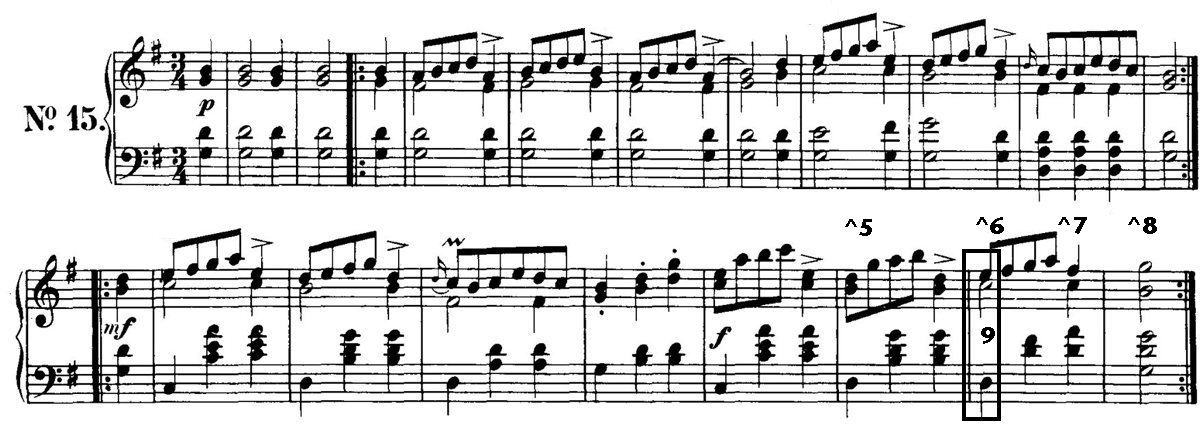
For reference, a simple example of the waltz ninth device: Schubert, Wiener-Damen Ländler, D734n15. The essential features are that the ninth is over the dominant and moves upward to the leading tone, not down to ^5. The freeing of the ninth from a downward "resolution" -- like the freeing of the seventh from any resolution and the stable addition of the sixth to a triad -- is a distinctive and pervasive feature of nineteenth-century music.


Debussy, Deux Arabesques, no. 2. No comment in the note. Here is the first theme period (after a short introduction) -- it's 10 bars, presented as 4 + 6. One might call it a presentation + consequent "hybrid" rather than a period if you decide that bars 3-4 are variants of the basic idea, not contrasting. Hard to say, really. Same with the focal tone, if any, in the right hand--could be either ^5 or ^3. I am inclined, therefore, to hear them both (I write at some length about complex upper voices here: link). Note the internal (?) rising cadence gesture in the final bar of the example (and close of the A-section).


Here is the approach to the structural cadence. Under normal circumstances, I would take the boxed bars as the structural cadence, but in a common nineteenth-century gambit Debussy undermines it by hollowing out the melody and forcing a long diminuendo. All this would still have been good enough but he then gives us a resounding traditional cadence later, with a steady crescendo this time, a stretched out IV-V-I -- see circled notes -- and enriched texture.

The waltz ninth figure in shown in the small box: there is a chord on the beat with ^6 but the whole thing obviously lies within an extended dominant.


Grieg, “An den Frühling,” op. 43, no. 6. No comment in the note.  For many years a favorite intermediate recital piece, "To Spring" is, I would imagine, no longer so well known. The theme, which is also the A-section, is a sentence where the bar numbers have been doubled -- that is, the basic idea is in bars 3-6, the varied repeat of the basic idea in 7-10, etc. (Caplin has an expression for this but I've never found it very congenial and so rarely can remember what it is.) The circled F#: ^5 at the beginning drops to ^3 in the continuation phrase. In the cadence, boxed, the line (now from ^2) rises to ^5.


In the final statement of the theme, Grieg sounds this cadence again, but now in the tonic key. The result is a a simple rising line with the waltz ninth: note that ^6 is over the cadential V. The deceptive close with ^8 is ironed out with a pleasantly rising chromatic figure in the coda, with the I arriving at the very end -- another example of the confusion of section and coda that is so common throughout the nineteenth century, but more and more so as the decades move on.


Lalo, “Chanson de l’Alouette.” My comment in the note: "ascent occurs in the piano." The piano's introduction puts strong emphasis on ^5 and ^6 -- at (a). The voice at first, however, is concerned only with ^5 -- at (b) -- and a stepwise descent in the upper octave -- at (c1) and (c2), where the piano picks up its initial figure again -- at (d).

 The close of the first verse follows up on the differing patterns of the voice and the accompaniment. Initially the voice rises to C5 -- at (e) -- then meets the piano's right-hand line by leaping up to G5. In the cadence the voice moves very firmly indeed from ^2 to ^1 -- at (f) -- while the piano as firmly rises from ^5 to ^8.

 The overall design, then:
Intro: 1-7
verse 1 = 8-29; piano continues through 36
-- C major clearly defined throughout, diatonic except for an excursion into A minor in the third of the poem’s four lines. Deceptive close gives C+ instead of C.

verse 2 = 37-54
-- begins in Ab major; abrupt turn to A minor in the third of of the poem’s four lines, with equally abrupt “cadence” C: vi-I.

verse 3 = 55-71; piano continues in 72-73
-- as in verse 2, but in the poem’s third line the turn toward A minor (a: V) is diverted to a firm close in Ab.

verse 4 = pickup to 74-96
--  Piano in 72-73 has an odd chord, as if B7 against an Ab pedal, but this clears out shortly to E major. Could have been a strong close in E major but stalls on B7 instead. B7 --> G7.

verse 5 = 97-122
-- strong C: V7 to start and quick return to C for reprise of the verse 1 melody; we hear it all -- see below; circled notes from the first page shown again -- but in bar 118 *neither* voice nor piano has the closing ^1, though both are assiduously prepared. Instead, both voices shoot up (the nightingale of course. . . ), the singer to ^5 (G5), the pianist to ^3 (E7).


Duparc, “Phidylé.”  My comment in the note: "In the piano, but quite clear." As the circled notes show, the voice participates in the rising figures for a while, but it is primarily the piano that works it out, reaching from B4 (the first circled note in the piano part) through Ab6 at the cadential arrival (very end of the example). At that same moment,  the voice moves as plainly as could be down from ^3.


Sunday, November 6, 2016

Minor key series, part 9 (Wolf; Brahms; Duparc) continued

Brahms, Op. 69n7, consists of two musically identical verses. The first is reproduced here.


The pairing of a simple rising line with a descending alto from ^5 is reminiscent of the Couperin passacaille, but here the alto descends more quickly. For much more on this song, possible analyses, and the text, see my essay Rising Gestures, Text Expression, and the Background as Theme: link. The section for which Op69n7 serves as the principal example begins on page 17.


Henri Duparc's "Lamento" was written in 1868, while the twenty-year old was a student of Cesar Franck, whose influence shows. Walter Everett (2004, 52) reads the pitch design in very nearly the way I do below, with ^5 prolonged for quite some time. then the line rising through A#4 to ^6 (B-nat4) and through C-nat5 to ^7 (C#5) and finally to ^8 (D5). The bass support is the tonic for ^5, nat-VI for ^6 (!), V7 for ^7, and the tonic again for ^8.   (Score notation is by Pierre Gouin and is available on IMSLP. My apologies for artifacts I've introduced in the first section below through compressing the width and moving measure 7 up a system.)


Reference: Everett, Walter. 2004. "Deep-Level Portrayals of Directed and Misdirected Motions in Nineteenth-Century Lyric Song." Journal of Music Theory 48/1 (2004): 25-58.


Saturday, November 5, 2016

Minor key series, part 9 (Wolf; Brahms; Duparc)

I had intended this post to show a later 19th century treatment of figure g in Hugo Wolf's setting of Goethe's satirical "peasant" poem "Der Schäfer." Two things happened, however. First, I realized on examining the piece more closely that figure g is not the model; instead, it is a convoluted or distorted version of figure c. More on that below. Second, I remembered that I had just written about a minor-key Brahms song in the essay Rising Gestures, Text Expression, and the Background as Theme (published on Texas Scholar Works: link). Then, looking at the work materials for that essay, I found another Brahms song and also one by Henri Duparc (both are mentioned in Walter Everett's article that was the starting point for my Rising Gestures essay).

Neither Brahms song (they are, btw, Op59n1 and Op69n7) nor the Duparc "Lamento" uses figure g, so the end result is that this post may perhaps be best regarded as an excursus in the minor key series. The nineteenth-century theme will continue, however, in the following post, where I look at the opening of the Tristan Prelude in connection with figure i. After that, I'll finally introduce figures k-n, which as it happens lack examples in the repertoire, and two interesting cases—Beethoven's 32 Variations in C minor, WoO80, which ought to have a rising line based on its harmonic plan, but doesn't—and a movement-length partimento by Durante. The last entries in the series will form a longish appendix on 17th century Dorian-mode pieces.

In brief, Goethe's poem "Der Schäfer" is about a shepherd who is lazy and neglects his work but who suddenly perks up and becomes energetic and responsible when a woman accepts him. This turn happens in the final lines, and is set by Wolf with a rising line.  The first structural tone of the melody is unclear, largely because of the contortions in line and harmony—see the score below—but also because neither ^8 nor ^5 is confirmed in the subsequent passage.

At the end, on the other hand, the motion from ^5 is very clear, if also very chromatic in the voice and oddly chromatic in the harmony:

I have removed the text and isolated the harmonies in this reduction. Also note the labeling of local harmonies and functions.
A further reduction shows more plainly that the entire passage, excepting the final tonic, involves prolongation of the dominant.

The end result, then, is that "Der Schäfer" uses figure c (below), not figure g.


Brahms, op. 59n1, is another Goethe setting, "Dämmrung senkt sich von oben," a nature poem that Brahms sets in four verses, the first two in G minor, where the second is a slight variant of the first, the third is a "B-section" contrast that begins in Eb major, and the fourth in G major builds on material of the second half of verse 1. It is the last verse that concerns us here.

The ^5 I have marked at the beginning is without reference to anything earlier in the song. Whether the whole piece should be read from an abstract ^3 (Bb) or ^5 is an open question: I would favor the former in the early verses but the latter in the final two. Regardless, the motion from ^5 and the elongated dominant are unmistakable in verse 4.


Considerable attention is given the subdominant throughout the verse, including the approach to the cadence (see both IV and iv below). The close, then, uses figure c, where ^5, ^6, and ^7 are all over V -- but note that the alternatives for the voice lay bare the simple and ancient opening wedge of counterpoint where the ascent ^5-^6-^7-^8 is balanced by a descent from ^3 to ^1.
Nevertheless, Brahms does here what Schubert did in pieces we examined early in this series (link): he actually avoids the problem of the minor key by switching at the end to the major.

Part 9 continues in the next post: Brahms, Op. 69n7, and Duparc "Lamento."

Reference: Everett, Walter. 2004. "Deep-Level Portrayals of Directed and Misdirected Motions in Nineteenth-Century Lyric Song." Journal of Music Theory 48/1 (2004): 25-58.