Showing posts with label operetta. Show all posts

Tuesday, June 8, 2021

Michael Buchler on "Take Me Out to the Ballgame."

SMT-V is the peer-reviewed video journal of the Society for Music Theory. In the newly released issue 7.4, Michael Buchler reveals the aspirational side to Tin Pan Alley in "I Don’t Care if I Never Get Back: Optimism and Ascent in 'Take Me Out to the Ball Game'.” Link to SMT-V.

Here is the abstract:

The chorus of “Take Me Out To The Ball Game” (Von Tilzer and Norworth, 1908) is familiar to anyone who has attended baseball games in North America. However, relatively few people are aware that there is an introductory verse that poetically and contrapuntally motivates and anticipates the well-known chorus. This video article demonstrates some relationships between the verse and chorus and also challenges an earlier analysis that views this song through the lens of common-practice melodic norms.

In the film, Michael mentions statements I have made about rising and upper-register cadences as being common in 19th century operetta and its descendants in 20th century musicals. Here are some essays where I discuss that topic:

Offenbach, Rising Melodic Gestures in La belle Hélène (1864). See the Introduction, section "Historical note on ascending cadence gestures" (p. 5). Link.

Offenbach, Rising Melodic Gestures in Orphée aux Enfers (1858; rev. 1874). Link.

Offenbach, Two One-act Operettas: Les deux aveugles (1855) and Pomme d’Api (1873). Link.

Johann Strauss, jr., Die Fledermaus: Ascending Cadence Gestures on Stage. Link.

On Ascending Cadence Gestures in Adolphe Adam's Le Châlet (1834). Link.

A Gallery of Simple Examples of Extended Rising Melodic Shapes, Volume 2. Section on Victor Herbert.  Link.

Addendum to the Historical Survey, with an Index. Section on Tin Pan Alley and Broadway. Link

Monday, July 8, 2019

I have published a new essay on the Texas ScholarWorks platform: link.

Title: Offenbach, Rising Melodic Gestures in La belle Hélène (1864)

Abstract:
Jacques Offenbach’s La belle Hélène (1864) was the successor to Orphée aux Enfers (1858; 1874) in both its send-up of Greek myth and its production triumph. Four other mature and now well-known operettas followed: Barbe-bleue (1866), La Vie parisienne (1866), La Grande-Duchesse de Gérolstein (1867), and La Périchole (1868). All of these—along with La belle Hélène—were composed to libretti by Henri Meilhac and Ludovic Halévy. 

Wednesday, January 9, 2019

Lehar, The Merry Widow, Act 1 Ball-music

Franz Lehar, Die lustige WitweThe Merry Widow (1905), Act 1 Ball-music. This single waltz strain is to be played offscreen under conversation, but also ad libitum, meaning it can be left out (the same music appears later in the score -- a recording I listened to recently included the first statement but dropped the second one). The design is a 32-bar period (common in waltzes after about 1860, but also found regularly later on in marches, one-steps, and rags). The first 16-bar phase is one of those awkward units where period or sentence might apply equally well, depending on how you take the identical rhythms but different melodic shapes.


A triadic interval frame is established quite clearly -- circled at the beginning below -- and is returned to at the end of the first 16-bar phase -- circled at the beginning of the second system. In the second 16-bar unit, the triad is shifted upward -- circled across the second and third systems -- and overlaps with a simple scalar progress through the octave, with a registral drop on ^3. See the next example.


Here is a schematic of the triad frame (as proto-background) and a parsing of the octave line in the final six bars.

Thursday, December 27, 2018

New publication: operettas by Offenbach

I have published a new essay on the Texas Scholar Works platform: Offenbach, two one-act operettas: Les deux aveugles (1855) and Pomme d’Api (1873)Link.

Here is the abstract:
Ascending cadence gestures are common in the repertoire of the operetta and in some early opéras comiques. Composers altered traditional dramatic cadence figures beginning in the mid-1830s, but it was multiple instances in Jacques Offenbach’s one- act stage pieces in the mid-1850s that popularized them and turned them into clichés of the musical theater. Les deux aveugles (1855) was the composer’s first undisputed success. Offenbach returned to the one-act format much later in his career with Pomme d’Api (1873). An afterword provides a table of theatrical cadences that bring attention to the upper register.

Tuesday, August 21, 2018

Offenbach, Pomme d'api (1873), no. 7 Romance

If I had been working through La Pomme d'api in topical rather than chronological fashion, I would have started with no. 7, Gustave's strophic romance "Consultez votre coeur," the only number in the operetta that positions a simple rising line in the structural cadence (without the complications of coda expressions). (For a number list and synopsis of the operetta, see the introduction: link.)

There are two strophes, where a partial line descends in the first, and a simple rising line with ^7 emphasized dramatically (with fermata) closes the second.

At (a), the proto-background frame ^8/^5, as F5-C5 (written). At (b), the frame expands outward with G5 as neighbor; at (c) a firm descent in the cadence, but a wedge is also formed with movement from below A4-A#4-B-nat4-C5. At (d), a reprise of (a) for the consequent, and at (e), the frame is flipped to permit a cadence to F4.


In the consequent phrase of the reprise, note the progress toward the cadence. Overall, the effect is that of the "mirror Urlinie," with descent from ^8 and subsequent return.


Saturday, August 18, 2018

Offenbach, Pomme d'api (1873), no. 6 Rondeau

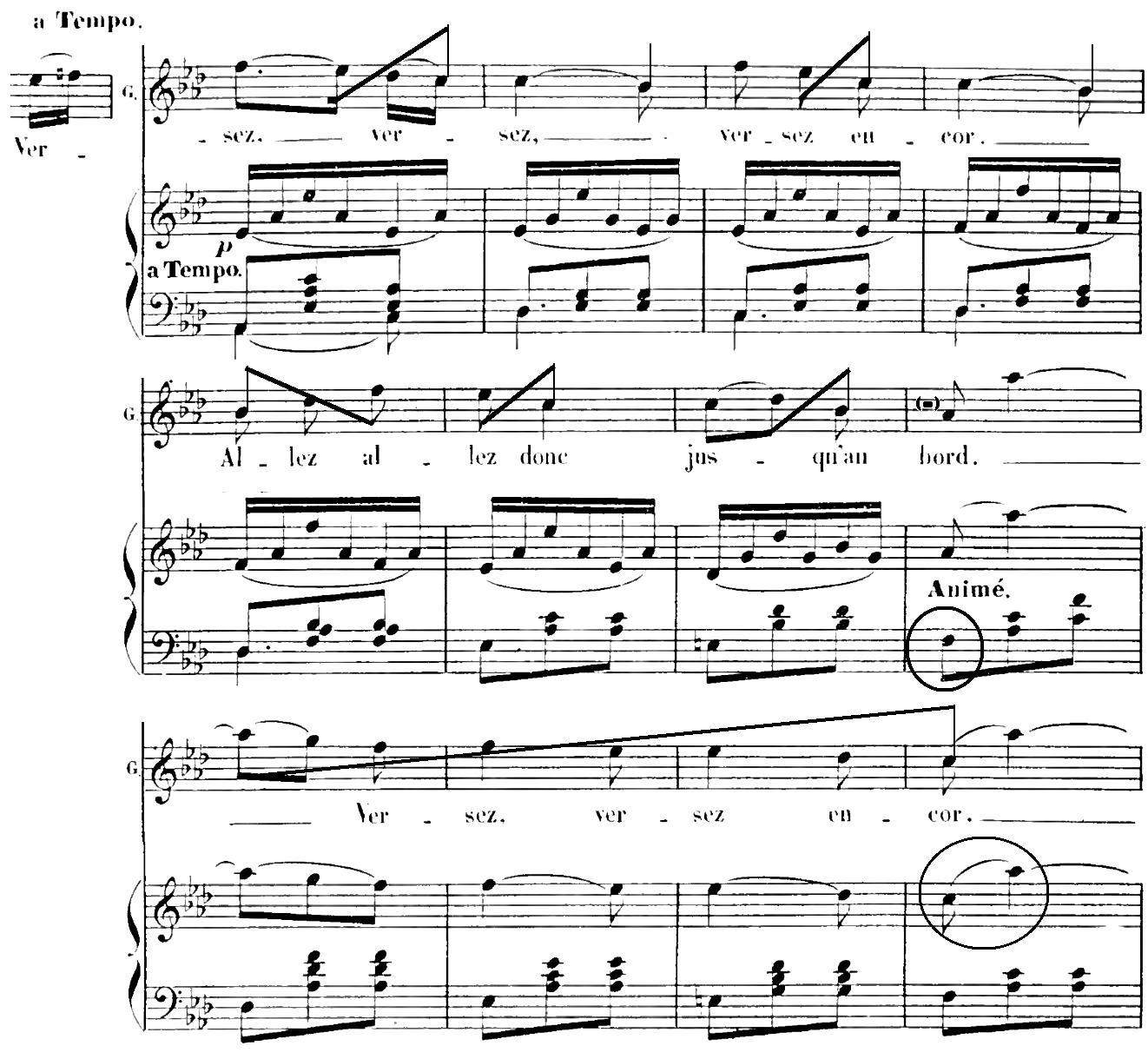
Number 6 is in three sections, after a short opening call "A table! A table!"  I wrote about the chanson "Versez, versez" in an earlier post: link. After a brief scena/recitative comes the rondeau "J’en prendrai un, deux, trois," which is the subject of today's post.

The design is vaguely that of a rondeau in the usual sense (that is, recurring theme with intervening contrasting sections). The A section consists of a 16-bar theme (bars 3-19), which has no cadence, after which another 16-bar theme is heard (bars 20-35); this one—we'll call it B—closes with a PAC in the dominant. A third, contrasting section C (bars 36-57) moves immediately to bVI of the dominant, introduces new melodic material (though the text continues in its catalogue fashion) and before very long reaches V (as dominant), where it stays for some time. When A returns (bars 57-72), the theme now closes firmly in the tonic and is followed by a lengthy coda (bars 72-92). After this, B and C are repeated in toto (bars 93-108 and 109-130, respectively), and so is the reprise of A and its coda (bars 130-161).

Here, voice part only, are A (theme1) and B (theme 2).

Here is the reprise of A. Note that the theme has a new second half, and that ends with a very straightforward descent in the cadence.

And here is the extended coda that immediately follows. The ascending octave in the cadence is very similar to the ending of no. 4.


t

Note: In no.8, the finale of the operetta, the opening 72 bars of the rondeau are repeated, or ABCA'-coda.

Thursday, August 16, 2018

Offenbach, Pomme d'api (1873), no. 5

No. 5 is an extended duo for Catherine and Gustave. It is in five parts:  (1) "C'est un Dimanche" is a  pastorale; (2) "A deux pas du chien savant" is a scena, with an interpolated reprise of the pastorale's opening theme in the middle; (3) "Et je vois l'un près de l'autre" is a solo for Catherine;  (4) "De grace écoule-moi ma bonne!" is another scena; and (5) "Pomme d'Api" is a duo, Allegretto with a presto coda.

Parts 3 & 5 are of interest here.

"Et je vois l'un près de l'autre" balances rising and falling linear figures in such a way that one hears a complex upper-voice design. Note that the theme's period, below, ends with a strongly implied ^3 over the directly expressed ^1.

In the consequent of the final reprise, more emphasis is given to the internal rising line in the cadence and to the original focal tone D5.


In section 5, "Pomme d'Api," a strong rising motive dominates the theme—see the circled notes below. The figure of the cadence bars is almost identical to that in "Et je vois l'un près de l'autre."


As in no. 3, the final consequent phrase is expanded, but not through the same method. This time the consequent is expanded through a deceptive resolution (fourth bar below), and the cadence follows, but the two voice parts—which could easily have closed on ^1/^8—instead hold on ^3 and ^5, respectively.


The presto follows. Its ascending line in the cadence is unmistakable. The orchestra then follows with a "proper" coda.


Wednesday, August 15, 2018

Offenbach, Pomme d'api (1873), no. 6 Chanson

The Trio (no. 6, in the operetta's Scene 12 [of 14]) opens with a short theme "A table! A table!"—(as 8+ bars), followed by Gustave's chanson "Versez, versez"; then a scena follows, "Ah! maintenant cela va mieux," and Catherine's rondeau "J’en prendrai un, deux, trois." The rondeau will be discussed in the next post. For number list and synopsis see the introduction: link.

"Versez, versez" is a small ternary form. Catherine joins Gustave during the B-section, and all three players sing the reprise. In the A-section, the cadence is a turn to the dominant, from which the B-section follows directly.

Here is the reprise, showing in the first three systems only Gustave's part, the principal melody. Catherine is singing a simple mid-range accompaniment and Rabastens follows the bass line.


For the final bars, I show all parts below. Note especially that Catherine and Gustave trade scale degrees (voice exchange) and thus Gustave is able to go one-note-too-far to Bb4 (concert or actual pitch).


Tuesday, August 14, 2018

Offenbach, Pomme d'api (1873), nos. 2 & 4

Gustave acknowledges Rabasten's demand that he abandon his unsatisfactory girlfriend in "Mon oncle ne vous fâchez pas" (no. 2). The design is ABABA, the text's three quatrains presented as 1 2 1 3 1. The strong focus on the melody's outer notes invites hearing a proto-background ^5/^8, as Ab4-Eb5 (written) -- see the opening period below.


In the first reprise, the frame is temporarily expanded upward to include Ab5--see the final bars of the example below--but the fifth frame is not disturbed.


In the final reprise, on the other hand, the frame is again expanded upward to include Ab5, firmly now thanks to Gustave's final note. (In Neumeyer 2009, I call this device ADDINV; here the result is a tonal frame of three pitches, Ab4-Eb5-Ab5, after the fifth is inverted and its fourth added on top.) The change happens quite directly, as you can see, without the inclusion of a line -- see the reprise below -- and a proto-background is the most musically satisfying large-scale figure for the number.


Number 4 is a trio about cooking dinner: "Va donc, chercher le gril!" (in the operetta's Scene 7). A traditional multi-section form, the trio begins with an Allegro vivo for all three singers. "Mais, que ferez-vous de ce gril?" follows, a brief scena/recit between Gustave and Catherine. "Nous mettrons le gril sur le feu" is much longer, beginning as a Moderato 16-bar period (between Rabastens and Catherine), after that a contrasting B-section for Catherine and Gustave, who then repeat the 16-bar period, but—as the example below indicates—without completing it, as Catherine gives comic emphasis to "grilled lamb chops." The presto coda that follows is the point of interest here. It consists of an eight-bar theme (period) that is repeated (plus a short orchestral codetta). Both statements of the theme include a rising line in the cadence -- these are boxed in the score below. Gustave sings the figure the first time, then all three offer it in the high-spirited finish.


As it happens, the presto may have the expressive effect of a coda, but in form-functional terms it is not a coda. William Caplin distinguishes between expansion and extension: essentially, the former happens within a theme, the latter after the theme's cadence. Codas are properly extensions, "added on" after the structural cadence. But in this case the presto expands the consequent of the 16-bar theme and only then provides the structural cadence itself.

To show how this works, here is the initial presentation of "Nous mettrons le gril sur le feu." Note that the closing cadence is to the dominant -- and coincidentally features an internal rising line as well.


Here is an abbreviated scheme that shows the design of the reprise consequent + presto first phrase.


The structural cadence, of course, happens on the repetition of the presto's 8-bar theme:

Friday, August 3, 2018

Offenbach, Pomme d'api

A one-act operetta written specifically for one of Offenbach's discoveries, the soprano Louise Théo, Pomme d'api was premiered in Paris in September 1873. The production was a success, and the composer promptly wrote for her the full-length La jolie parfumeuse, which was premiered in November of the same year. Although successful, too, just three months later La jolie parfumeuse was left in the shadow of the remarkable run of Offenbach's four-act version of Orphée aux enfers (originally two acts, 1858).

The music of Pomme d'api consists of the overture and eight numbers:
1. Couplets (Rabastens) "L’employé m’a dit, de quel âge"  (in Scene 1)
2. Romance (Gustave) "Mon oncle ne vous fâchez pas" (in Scene 2)
3. Couplets (Catherine) "Bonjour monsieur je suis la bonne"  (in Scene 3)
4. Trio "Va donc, chercher le gril!" (in Scene 7)
5. Duo (Catherine, Gustave) "C’est un dimanche, un matin"   (in Scene 11)
6. Trio "A table! A table!"       (in Scene 12)
   (a) Chanson (Gustave) "Versez, versez"
   (b) Rondeau (Catherine) "J’en prendrai un, deux, trois"
7. Romance (Gustave) "Consultez votre coeur"  (in Scene 14)
8. Finale "J’en prendrai un, deux, trois"   (in Scene 14)
Of these, only numbers 1 & 3 lack prominent rising lines in their cadences. As we will see, the character and significance of the ascending cadence gestures varies considerably.

The plot is simple enough, as these entangled romances go: An older man, Rabastens, disapproves of his nephew Gustave's current girlfriend and cuts off the young man's allowance. Gustave reluctantly goes along with the demand and rejects her. Having fired his maidservant, Rabastens awaits the arrival of her replacement, who is Catherine, (of course) Gustave's now ex-girlfriend. She plays up to Rabastens in order to rebuke Gustave, who is disconsolate and decides to go away, at which point Catherine realizes that he still loves her, Rabastens is reconciled to them, and all ends well (Gustave's allowance is even increased!). Much of the action revolves about dinner, which explains the title: the pomme d'api is one of the earliest named apple varieties, already mentioned in botanical volumes in the early 17th century.

Information about design:

1. Couplets (Rabastens) "L’employé m’a dit, de quel âge"  (in Scene 1)
Two strophes (different text, same music); in the voice, proto-background ^1/^5.
2. Romance (Gustave) "Mon oncle ne vous fâchez pas" (in Scene 2)
--ABABA design; proto-background ^5/^8. The text is also in a couplets design, its three quatrains presented as 1 2 1 3 1.
3. Couplets (Catherine) "Bonjour monsieur je suis la bonne"  (in Scene 3)
Two strophes, with acceleration near the end of each.
4. Trio "Va donc, chercher le gril!" (in Scene 7)
Three sections: Allegro vivo; scena/recit; Moderato. (1) "Va donc, va donc, chercher le gril!" The opening Allegro, for all three singers, is in AB design, where A is an eight-bar period, B is considerably longer and closes on V. (2) "Mais, que ferez-vous de ce gril?" The brief scena/recit is between Gustave and Catherine. (3) "Nous mettrons le gril sur le feu" The much longer Moderato is more complex: a 16-bar period opens (between Rabastens and Catherine), a B-section follows for Catherine and Gustave, and they then repeat the 16-bar period, which, however, is broken off by Catherine, who gives comic emphasis to "grilled lamb chops," and a presto coda for all three follows.
5. Duo (Catherine, Gustave) "C’est un dimanche, un matin"   (in Scene 11)
An extended number. (1) "C'est un Dimanche." Duo. Pastorale, small ternary form. (2) "A deux pas du chien savant" scena, varied tempi and styles, including a reprise of the pastorale's opening theme in the middle. (3) "Et je vois l'un près de l'autre" Allegretto presqu' Andantino. Solo for Catherine, ABACA. (4) "De grace écoule-moi ma bonne!" scena. (5) "Pomme d'Api" Allegretto. Duo. Small ternary form with presto coda.
6. Trio "A table! A table!"       (in Scene 12)
   (a) Chanson (Gustave) "Versez, versez"
The trio theme—"A table! A table!"—(as 8+ bars) precedes. "Versez, versez" is a small ternary form; Catherine joins in during the B-section, and all three sing the reprise. A scena follows: "Ah! maintenant cela va mieux."
   (b) Rondeau (Catherine) "J’en prendrai un, deux, trois"
Allegro vivo, follows on the scena above. As with (a), the others join in during the B-section and all three sing the reprise, which is extended through a coda, after which the entire rondeau is repeated.
7. Romance (Gustave) "Consultez votre coeur"  (in Scene 14)
Strophic, two verses, a 12-bar theme.
8. Finale "J’en prendrai un, deux, trois"   (in Scene 14)
"J'en prendrai un, deux, trois" Reprise of the rondeau from no. 6
In the next post, I will start the analytical observations about rising cadence gestures.

Tuesday, July 24, 2018

Johann Strauss, jr., a galop (schnell-polka)

After mid-century, the galop (see previous post) was displaced by the faster-tempo polka (the slower-tempo polka was the original type that had become very popular by about 1840). The dance was slightly different from the galop but the music was the same. (The can-can, btw, evolved the same way and at the same time.) The slower-tempo polka became known in Vienna as the polka française, the faster one as the schnell-polka.

Johann Strauss, jr., wrote polkas of both types (though not nearly so prolifically as he did waltzes) and also gave them prominent placement in his stage works.  The Schnell-Polka (Galopp) "So ängstlich sind wir nicht, Op.413" uses motives from the comic operetta "Eine Nacht in Venedig."

The second strain of the trio, below, gives yet another of Strauss's manifold plays on the upper tetrachord of the major key, and on the functions and relationships of ^5, ^6, and ^7. At (a), ^5 is the traditional consonance; at (b), ^6 is possibly the ninth of a V9 but doesn't resolve directly--in fact it doesn't resolve at all as the ^6-inflection is repeated in bar 4. At (c), the string of sixths, rising, lends strength to a focus on ^5 as G4. A crucial moment is in bar 8, where the ^6-inflection occurs over the tonic resolution (arrow). Bars 1-8 are repeated and the ^6-inflection disappears in the cadence, clarifying a straightforward rising fourth line. (Note that this line is confirmed by the strong position of ^5 at (a) and strong-beat placements of each member of the line in the ascent.)


Thursday, May 24, 2018

Fledermaus essay published

I have gathered all the blog posts in the Fledermaus series, added additional information, and published an essay on the Texas Scholar Works platform: Johann Strauss, jr., Die Fledermaus: Ascending Cadence Gestures on Stage. Link.

Here is the abstract:
Die Fledermaus (1874), today the best-known operetta by Johann Strauss, jr., is also a treasure trove of ascending cadence gestures. This article documents and interprets those multiple instances and their effects.

Monday, May 21, 2018

Strauss, Die Fledermaus, addendum: Act II n10 Csardas

Apart from Adele's "Laughing Song" ("Mein Herr Marquis," n8b), the best known solo aria in the operetta is Rosalinde's Csárdás, n10. The two sections of the standard slow-fast design both make use of rising gestures.

In the opening section, unfoldings over a simple cycle of fifths progressions—ii-V-I, mostly in inversions—bring ^9 (E5) down to ^8 (D5) in the first four bars. A rising line fills the second fourth, A4-D5 (bars 3-4). The figure is repeated and stretched into the final cadence (bars 5-8). Considered abstractly, then, a background for this section would be a stationary ^8.
In the second, fast section, ^5 is the focal tone, aided by its upper neighbor (B4 circled in bars 2 and 6) and a descending figure running across V7 closes (also circled). A line of the rising fourth is now the bright flourish at the very beginning.

The Più Allegro—another of those codas that confound the difference between formal-structural and coda-accessory closes—takes the same figures, but shifts the focal note up an octave to A5 and carries that into the voice's ending, where ^5 substitutes for ^7 in order to give even more dramatic emphasis to the final D6!


Strauss, Die Fledermaus, addendum: Act II n6 chorus

After finishing the series on Die Fledermaus, I again watched the excellent performance from the Wiener Staatsoper starring Lucia Popp and Bernd Weikl, with Theodor Guschlbauer conducting  (1980; DVD release 2007).

In the course of this audio-viewing, two more numbers revealed themselves as having rising cadence gestures. The first of these is an omission: the opening chorus of Act II (n6) reprises, but also develops, Falke's "Komm mit mir zum Souper" invitation to Eisenstein (from n3). The reprise is also a reminder to the audience that Falke is the driver behind the narrative's events.

The chorus takes full advantage of this charming polka as guests laud the pleasures of Prince Orlofsky's party/dance. In the principal strain, neighbor notes moves about ^8:
After a second strain, the first is repeated. Then the tempo changes abruptly, to Molto animato as the singers call out their orders, after which a new strain, Vivo, uses an eight-bar unit as the presentation phase of a 16-bar sentence -- see bars 1-8 below, with its remarkable treatment of ^7 and ^6. The continuation moves quickly up to ^8 (bars 9-12 below) then adds four more bars of descent ending with an IAC.


The continuation is then repeated, but now the ascent is the main event, and ^8 is celebrated, fortissimo, for several more bars:


Concluding comment on Die Fledermaus

The number of ascending cadential gestures in Die Fledermaus is substantial. Certainly there are many more than one would expect in the waltz sets of Johann Strauss, jr., where he tends to be conservative in the cadences (apart, of course, from the characteristic figures of the waltz repertoire). On the other hand, significant ascending motives and cadences are very typical of the opera bouffe and operetta repertoires. Clearly Strauss knew and responded to those genre-based opportunities.

 In the introduction to this series, I wrote that—in addition to continuing documentation of rising cadential figures—I wanted "to put more emphasis on the expressive and dramatic functions of ascending cadence gestures in texted works. My method is quite simple: for each song or number I will ask the question, Why does an ascending melodic figure dominate the cadence(s) and not the clichéd falling version inherited from 18th century practice?"

As will be obvious if you have read earlier posts, I didn't follow through on that plan. After n2—the trio for Rosalinde, Eisenstein, and Blind—I largely gave up. I did manage these observations there: [link to the post]
In this case, (1) the focus on the upper edge of the register in the main phrase (bars 1-5 above); (2) the repetitions of the pick-up chromatic ascending figure (bars 9-12), which invite continuation in the same direction (bars 12-13); (3) the more and more peremptory "hinaus" (get out!) (bars 12-13); (4) the exaggerated melodramatic humor in the subverted tonic at the end, as Rosalinde hits and holds her high note. 
The Vivace [ending] is a typical operatic ensemble close, whose simple harmonic progressions and repetitious figures are similar to "one more time" passages in Classical-period instrumental codas. After waltzes and polkas, these ensemble endings are the most frequent source of rising cadence gestures in 19th century music.
Perhaps  Die Fledermaus wasn't the best subject for an inquiry like this, if the goal is to make fine distinctions (why rising in this aria, falling in that?). Almost all of its songs and ensemble pieces are dance-based, with particular emphasis on the waltz and polka. By 1850 at the latest, the endings of songs, but especially ensemble pieces and finales, generally favored rousing high-register gestures. Thus, the answer to my question is simple: genre expectations assumed the possibility of significant ascending motives and cadences.

I would like to be able to claim the following, as well, but I will do no more than hint for now. A study now underway of songs by Cécile Chaminade and Hugo Wolf will, I hope, offer some insights.
Such genre expectations also made it easier to experiment with ascending figures and cadences in relation to mood or affect: instead of the typical falling line for slow-tempo melancholy, a rising conclusion could signal an existentially charged sighing regret, nostalgia, or utopian feeling. In a faster tempo, a falling cadential line could more easily signal assertion, firmness, or resolve when understood as balanced against the option of the lighter, brighter quality of an ascending line

Sunday, May 20, 2018

Strauss, Die Fledermaus n16, Act III finale

In Act III, as we saw in the previous post, everyone converges on the jail, for different reasons but mainly to participate in Falke's revelation of his trick on Eisenstein. Since that trick was to induce Eisenstein to flirt with his disguised wife, the main element of the plot now is their reconciliation. Consistent with the farcical nature of the plot, when Eisenstein blames the champagne, Rosalinde promptly forgives him and all ends well.

The finale is brief, compared with those for the first two acts. A polka sets up an explanation of the ruse. Its introduction generates a simple ascent from ^5 to ^8. The theme that follows consists of unfolded intervals; the main voice is the lower one, ^1-^7-^1, with a covering ^5-^4-^3.


When Eisenstein says "Du siehst, nur der Champagner war an allem Schuld!," everyone joins in a reprise of the Prince's toast that opened the Act II finale—and now closes the operetta.


Saturday, May 19, 2018

Strauss, Die Fledermaus n14, Act III, "Spiel' ich . . ."

In one of the subplots (if we can dignify them with that term), Rosalinde's maid Adele aspires to be a professional singer and actress. During the evening party, she comes to believe that Frank (the warden disguised as a marquis) can help her. The following morning (we are now in Act III), she and her sister show up at the jail. In n14, the couplets "Spiel' ich die Unschuld vom Lande," Adele presses her point. Musically, she shows off a variety of styles within a compact form. 
A1   8 bars        — for the naïf from the countryside, a 6/8 tune like a contredanse gigue, one of the types that had become identified as French folk song by the later 19th century.
A2   8 bars with 4-bar extension  (on V)
B1   8 bars closes on tonic -- the second from section
B2   12 bars coda, repeats 4 bar phrase of A1 
C    8 bars    meno mosso in 3/4   — leads to a bit of a waltz at the end. Adele makes the point of her varied skills.
2 bars transition 
D1  8 bars  Tempo di marcia    -- "Spiel' ich eine Königin"  (for the queen, a regal march)
1 bar intro
D2  8 bars
D2   repeat with Ida and Frank 
C   reprise
repeat 2 bars transition 
E1   10 bars 2/4 Allegretto grazioso.  "Spiel ich 'ne Dame von Paris" (for the lady of Paris, a 2/4 grazioso--these have their source in the 18th century contredanse-gavotte and remain a staple as late as film music underscore in the 1940s)
E2    8 bars
F      12 bars
E2’   9 bars; with cadence to tonic
The music of interest to us here is in sections D and E/F. The 8-bar consequent of D finishes with a descending but open cadence. The focal tone is ^5 (as D5); in the cadence this moves to ^4 (C5) and one then imagines ^3 (B4). (So, an unfolded third C5-A4 to the third G4-[B4]).


In the repeat of the consequent--with added sound effects from Ida (Adele's sister) and Frank--Adele takes the focal tone ^5 up to ^7 and ^8 (F#5-G5) in the cadence:


In the analogous place in the E theme (specifically, the repeat of it that closes the aria), the focal tone is again ^5 (D5), the singer takes it up through D#5 to E5 over the cadential ii6, then substitutes ^5 for ^7, while the orchestra provides the ^7:

Thursday, May 17, 2018

Strauss, Die Fledermaus n12, Act III, Entre'act & n13, Melodrama

The scene for Act III is the jail. The Entre'act--which functions as the introduction to Act III--helps switch locations for the audience in that it is a reprise of all of the Vogelhaus march, both the 2/4 and 6/8 sections. In the course of that, the powerful (con forza) cadence is repeated:


In n13, Frank has returned to the jail and settles down, all the while recalling pleasant memories (and, of course, several musical fragments) of the evening's party, including the Prince's toast, with its ascending cadence gesture. At the end of the melodrama (that is, a scene of action--or in this case rather less and less action) he falls asleep.

Tuesday, May 15, 2018

Strauss, Die Fledermaus n9, the "Eins, Zwei, Drei" galop

Before we leave Act II, there is one further number to discuss. The action during n9 is between Rosalinde (disguised as a Hungarian countess) and Eisenstein, who is trying to seduce her using his special chiming pocket watch (which, we learned in Act I, he claims never fails). A brief galop, "Eins, Zwei, Drei," appears three times in the course of the scene. Its melody is about as obvious a rising line as one could want, but it is given a proper harmonization only in its first iterations, not the repetitions.

In the first instance, the repetition of the theme is cut off partway through by a dissonance as Eisenstein reacts to Rosalinde's miscounting:


In the second instance, Eisenstein deliberately miscounts wildly and the final tonic is replaced by another dissonance.


The third instance is at the end of the number, which the two singers bring to a dramatic close, but where the tune only appears once the cadence is finished, over a tonic pedal (circled). Adding insult to cadential injury, the codetta surges past ^8 to ^10 (F#6; see the box) and we hear several V-I's in a row.


Sunday, May 13, 2018

Postscript to Strauss, Die Fledermaus n11, Act II finale

The five parts of the Act II finale are (1) Orlofsky's toast to champagne--which we discussed in the previous post; (2) a comic exchange between Frank and Eisenstein; (3) Falke's waltz-song "Brüderlein und Schwesterlein," which leads into the "Du und Du" waltz; (4) ballet (handled in various ways in different productions); and (5) Prince Orlofsky's call to dance "Stellt Euch zum Tanz" and the dance itself "Ha, welch ein Fest, welche Nacht voll Freud!"

In the last of these, Strauss shows one of the strong tendencies in his later waltzes: toward 32-bar units, either by "stretching out" double periods or sentences (making them 16 + 16 rather than 8 + 8), or--as here--by so closely linking two 16-bar strains that they make a single musical unit:


There are no ascending cadence gestures in this extended and exhilarating waltz, but it doesn't have the last word in the Act II finale, as the proceedings come to a halt on a resounding cadential dominant -- see the beginning of the example below -- and everyone offers up a last salute to champagne by repeating the music for the Prince's toast. In the process the choral sopranos mark out the essential elements of the voice leading for the tune that Rosalinde—along with Orlofsky, Adele, and her sister—sings in a register that makes its yodeling topic even more obvious than it was earlier.


The orchestra, then, goes loudly to it one more time, stretching ^6 over IV and ^7 over V to two bars each and then beating on ^8 for no less than nine bars.