Showing posts with label Offenbach. Show all posts

Monday, July 8, 2019

I have published a new essay on the Texas ScholarWorks platform: link.

Title: Offenbach, Rising Melodic Gestures in La belle Hélène (1864)

Abstract:
Jacques Offenbach’s La belle Hélène (1864) was the successor to Orphée aux Enfers (1858; 1874) in both its send-up of Greek myth and its production triumph. Four other mature and now well-known operettas followed: Barbe-bleue (1866), La Vie parisienne (1866), La Grande-Duchesse de Gérolstein (1867), and La Périchole (1868). All of these—along with La belle Hélène—were composed to libretti by Henri Meilhac and Ludovic Halévy. 

Thursday, December 27, 2018

New publication: operettas by Offenbach

I have published a new essay on the Texas Scholar Works platform: Offenbach, two one-act operettas: Les deux aveugles (1855) and Pomme d’Api (1873)Link.

Here is the abstract:
Ascending cadence gestures are common in the repertoire of the operetta and in some early opéras comiques. Composers altered traditional dramatic cadence figures beginning in the mid-1830s, but it was multiple instances in Jacques Offenbach’s one- act stage pieces in the mid-1850s that popularized them and turned them into clichés of the musical theater. Les deux aveugles (1855) was the composer’s first undisputed success. Offenbach returned to the one-act format much later in his career with Pomme d’Api (1873). An afterword provides a table of theatrical cadences that bring attention to the upper register.

Tuesday, August 21, 2018

Offenbach, Pomme d'api (1873), no. 7 Romance

If I had been working through La Pomme d'api in topical rather than chronological fashion, I would have started with no. 7, Gustave's strophic romance "Consultez votre coeur," the only number in the operetta that positions a simple rising line in the structural cadence (without the complications of coda expressions). (For a number list and synopsis of the operetta, see the introduction: link.)

There are two strophes, where a partial line descends in the first, and a simple rising line with ^7 emphasized dramatically (with fermata) closes the second.

At (a), the proto-background frame ^8/^5, as F5-C5 (written). At (b), the frame expands outward with G5 as neighbor; at (c) a firm descent in the cadence, but a wedge is also formed with movement from below A4-A#4-B-nat4-C5. At (d), a reprise of (a) for the consequent, and at (e), the frame is flipped to permit a cadence to F4.


In the consequent phrase of the reprise, note the progress toward the cadence. Overall, the effect is that of the "mirror Urlinie," with descent from ^8 and subsequent return.


Saturday, August 18, 2018

Offenbach, Pomme d'api (1873), no. 6 Rondeau

Number 6 is in three sections, after a short opening call "A table! A table!"  I wrote about the chanson "Versez, versez" in an earlier post: link. After a brief scena/recitative comes the rondeau "J’en prendrai un, deux, trois," which is the subject of today's post.

The design is vaguely that of a rondeau in the usual sense (that is, recurring theme with intervening contrasting sections). The A section consists of a 16-bar theme (bars 3-19), which has no cadence, after which another 16-bar theme is heard (bars 20-35); this one—we'll call it B—closes with a PAC in the dominant. A third, contrasting section C (bars 36-57) moves immediately to bVI of the dominant, introduces new melodic material (though the text continues in its catalogue fashion) and before very long reaches V (as dominant), where it stays for some time. When A returns (bars 57-72), the theme now closes firmly in the tonic and is followed by a lengthy coda (bars 72-92). After this, B and C are repeated in toto (bars 93-108 and 109-130, respectively), and so is the reprise of A and its coda (bars 130-161).

Here, voice part only, are A (theme1) and B (theme 2).

Here is the reprise of A. Note that the theme has a new second half, and that ends with a very straightforward descent in the cadence.

And here is the extended coda that immediately follows. The ascending octave in the cadence is very similar to the ending of no. 4.


t

Note: In no.8, the finale of the operetta, the opening 72 bars of the rondeau are repeated, or ABCA'-coda.

Thursday, August 16, 2018

Offenbach, Pomme d'api (1873), no. 5

No. 5 is an extended duo for Catherine and Gustave. It is in five parts:  (1) "C'est un Dimanche" is a  pastorale; (2) "A deux pas du chien savant" is a scena, with an interpolated reprise of the pastorale's opening theme in the middle; (3) "Et je vois l'un près de l'autre" is a solo for Catherine;  (4) "De grace écoule-moi ma bonne!" is another scena; and (5) "Pomme d'Api" is a duo, Allegretto with a presto coda.

Parts 3 & 5 are of interest here.

"Et je vois l'un près de l'autre" balances rising and falling linear figures in such a way that one hears a complex upper-voice design. Note that the theme's period, below, ends with a strongly implied ^3 over the directly expressed ^1.

In the consequent of the final reprise, more emphasis is given to the internal rising line in the cadence and to the original focal tone D5.


In section 5, "Pomme d'Api," a strong rising motive dominates the theme—see the circled notes below. The figure of the cadence bars is almost identical to that in "Et je vois l'un près de l'autre."


As in no. 3, the final consequent phrase is expanded, but not through the same method. This time the consequent is expanded through a deceptive resolution (fourth bar below), and the cadence follows, but the two voice parts—which could easily have closed on ^1/^8—instead hold on ^3 and ^5, respectively.


The presto follows. Its ascending line in the cadence is unmistakable. The orchestra then follows with a "proper" coda.


Wednesday, August 15, 2018

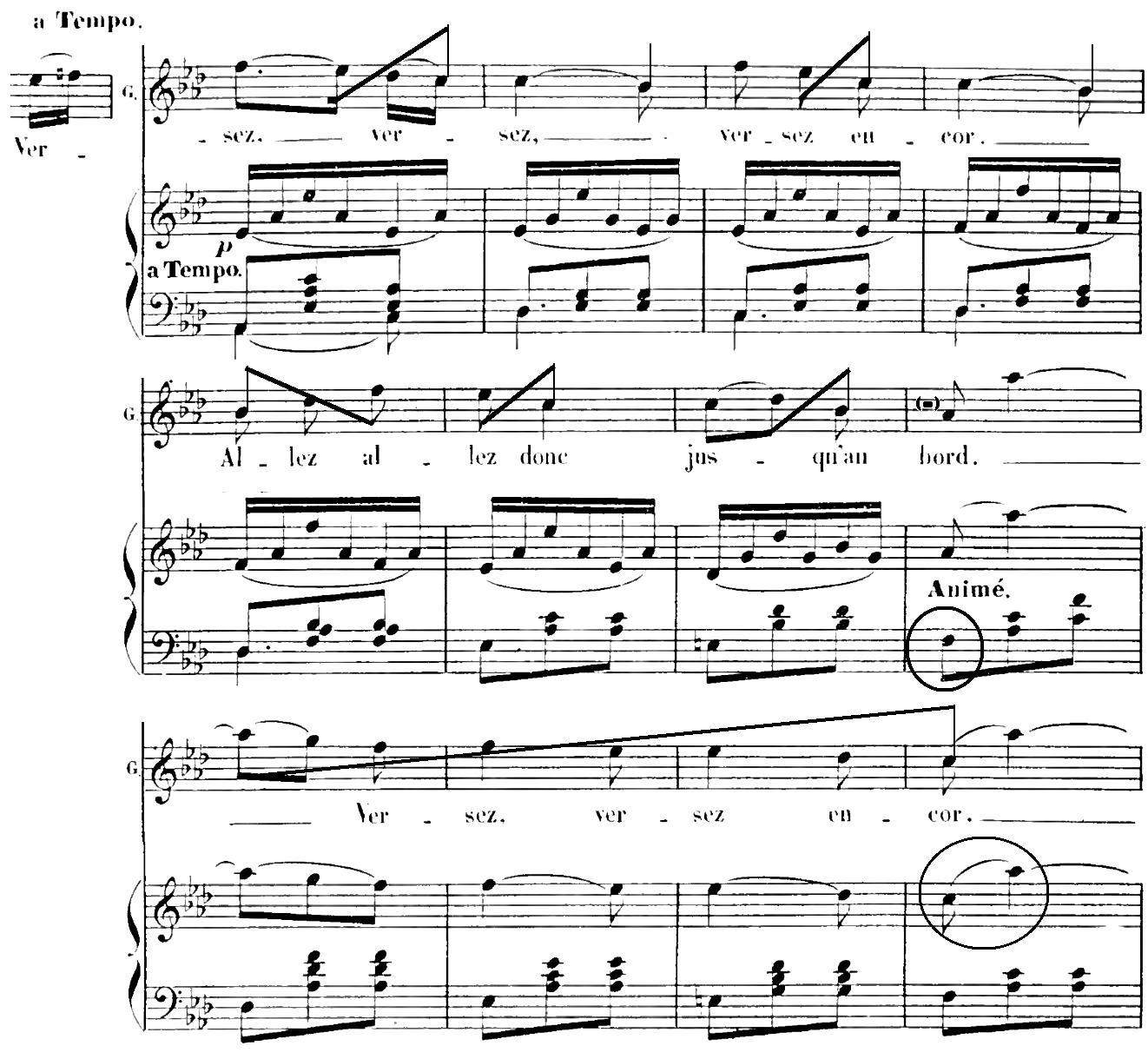
Offenbach, Pomme d'api (1873), no. 6 Chanson

The Trio (no. 6, in the operetta's Scene 12 [of 14]) opens with a short theme "A table! A table!"—(as 8+ bars), followed by Gustave's chanson "Versez, versez"; then a scena follows, "Ah! maintenant cela va mieux," and Catherine's rondeau "J’en prendrai un, deux, trois." The rondeau will be discussed in the next post. For number list and synopsis see the introduction: link.

"Versez, versez" is a small ternary form. Catherine joins Gustave during the B-section, and all three players sing the reprise. In the A-section, the cadence is a turn to the dominant, from which the B-section follows directly.

Here is the reprise, showing in the first three systems only Gustave's part, the principal melody. Catherine is singing a simple mid-range accompaniment and Rabastens follows the bass line.


For the final bars, I show all parts below. Note especially that Catherine and Gustave trade scale degrees (voice exchange) and thus Gustave is able to go one-note-too-far to Bb4 (concert or actual pitch).


Tuesday, August 14, 2018

Offenbach, Pomme d'api (1873), nos. 2 & 4

Gustave acknowledges Rabasten's demand that he abandon his unsatisfactory girlfriend in "Mon oncle ne vous fâchez pas" (no. 2). The design is ABABA, the text's three quatrains presented as 1 2 1 3 1. The strong focus on the melody's outer notes invites hearing a proto-background ^5/^8, as Ab4-Eb5 (written) -- see the opening period below.


In the first reprise, the frame is temporarily expanded upward to include Ab5--see the final bars of the example below--but the fifth frame is not disturbed.


In the final reprise, on the other hand, the frame is again expanded upward to include Ab5, firmly now thanks to Gustave's final note. (In Neumeyer 2009, I call this device ADDINV; here the result is a tonal frame of three pitches, Ab4-Eb5-Ab5, after the fifth is inverted and its fourth added on top.) The change happens quite directly, as you can see, without the inclusion of a line -- see the reprise below -- and a proto-background is the most musically satisfying large-scale figure for the number.


Number 4 is a trio about cooking dinner: "Va donc, chercher le gril!" (in the operetta's Scene 7). A traditional multi-section form, the trio begins with an Allegro vivo for all three singers. "Mais, que ferez-vous de ce gril?" follows, a brief scena/recit between Gustave and Catherine. "Nous mettrons le gril sur le feu" is much longer, beginning as a Moderato 16-bar period (between Rabastens and Catherine), after that a contrasting B-section for Catherine and Gustave, who then repeat the 16-bar period, but—as the example below indicates—without completing it, as Catherine gives comic emphasis to "grilled lamb chops." The presto coda that follows is the point of interest here. It consists of an eight-bar theme (period) that is repeated (plus a short orchestral codetta). Both statements of the theme include a rising line in the cadence -- these are boxed in the score below. Gustave sings the figure the first time, then all three offer it in the high-spirited finish.


As it happens, the presto may have the expressive effect of a coda, but in form-functional terms it is not a coda. William Caplin distinguishes between expansion and extension: essentially, the former happens within a theme, the latter after the theme's cadence. Codas are properly extensions, "added on" after the structural cadence. But in this case the presto expands the consequent of the 16-bar theme and only then provides the structural cadence itself.

To show how this works, here is the initial presentation of "Nous mettrons le gril sur le feu." Note that the closing cadence is to the dominant -- and coincidentally features an internal rising line as well.


Here is an abbreviated scheme that shows the design of the reprise consequent + presto first phrase.


The structural cadence, of course, happens on the repetition of the presto's 8-bar theme:

Friday, August 3, 2018

Offenbach, Pomme d'api

A one-act operetta written specifically for one of Offenbach's discoveries, the soprano Louise Théo, Pomme d'api was premiered in Paris in September 1873. The production was a success, and the composer promptly wrote for her the full-length La jolie parfumeuse, which was premiered in November of the same year. Although successful, too, just three months later La jolie parfumeuse was left in the shadow of the remarkable run of Offenbach's four-act version of Orphée aux enfers (originally two acts, 1858).

The music of Pomme d'api consists of the overture and eight numbers:
1. Couplets (Rabastens) "L’employé m’a dit, de quel âge"  (in Scene 1)
2. Romance (Gustave) "Mon oncle ne vous fâchez pas" (in Scene 2)
3. Couplets (Catherine) "Bonjour monsieur je suis la bonne"  (in Scene 3)
4. Trio "Va donc, chercher le gril!" (in Scene 7)
5. Duo (Catherine, Gustave) "C’est un dimanche, un matin"   (in Scene 11)
6. Trio "A table! A table!"       (in Scene 12)
   (a) Chanson (Gustave) "Versez, versez"
   (b) Rondeau (Catherine) "J’en prendrai un, deux, trois"
7. Romance (Gustave) "Consultez votre coeur"  (in Scene 14)
8. Finale "J’en prendrai un, deux, trois"   (in Scene 14)
Of these, only numbers 1 & 3 lack prominent rising lines in their cadences. As we will see, the character and significance of the ascending cadence gestures varies considerably.

The plot is simple enough, as these entangled romances go: An older man, Rabastens, disapproves of his nephew Gustave's current girlfriend and cuts off the young man's allowance. Gustave reluctantly goes along with the demand and rejects her. Having fired his maidservant, Rabastens awaits the arrival of her replacement, who is Catherine, (of course) Gustave's now ex-girlfriend. She plays up to Rabastens in order to rebuke Gustave, who is disconsolate and decides to go away, at which point Catherine realizes that he still loves her, Rabastens is reconciled to them, and all ends well (Gustave's allowance is even increased!). Much of the action revolves about dinner, which explains the title: the pomme d'api is one of the earliest named apple varieties, already mentioned in botanical volumes in the early 17th century.

Information about design:

1. Couplets (Rabastens) "L’employé m’a dit, de quel âge"  (in Scene 1)
Two strophes (different text, same music); in the voice, proto-background ^1/^5.
2. Romance (Gustave) "Mon oncle ne vous fâchez pas" (in Scene 2)
--ABABA design; proto-background ^5/^8. The text is also in a couplets design, its three quatrains presented as 1 2 1 3 1.
3. Couplets (Catherine) "Bonjour monsieur je suis la bonne"  (in Scene 3)
Two strophes, with acceleration near the end of each.
4. Trio "Va donc, chercher le gril!" (in Scene 7)
Three sections: Allegro vivo; scena/recit; Moderato. (1) "Va donc, va donc, chercher le gril!" The opening Allegro, for all three singers, is in AB design, where A is an eight-bar period, B is considerably longer and closes on V. (2) "Mais, que ferez-vous de ce gril?" The brief scena/recit is between Gustave and Catherine. (3) "Nous mettrons le gril sur le feu" The much longer Moderato is more complex: a 16-bar period opens (between Rabastens and Catherine), a B-section follows for Catherine and Gustave, and they then repeat the 16-bar period, which, however, is broken off by Catherine, who gives comic emphasis to "grilled lamb chops," and a presto coda for all three follows.
5. Duo (Catherine, Gustave) "C’est un dimanche, un matin"   (in Scene 11)
An extended number. (1) "C'est un Dimanche." Duo. Pastorale, small ternary form. (2) "A deux pas du chien savant" scena, varied tempi and styles, including a reprise of the pastorale's opening theme in the middle. (3) "Et je vois l'un près de l'autre" Allegretto presqu' Andantino. Solo for Catherine, ABACA. (4) "De grace écoule-moi ma bonne!" scena. (5) "Pomme d'Api" Allegretto. Duo. Small ternary form with presto coda.
6. Trio "A table! A table!"       (in Scene 12)
   (a) Chanson (Gustave) "Versez, versez"
The trio theme—"A table! A table!"—(as 8+ bars) precedes. "Versez, versez" is a small ternary form; Catherine joins in during the B-section, and all three sing the reprise. A scena follows: "Ah! maintenant cela va mieux."
   (b) Rondeau (Catherine) "J’en prendrai un, deux, trois"
Allegro vivo, follows on the scena above. As with (a), the others join in during the B-section and all three sing the reprise, which is extended through a coda, after which the entire rondeau is repeated.
7. Romance (Gustave) "Consultez votre coeur"  (in Scene 14)
Strophic, two verses, a 12-bar theme.
8. Finale "J’en prendrai un, deux, trois"   (in Scene 14)
"J'en prendrai un, deux, trois" Reprise of the rondeau from no. 6
In the next post, I will start the analytical observations about rising cadence gestures.

Wednesday, September 27, 2017

JMT series, part 6c (note 31, the waltz ninth)

By the mid 1850s, when Jacques Offenbach began his prolific career as a composer of operetta and opera bouffe, rising cadence gestures were already well embedded in musical practice. (See my essay on Adolphe Adam's Le Châlet [1834]: link. The essay was based on posts to this blog; follow the labels for "Adam" or go to the first post in the series: link.)

The composition and production history of Offenbach's final work, Les contes de Hoffmann [The Tales of Hoffmann] is complicated, but there is no ambiguity about its most famous number, the Barcarolle "Belle nuit, ô nuit d'amour," number 13 in the four-act version of published French editions from the two decades after the composer's death. A duet for two sopranos, Giuletta, female lead of Act 3, and Nicklausse, Hoffmann's muse (a pants role), the soloists are joined by a chorus in the second half of the piece.

My comment in note 31: "^5 is prominent in the upper octave as a cover tone, also." Alas, here I was a bit optimistic about the status of the rising line. It is a distinctive figure to be sure--in fact, it is Giuletta's cadence line, and therefore ought to be given priority over the orchestra's plodding descent at that same place in the music. The orchestra's role in the gestures and topical expression of this particular number, however, is so strong that nowadays I have to regard the voice and orchestra as equals. That being the case, Giuletta's rising line is an inner voice, a "structural alto" to the orchestra's descending line from ^5. Details below.

I have shown just two systems from the vocal score. In the first, see the prominent A5 (^5), which of course has sounded many times before.

At (a) is the orchestra's descending line in the fifth octave (the keyboard reduction is corroborated by the full orchestral score, btw). At (b): Giuletta's ascending line, with ^6 (*) as the waltz ninth. At (c) Niklausse copies part of the orchestra's descent in the fourth octave. At (d) the curious detail of the second chorus alto repeated ^4-^3.

Saturday, September 16, 2017

JMT series, parts 6b2 and 6c

The two final posts for note 31 (the waltz ninth) are on Beethoven Symphony no. 1, III, and the barcarolle from Offenbach's Hoffmann. These posts are lengthy and I am still preparing them. In the meantime, I will continue with later entries in the JMT series. When the longer pieces are ready and published, I will edit this post to provide links.

Friday, June 3, 2016

Offenbach's "catalogue" of melodic figures

In correspondence, Jeremy Day-O'Connell asked what I thought of the V9 chord in the theme of the famous can-can (Galop infernale) from Offenbach's Orpheus in the Underworld (Orphée aux enfers [first production 1858]). I took a look and found that, within a few seconds, that great genius of satirical operetta (opéra bouffe) packed in hints or realizations of many of the century's characteristic melodic treatments of scale degrees ^2 and ^6. Here they are:


At (a), a hint of what became the V13 chord (more on that below). At (b1), ^2 colors the tonic with a major second (as 9 in 9-8). At (b2), ^6 colors the tonic triad, a hint of what shortly would become the Iadd6 chord. At (c), ^6 in its classical position as third of the subdominant triad. At (d), a true dominant ninth chord. At (e1) and (e2), the alternation of 9-8 and 6-5 over tonic and dominant, a figure that is a cliché in the early waltz repertoire, as we saw in previous posts on Schubert.

As a postscript, here are bars 1-2 rewritten as an "evolution of the 13th chord." At (a), bars 1-2 showing the ancient escape tone figure I have mentioned in previous posts. The more common version creates a ninth as the escape tone, but this one can be found often in eighteenth-century music as well. At (b), the melody is simplified, the longer note values giving more attention to the dissonance, raising the question (note the ?) of whether this might be a harmony rather than a coincidental dissonance. At (c), then, the V13 has fully arrived as the 13th displaces the 12th altogether.