Showing posts with label menuet. Show all posts

Friday, March 20, 2026

Ascending Lines in the 18th century

 This continues the series of posts about a short section in William Caplin's Cadence: A Study of Closure in Tonal Music (2024). Here as a reminder is the basic design of chapter 5, with §5.1.2.11.

Caplin begins the section with "Despite what is often taught in elementary harmony classes, a melodic line that ascends to its goal tonic occurs infrequently in the classical repertory" (265) and ends it with "In both cases, we sense the composer giving special emphasis to the ascending line in a manner that highlights all the more this nonconventional melody." I know of no textbook that does what Caplin claims; perhaps he is referring to the rule about the leading tone ^7 resolving upward to ^8, but two notes are not a line. And as we'll see below it is Haydn's treatment in op.77, no 2, that is "special," not the ascending line in general, even in the 18th century.

In his review of Cadence, Poundie Burstein is a bit more generous, beginning with "[the book] explores at length various standard top-voice paradigms for cadential progressions. One such paradigm that it briefly addresses is the melodic pattern ^5-^6-^7-^8,"--note "standard" and "paradigm"--but then he emphasizes what seems the opposite:

What is particularly striking about the ^5-^6-^7-^8 cadence is that its top voice surges entirely upwards, which tends to militate against the sense of closure expected at a cadence. As Caplin rightly notes, such a cadence is a “nonconventional" one that "occurs infrequently in the classical repertory” (265). In contrast, cadences whose top voice is framed by 5-6-7-8 in the upper voice are far more typical of nineteenth century practice.

This last is certainly true, but the generalizing that Burstein does is more of a problem. According to him, the ascending line in the Haydn quartet example (see below) has an "odd character," a "striking nature" that suggests it might better be called a "non-cadential 'tonic arrival'" rather than a "genuine cadence." Burstein also echoes Caplin's reading of "struggle" in this cadence.

I wrote in my earlier post (link): I hear it quite differently, as the most emphatic, in-your-face ascending ^5-^6-^7-^8 line in the Classical repertoire. It stands out in every respect, you can't miss it, and you know you're done when it's done. That's a cadence.

And to "odd character," "striking nature," and "non-cadential 'tonic arrival'": Consider that the simple descending line must cope with the disruptive ("striking"?) cadential 6/4 that was essential to the Italian style after its introduction into Neapolitan opera in the 1730s. Disruptive enough, in fact, that a few Schenkerians are still arguing about it three centuries later. By contrast, the harmony and voice leading for the rising line, with a pleasant set of parallel sixths or thirds even, are quite smooth.


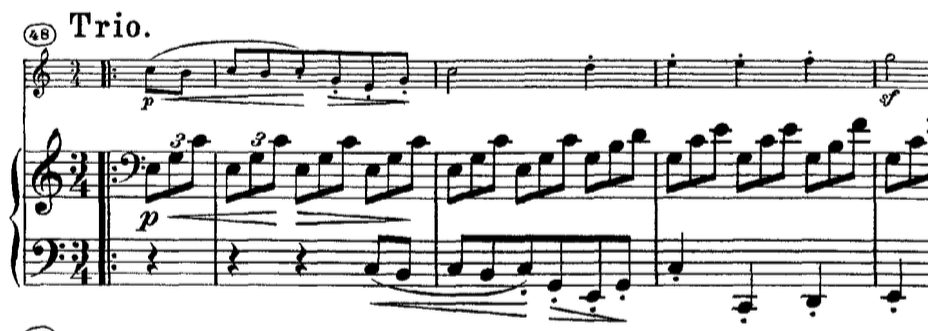
Here is an example I found recently: Mozart, Divertimento [Trio] for Violin, Viola, and Cello, K. 563 (1788), Menuet 2, Trio 2. No mistaking this for anything other than a Ländler, or we should say the very recognizable Ländler topic within a typical ABA small form in a multi-movement 
instrumental piece meant for private or salon performance


The fact that Mozart includes the upper-register close, with the ascending line based on the focal note F5 as a bonus, shows not only what we would expect of him, a comprehensive, curious, and immediate knowledge of all the music around him, but also the definite possibility that musicians playing in public places like restaurants and taverns occasionally used these cadence figures in performance. The instrumentation, btw, invokes what became known in Vienna as the "Linzer Geiger," a popular type with two violins and bass.

Here is a reduction of the A-section:
Note that Mozart maintains the one-chord-per-bar convention of the Ländler.
-----
My series Ascending Cadence Gestures: New Historical Survey includes the time span 1650-1780 in Part 3 and 1780-1860 in Part 4. Link to a post directing to Part 3 files: link. Link to a post directing to a Part 4 summary: link.

Wednesday, January 9, 2019

Grieg, Lyric Pieces, Op. 68, part 1

The ninth of Edvard Grieg's ten sets of highly accessible piano miniatures, the Lyric Pieces, was his Op. 68, written in 1898-99 and published in 1899. The second piece in Op. 68 is titled "Grandmother's Menuet." It is delicate and whimsical, presumably in the familiar mould of humorous "old people's" dances, the best known of that type being the "Großvater Tanz," a traditional tune familiar to everyone even nowadays through its quotation in the "Grandfather's Dance" in Act 1 of The Nutcracker.

The design is ABA'BA', where each version of A is 16 bars (8 + 8 where the second eight repeats the first an octave higher), B is 20 bars, A' is also 16 bars but the second eight form a stuttering repetition of the cadence (to be discussed below), and B, then A', are literally reprised.

The opening is striking -- and is referenced in undergraduate textbooks -- for its secondary dominant ninth chord (V9 or V), a "proper" harmony whose ninth resolves directly into the next chord. (On the dominant ninth chord and its several types, see my blog On the Dominant Ninth Chord.) Despite the positioning of ^3, as B4, over that secondary harmony, a traditional Schenkerian reading would assume a displacement, as if the B4 has been shifted over from its proper place above an implied I on the first beat. In that case, ^2 is first offered in the foreground in bar 2 but then implied in the middleground in bar 4, initiating a leading-tone third-line with G4 in bar 5 and F#4 in bar 7.

I prefer a more literal minded reading, as shown below. The stable note at the opening is ^1/^8, as G4, and we give that preference in the unfolding of G4-B4. The unfolding reverses itself in bar 5 in the sense that the lower note is now subordinate to the higher one, which is again G4. Although I have shown the ending as ^6-^7-^8, I would probably simplify the reading overall to ^8-^7-^8, or G4 in bar 1, F#4 in bar 7, and G4 in bar 8.


Section B, on the other hand, pounds away at B4 and sometimes B5 for all of its twenty bars. Since the texture is quite different from A, is entirely in octaves, as shown in the beginning, and it's clear that the underlying key is E minor, I don't hear this section as promoting B4 in the main section.


The altered reprise of A in its second phase repeats the cadential phrase but stops before the tonic (see the first one-bar grand pause). Single-bar repetitions occur an octave higher, then an octave lower before the tonic concludes. The overall effect, of course, is to give exaggerated attention to the rising cadence figure.


Friday, September 29, 2017

JMT series, part 10 (Beethoven, Op. 22, III)

I intended this originally as a response to an article by Jason Yust; the menuet movement from the Piano Sonata, Op. 22, is the author's main example: link. There is, however, little to be said from the standpoint of traditional Schenkerian analysis, as Yust's goal is to rationalize the orthodox form of the theory, and therefore the analysis of Op, 22, III, assumes a priori Schenker's analysis from Free Composition and seeks to formalize it. Broadly, his position is similar to Matthew Brown's rationalization of Schenkerian theory (2005). Brown rejects the ascending Urlinie with a bit of circular reasoning; Yust doesn't engage it at all. The closest he comes is a critical note on the waltz ninth in this menuet's Urlinie: "Neumeyer (1987) . . . considers G to be an ascending passing tone rather than an upper neighbor. According to his interpretation, the G and A at the end of m. 7 are successive notes in a single voice, even though they both are sustained as part of the dominant ninth harmony over all of mm. 5–7" (2015, n33). More on that at the end of this post.

Yust does mention my article on proto-backgrounds (2009). As I noted above, he belongs among the "rationalizers" of Schenkerian theory (and so do I--in Neumeyer 2009, at least); he summarizes the earlier history very well (in paragraphs 0.1.1 & 0.1.2, and introductory paragraphs to subsequent sections). Although I can hardly claim to have offered a formalized theory in Neumeyer 2009, I did focus on a generative model (that is, building out from the background through transformations), which Yust also favors. Here is a sample, his Example 15; I have removed its analysis of the bass to show only the reading of the treble parts. The specific aim of the work is to portray contrapuntal melody (2 or more part-writing "voices") in a single diagram or figure (which presumably can then be subject to computerized comparisons). Level 0 is the "chord of nature" and is indistinguishable from one of my proto-backgrounds. At Level 1 the passing tone C is represented as a digression from the interval; then a second voice appears--as a hierarchically subordinate voice it is shown below the primary voice. Level 2, so to speak, harmonizes the two voices, drawing them together into a single diagram. The only comparison I can possibly make is to say that, in my view, Level 0 could just as easily have had the fourth F5-Bb5 instead of the third Bb4-D5.


In the details of his analysis, Yust brings out motivic thirds, beginning with the pick-up gesture. In my view, the fourth is more prominent, tying together accented notes at the beginning, F4-Bb4, and then being repeated. Stretched to a fifth -- one can hear the stretching in Enat5 -- the fourth can still be heard as a shadow within the compressed thirds that follow and continue throughout the continuation phrase. This theme, incidentally, is in the antecedent + continuation design, which Caplin regards as a hybrid but which I have found to be fundamental to 18th century galant style and have re-named the "galant theme" (link).


A reading using proto-backgrounds is not kind to my JMT analysis of the theme as using the registral variant, ^5-^6-(reg.) ^7-^8, since the stable interval would strongly imply/imagine ^5 (as F5) at the end. See below.


Thinking of the proto-background more abstractly, the initial fourth could be recovered -- circled notes below -- but the registral variant of the Urlinie would be undercut by this version, as well.


I still do think that a registral variant (link) is not difficult to hear in this theme and in the reprise (below), but it is obviously not compatible with a reading based on proto-backgrounds, which are after all biased in favor of registral definition and stability.


Note on the note: "Neumeyer (1987) . . . considers G to be an ascending passing tone rather than an upper neighbor. According to his interpretation, the G and A at the end of m. 7 are successive notes in a single voice, even though they both are sustained as part of the dominant ninth harmony over all of mm. 5–7" (Yust 2015, n33). I have written about the "waltz ninth" many times by now--here's a (link) to a recent post in this JMT series. Yust's criticism is the same as the one I've just made with respect to proto-backgrounds and does tend to undermine the registral variant. The waltz ninth is another matter. Nineteenth-century practice is broader--more creative and expressive--than eighteenth-century proscriptions. At (a), the ninth as neighbor note; at (b), the directly resolving ninth, a cliché in the waltz repertoire by no later than 1830. Note that the essential Schenkerian melodic note, C, is nowhere to be seen (or heard) -- in four-part writing of ninth chords, one leaves out the fifth. At (c), the figure that applies to all three "extended" chords: keep the seventh below the newly added top note in ninth, eleventh, and thirteenth chords. At (d), the voiceleading for the rising line with waltz ninth, understood as at (e) splitting the ninth in two; the same at (f) in Schenkerian notation.


References:
Brown, Matthew. 2005. Explaining Tonality: Schenkerian Theory and Beyond. Rochester: University of Rochester Press.
Neumeyer, David. 2009. “Thematic Reading, Proto-Backgrounds, and Registral Transformations.” Music Theory Spectrum 31 (2): 284–324.
Yust, Jason. 2015. "Voice-Leading Transformation and Generative Theories of Tonal Structure." Music Theory Online 21/4: link

Monday, September 25, 2017

JMT series, part 6b-2 (note 31, the waltz ninth)

Beethoven, Symphony no. 1, Scherzo. As we saw in the earlier post, part 6a-1, the scherzo of the Second Symphony clearly draws on the "waltz ninth" device -- that is, positioning both ^6 and ^7 over the dominant. The Menuetto in the First Symphony is equally clear in its final cadence—see below—but the analysis of the background will not be as simple.


My comment in the note: "if the structural cadence is taken to be at the end and not in mm. 57-58." That was a somewhat risky statement, as the usual formal functions would certainly point to bars 57-58. In an essay on analysis and performance (that is, recordings), Carl Schachter predictably took me to task on that point: "The phrase that begins with m. 52 represents the Menuet’s structural cadence, closing into the final structural tonic in m. 58. The emphasis on ^1 starting in m. 58 is so unremitting that we must regard the closing measures as a coda; David Neumeyer's suggestion that the structural close might be at the very end, with an ascending Urlinie ^5-^6-^7-^8 is not very plausible, at least to my ear." On the face of it--thinking of it in terms of 18th century formal function clichés--he is right. Here is the reprise (in Singer's transcription) with annotations following Caplin. Everything is "textbook": the reprise offers a complete theme (a 14-bar sentence) with a PAC in the tonic at the end, after which a pedal point tonic runs along for several bars before giving way to accelerated V-I figures culminating in one last emphatic cadence. The two cadences are boxed.


Nevertheless, this menuet/scherzo strikes me as an early instance in which the rising gesture, common to codas in this period, begins to contest priority with the standard structural cadence that complies with the expected formal functions. As I have written elsewhere in this blog and in essays, this change was in part due to the historical shift away from partimento practices; that is to say, from the Italian models that had dominated European music for well over a century. The muddling of the formal functions themselves was the principal route for a changed role for rising gestures, including the rising line, as we saw in the scherzo of the Second Symphony. Beethoven doesn't rethink cadence and coda so fundamentally in the First Symphony—basically, I agree with Schachter's objection as based on routine formal functions—but I will argue for the final bars as the culmination of a developmental process that bypasses—skips over—the structural cadence.

I am, however, obliged to disagree almost entirely with Schachter's Schenkerian analysis, which is, to put it mildly, bizarre, with chromatic parallels in the first middleground, notes plucked out of the bass when they don't need to be, and an imagined ^3 and ^2 in the background descent.

Schachter describes his essay as a study in “how an awareness of large-scale connections can help one in working out appropriate strategies for pacing, accentuation, and other rhythmic details of performance. I shall be concentrating on a few small details, but they are details whose shaping depends upon a conception of the work as a whole, for these details—far from having a simple location in their immediate environments—reverberate throughout the entire piece. . . . These intimations of the whole suggest to me ways of playing that one might not adopt if the detail were of purely local significance” (48).

He looks at three pieces on these terms, the last of them being the scherzo in the First Symphony. A “Menuetto” in name only, this movement is in a tempo fast enough to push it well out of the realm of dance music—the topical basis of the third movement in 18th century symphonies, including Mozart’s and (most of) Haydn’s—toward autonomous instrumental music. Or, better said, toward a different and largely new topical association. Had he followed 18th century conventions, Beethoven would have notated the movement in 6/8 time, as a gigue.

Beethoven, Symphony no. 1, III, opening (reduction):


Notation of the opening melody as a gigue:

As we know now, in the 18th century notation itself had strong topical associations (Allanbrook 1983; cited in Mirka 2014). Listening to the examples above, it is obvious that the "Menuetto" is no jig either, practical or stylized: it is frenetic, quixotic, sometimes dramatic, and sharply profiled in dynamics, register, and treatment of instruments. In other words, the topic is new, perhaps born out of the late symphonies of Haydn or perhaps an intensified (but also warped), stylized version of the German dance (Deutscher), the faster and usually louder alter ego of the Ländler.

We will pass through the early history of "scherzo" quickly. It apparently originated about 1600 as a verse form and therefore was linked to vocal music. When the term moved over into instrumental music later in the century and in the early 18th century, it almost always designated a movement in a multi-movement set, in duple meter (most often 2/4) and without trio. It may well have been an alternative title to the ambiguous "aria." Haydn in his string quartets, opus 33, used the term deliberately to designate movements that take the place of the menuet in a sonata cycle, and Beethoven eventually followed suit. According to Hugh McDonald, "it was Beethoven who established the scherzo as a regular alternative to the minuet and as a classic movement-type. From his earliest works the scherzo appears . . . in place of the minuet, and he took the term literally by giving the movement a light and often humorous tone." Of the pieces immediately preceding the First Symphony, which is Opus 26, four (opuses 20, 23-25) contain scherzi. Here are incipits:

From the Septet, op. 20, in Carl Czerny's reduction. As in opus 26, instrumentation, register, dynamics, and meter/accent are all in play.
 From the Violin Sonata, op. 23. "Scherzoso" here is obviously a qualifier for "Andante," not a topic on its own.

From the Violin Sonata, op. 24:


From the Serenade, op. 25 in a later reduction:


And here are incipits from pieces following the First Symphony:

From the Piano Sonata, op. 28:


From the String Quintet, op. 29 in a later reduction:


From the Violin Sonata, op. 30n2:


Not surprisingly, the issue at hand for Schachter with respect to performance is hypermeter; like Beethoven’s later scherzi, the First Symphony's "Menuetto" is written in 3/4 meter but without question each bar is like a beat. Schachter focuses on the problem of the proper downbeat for the hypermeter: is it in bar 1 or bar 2? I have rewritten the opening melody in 6/4 meter to try to capture these two versions:


To Schachter, "b" is the proper meter, and "a" is a "shadow meter," maintained sufficiently that it *could* become the primary meter by means of later developments in the movement. The drama of the piece is the conflict between these two and its late resolution (in the reprise). Engaging though the account is on its own terms, it founders on two points: (a) as I said earlier, a bizarre, in my view radically un-Schenkerian reading of tonal structure; (b) in Schachter's final recommendation, small fruit from all the detailed analysis: he suggests making the accents of bars 3 & 4 roughly equal, the larger gestures of the reprise then bringing the metric conflict to resolution. Those larger gestures were going to happen anyway, the aural legacy of subtle differences in the opening measures being negligible.

The figure of the rising fourth motive, on the other hand, will remain memorable throughout.

I'll discuss point (a) in tomorrow's post.

References:
Allanbrook, Wye. 1983. Rhythmic Gesture in Mozart. University of Chicago Press.
McDonald, Hugh, and Tilden A. Russell. "Scherzo." Oxford Music Online.
Mirka, Danuta. 2014. "Topics and Meter." In The Oxford Handbook of Topic Theory, 357-380.
Schachter, Carl. 2000. “Playing What the Composer Didn’t Write: Analysis and Rhythmic Aspects of Performance.” In Essays in Honor of Jacob Lateiner, edited by Bruce Brubaker and Jane Gottlieb, 47-68. Pendragon.

Thursday, September 14, 2017

JMT series, part 4a-1 postscript

Work for yesterday's post about the Scherzo in Beethoven's Second Symphony involved examining the orchestral parts. I found that the upper winds "overshot" ^8 in the final cadence, complicating my reading of a simple rising line (those "extra" notes had been deleted from the piano reduction I relied on during research for the 1987 JMT article).

Having found that, I decided to re-examine some of my analyses of Haydn symphony third movements. Symphony 100 produced some interesting results. Here is the original post: link.

In the original post I noted that the inverted arch shape of the opening melody worked against a rising line, but the orchestration in fact plays on a low-then-high registral pairing throughout that supports the rising line at a higher level.

In the A-section, the flute and the first violins begin in the same octave -- circled below -- but in the re-orchestrated repeat (bars 9-16), the flute plays an octave higher -- circled notes in bars 9-10; see also bars 14-16 in the second system below.


The upper winds rejoin the first violins in the B-section -- boxed notes in bars 17 ff above. This holds till the stop on V in bar 28 -- see boxed notes below.  After that an interesting wedge figure brings out the registral differences as the flute moves chromatically down from D6, then returns to it -- circled notes and line --  while the first violins (and first oboe) rise from D5 before likewise returning to where they started.


The reprise is 8 bars rather than 16 and it combines the orchestrations of the two versions from the A-section: brass and timpani play as in bars 1-8 while the strings and winds play as in bars 9-16, except for the addition of the persistent rising figure (boxed) that motivically connects the ends of the first and second phrases and brings particular clarity to the flute's upper-register scale in the structural cadence.


Thursday, September 7, 2017

Mozart, Divertimento, K188

Mozart's Divertimento in C major, K188/240b, was composed in Salzburg in 1773. As was the case in K186, the instrumentation is unusual: 2 flutes, 5 trumpets, and timpani. See incipits for each of the six movements below. Here are Neal Zaslaw's characterizations of the several movements: "The divertimento’s opening Andante is a stately intrada, the following Allegro a kind of diminutive sonata movement. The third and fifth movements, old-fashioned minuets without trios, frame an Andante in which Alberti-bass figurations from the flutes give the effect of an enlarged hurdy-gurdy, with a giant organ-grinder turning the crank. A brilliantly orchestrated gavotte serves as the brief Finale" (Zaslaw 1990, 240). The two menuets are of interest to us here.


The final four bars of the first strain (continuation in an antecedent + continuation theme) produce a cadence in the dominant key, with a "plain as day" ascending line in the first flute, reinforced at the end by the first trumpet. The entire construction is transposed to the tonic key to end the second strain. See circled notes in both cases.


In the second menuet, another antecedent + continuation theme begins, with another rising line, this time even more vigorously pursued by the first trumpet than by the first flute. The entirety of the theme is repeated in reprise to close the second strain. Because ^8 and its registral environment are prominent, I regard this as a "mirror Urlinie": ^8-^7-^5/^5-^6-^7-^8.

Reference: Neal Zaslaw and William Cowdery, eds. 1990. The Compleat Mozart: A Guide to the Musical Works of Wolfgang Amadeus Mozart. New York: W. W. Norton.

Wednesday, September 6, 2017

Mozart, Divertimento, K186

The divertimento for ten wind instruments, K 186/159b, was composed in Milan in 1773. It is unusual for its two clarinets (Mozart had previously employed them in K113 and also includes them in the companion to K186, K166) and for its English horns. Below are incipits for each of the five movements. The first is a small-scale binary form -- the Italianate sonata-overture in miniature. The menuet and central andante aria are typical of serenades and divertimenti, but the fourth movement is a slow pastorale, not a second menuet. The finale is again typical: a 2/4 contredanse that shows its kinship with the gavotte in its square phrasing that always starts midway through the bar. The movements of interest for their ascending cadence gestures are the first and the last.


In the opening 12-bar theme -- a sentence nominally but hardly conforming to anything like the stereotype -- the emphasis on the upper register is strong throughout: see circled notes. At the end, the clarinets and oboes separate, the clarinets again holding to the upper register, but all confirm the cadence with a resounding ^7-^6-^7-^8 -- see circled notes in the fourth system.


The contredanse finale is so strict in its design that it could easily be danceable (indeed, its 124 bars, or 140 with repeats in the first presentation of the theme, are about the right minimal length for a dance). In the small-binary form theme (8 + 8), the oboes bring the melody down in both strains, but -- as they did in the first movement -- the clarinets insist on the upper register. They do so in the most direct possible way in the first strain.

The design of the whole is ABACA-coda1-A-coda2. In every case, the theme (A) is repeated without change. Section B is 20 bars (taking into account the half bar), C is 16, the codas are 8 bars each.


Tuesday, June 27, 2017

JMT series, part 4b (simple rising lines)

Continuing with pieces listed in note 28 of my 1987 JMT article, we reach J. S. Bach, cantata No. 11, "Lobet Gott in seinen Reichen!", the soprano aria “Jesu, deine Gnadenblicke." For this piece I neglected to provide the qualifying comment that I gave for a Handel aria to be discussed in a later post; namely, that the rising line occurs in the instrumental parts, not in the voice, and thus—although interesting, to be sure—it is not part of the background. If this were 1990, I might be worried about the loss of an example of an ascending Urlinie, but since the number has burgeoned in the intervening years to well over 1500, it is now longer a matter of concern.

Cantata 11 is for the Feast of the Ascension, which fact probably sparked my interest in the first place, before I realized that the power of stylistic clichés in the 18th century would overwhelm text-painting/motivic analogues.

The text of the cantata follows the narrative of the Ascension. After a grand opening chorus of praise (complete with trumpets and drums), a bass recitative and alto aria implore Jesus not to leave his disciples. (The alto aria is unusually long.) A brief tenor recitative announces that He has ascended into Heaven, and a chorale verse follows, its opening line perhaps a bit too obvious—"Nun lieget alles unter dir"; literally "Now everything lies under you"—but the argument of the verse is actually "Everything is now subject to You," as the title of the chorale it derives from already makes clear: "Du Lebensfürst, Herr Jesu Christ" (You Prince of Life, Lord Jesus Christ). Further recitatives recount the explanation of the two angels who appear to the disciples and the latter's response. Then, as the tenth (and penultimate) number—another exuberant chorus closes the cantata as its n11—is the alto aria “Jesu, deine Gnadenblicke."

In the appendix of their book Dance and the Music of J.S. Bach (1991), Meredith Little and Natalie Jenne label “Jesu, deine Gnadenblicke" a menuet, based on their extensive (and I will say quite convincing) research into dance topics. In early 18th century music and dance culture, the menuet combined qualities of the pastoral, elegance, and confirmation, and is therefore a perfect fit for this aria, in which the individual is reconciled to the Ascension, especially clear in the third line "Deine Liebe bleibt zurücke" (Your love remains behind).

The design is a da capo aria, laid out as follows (it fits the standard formula: two segments in A, each using the same two lines of text and surrounded by ritornellos; mode change for B with the remaining text, no ritornellos; and of course A da capo):

A
Ritornello
Jesu, deine Gnadenblicke
Kann ich doch beständig sehn.         (close in the dominant)
Ritornello
Jesu, deine Gnadenblicke
Kann ich doch beständig sehn.         (close in the topic)
Ritornello
B                                      (opens in E minor, internal cadence in A minor, close in B minor)
Deine Liebe bleibt zurücke,
Daß ich mich hier in der Zeit
An der künft'gen Herrlichkeit
Schon voraus im Geist erquicke,
Wenn wir einst dort vor dir stehn.
A da capo

From the outset (and throughout, even under the voice part), the counterpoint in the instrumental parts is complex--far more so than the typical menuet of chamber or larger ensemble music.


The voice in the first section of A establishes a tonal space of B4-D5-G5 -- boxed below -- and lines move about within this space, but focused on the lower third. In this context, G5 is a cover tone and the principal space is B4-D5.


The second section in A is considerably more complex, and patterns of lines would be more abstract, but the clue to a principal space B4-D5 is in "kann ich doch" or just the word "doch." It may seem odd to give special attention to this word, as Bach certainly does, but it is the expressive key to the text. "Despite" (that's the sense of "doch" here) the Ascension and subsequent lack of His physical presence, I (the singer, the believer) can still continually see (beständig seh'n) Him in a vision of Grace (Gnadenblikke).


The closing ritornello continues the complicated counterpoint, which closes three times on the tonic: bar 6 of the example below, bar 10, and finally bar 17. The phrases are then six bars (1-6), four (7-10), four (10-13), and four (14-17). Of course, the overlapping at bar 10 would not happen in a menuet actually meant for dancing -- but, still, Bach holds to the underlying dance model surprisingly well. The first and last cadences ascend to ^8, the second, and weakest of the three, descends from ^3 (B5).


Thursday, February 2, 2017

Three oddities, part 2

Paul Dukas's impressive Variations, interlude et final sur un thème de Rameau was published in 1907. The theme is the second last number in Rameau's Pièces de clavecin, a menuet titled "Le Lardon." A simple rising line in the first strain and a slightly more complicated one in the second strain are both clear enough, though the focal tone is less so: at (a) the repeated ^5 is crossed at (b) by the left hand's ^8 (D5). This happens again in the consequent phrase. Thus, at (c) one could easily hear--in fact, I do hear--the rising line moving within a ^5-^8 frame. At (d), the contrasting middle phrase overtops D5 with F#5, but that fits into the common "one-too-many" figure and doesn't materially affect the balance in the somewhat altered reprise.


From this simple menuet emerges an abundance of character and figural variations, some of which are free ("fantasy variations") while others hold more closely to the theme. The very first variation abruptly changes the texture to one that is dense with chromatic elaborations. In the midst of this one can just catch snatches of the tune (arrow).


The ascending cadence of the theme's first strain is preserved—

 —but the figuration obscures the ending of the variation considerably (see the arrow pointing to A4 in the example below). I find it easier to hear a descent from E5 to D5: E5 is the chord tone in the first set of circled notes and connects to itself above the final tonic chord (second circled notes) and settles to D5 (third circled notes).

In contrast, variation 4 places the figuration in the left hand and preserves the melody quite clearly in the right. The first circled notes show the scalar descent from bars 3-4 of the theme, the second set the cadence of the first strain. Note that the opening of the second strain has been placed in the lower voice (bar 9, circled); the upper register is regained for the reprise and once again the ascent is largely cleared of elaboration.