Showing posts with label Grieg. Show all posts

Wednesday, January 9, 2019

Grieg, Larvikspolka, EG 101 (1858)

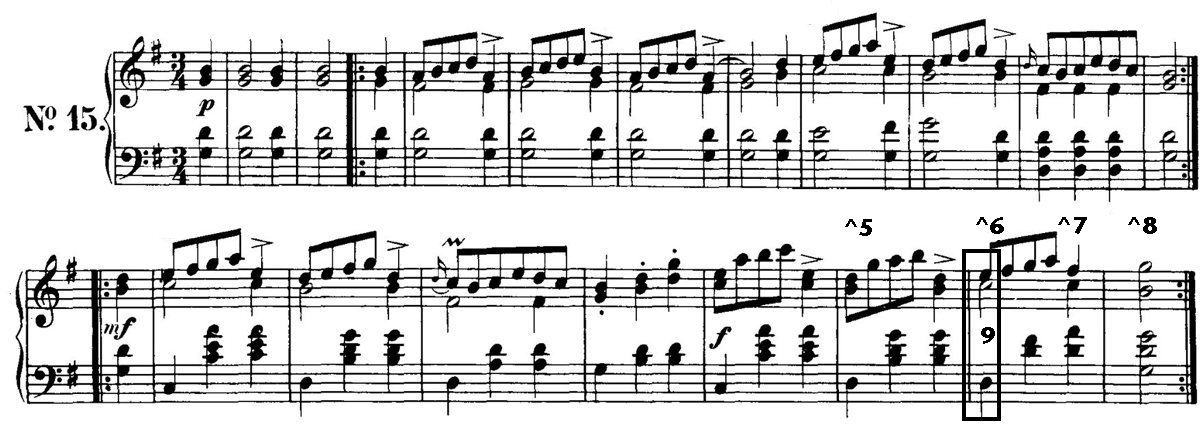
Presumably a collected piece of social dance music. Larvik is a city in southern Norway. The design of this polka is the very common ABACA of social dance music, beginning with contredanses in the late 1700s and then spreading to almost all other types. The ABACA can be almost indistinguishable from a small ternary form (ABA) with trio (C) and truncated reprise (A), though the "trio" is only one strain, not the two we usually find in the familiar Classical instrumental repertoire of sonatas, etc. The equally common case used here has A as a single principal strain, B a first "trio" in the subdominant key, and C a second trio in the relative minor. (In the contredanse repertoire C is almost always in the parallel or relative minor, which fact might suggest that Larvikspolka is a traditional tune, not a newly composed one from the 1850s). The modern notation is by "Sigerland" and is available on IMSLP: link.


I hear a primitive rising line in A:


In the first iteration of A, however, an inner voice is pushed above (F4 to F5) and the unfolded B4-F5 closes into C5-E5--see below. We can then trace the voices in the two trios. The C5-E5 interval remains stable in the first trio B, except that E5 moves up to F5. In the second trio C, G4 becomes A4/A5 and C5 remains stable.

A synoptic view, then, is as follows:


Note: I have "collapsed" two aspects into one, as the line ^5-^7-^8 is easily understood based on the proto-background ^5-^8.

Grieg, Lyric Pieces, Op. 68, part 2

The somewhat strange Valse mélancholique is no. 6, the last number, in Grieg's Op. 68. Sounding like a merger of Chopin's well-known melancholy waltz in A minor and the most repetitious of Tchaikovsky's ballet waltzes, the Valse mélancholique is also insistently dissonant, breaks up its harmonic progression oddly on more than one occasion, and includes a decidedly un-melancholic explosion in its structural cadence.

A rising line is a central figure in the opening. A four-introduction is followed by a thirty-two bar period that forms the waltz's first strain. The 16-bar antecedent phase, bars 5-20, brings a line very gradually up from D5 (doubled with D4) but it is broken after the F5 in bar 19 by a surprise harmonic break to a Neapolitan (G minor: an Ab6 chord) in bar 20, after which the consequent phase begins and plods along, becoming more and more insistent and finally pounding out the concluding notes of the rising line.


I hear the more active "alto" as thoroughly meshed with the octaves just discussed above, but it is entirely legitimate to hear the internal voice more or less independently. I have traced it in red below, an extra strand emerging after bar 28 being in green. Regardless of how it begins, however, the dramatic rising trajectory of the octaves takes over in the final bars.


The coda follows directly on the repetition of the fortissimo cadences in the reprise and takes a classic coda form with "reminiscences" over a tonic pedal point. Note that the octaves, having fulfilled their role, are gone, and we hear the alto's tune, still in the middle of the texture.


Grieg, Lyric Pieces, Op. 68, part 1

The ninth of Edvard Grieg's ten sets of highly accessible piano miniatures, the Lyric Pieces, was his Op. 68, written in 1898-99 and published in 1899. The second piece in Op. 68 is titled "Grandmother's Menuet." It is delicate and whimsical, presumably in the familiar mould of humorous "old people's" dances, the best known of that type being the "Großvater Tanz," a traditional tune familiar to everyone even nowadays through its quotation in the "Grandfather's Dance" in Act 1 of The Nutcracker.

The design is ABA'BA', where each version of A is 16 bars (8 + 8 where the second eight repeats the first an octave higher), B is 20 bars, A' is also 16 bars but the second eight form a stuttering repetition of the cadence (to be discussed below), and B, then A', are literally reprised.

The opening is striking -- and is referenced in undergraduate textbooks -- for its secondary dominant ninth chord (V9 or V), a "proper" harmony whose ninth resolves directly into the next chord. (On the dominant ninth chord and its several types, see my blog On the Dominant Ninth Chord.) Despite the positioning of ^3, as B4, over that secondary harmony, a traditional Schenkerian reading would assume a displacement, as if the B4 has been shifted over from its proper place above an implied I on the first beat. In that case, ^2 is first offered in the foreground in bar 2 but then implied in the middleground in bar 4, initiating a leading-tone third-line with G4 in bar 5 and F#4 in bar 7.

I prefer a more literal minded reading, as shown below. The stable note at the opening is ^1/^8, as G4, and we give that preference in the unfolding of G4-B4. The unfolding reverses itself in bar 5 in the sense that the lower note is now subordinate to the higher one, which is again G4. Although I have shown the ending as ^6-^7-^8, I would probably simplify the reading overall to ^8-^7-^8, or G4 in bar 1, F#4 in bar 7, and G4 in bar 8.


Section B, on the other hand, pounds away at B4 and sometimes B5 for all of its twenty bars. Since the texture is quite different from A, is entirely in octaves, as shown in the beginning, and it's clear that the underlying key is E minor, I don't hear this section as promoting B4 in the main section.


The altered reprise of A in its second phase repeats the cadential phrase but stops before the tonic (see the first one-bar grand pause). Single-bar repetitions occur an octave higher, then an octave lower before the tonic concludes. The overall effect, of course, is to give exaggerated attention to the rising cadence figure.


Wednesday, October 17, 2018

Post no. 300

It is four years to the day that I started this blog (introductory post), and this post is the 300th in the series. The blog has provided material for over twenty essays published on the Texas ScholarWorks platform (link to my author page).

The focus has been quite narrow throughout: ascending cadence gestures in traditional European tonal music. Though my work on these figures has its roots in Schenkerian analysis—an article I published thirty-one years ago ("The Ascending Urlinie," in Journal of Music Theory)—I use those particular constructions only some of the time, because of problems with the figure of the focal tone (Kopfton), which I see as defined too narrowly to be generally useful. I opt more often (1) for the model of proto-backgrounds (link; see also Neumeyer 2009), (2) for style historical methods in connection with the dominant ninth chord and what I call the “waltz ninth,” (3) for similar methods and speculative modes for improvisatory practices, especially in the later 18th and early 19th centuries, and (4) for historical narratives of music for social dance, of music for the stage through the nineteenth century, and of composition in general in the later decades of that century, both narratives continuing to be relevant in the first half of the 20th century, as well.


The great majority of the traditional tonal music preserved in scores and manuscript makes use of form-defining cadences in which the principal melody line descends the scale to end on the tonic note. A significant minority, however, follow an upward path to end on scale degree eight (^8), a “circling” path around ^8, or a “mirror” path down from ^8 to ^5 and returning. An early surprise in my work was to find a considerably larger than average percentage of rising lines in the country dances preserved in John Playford's Dancing Master (first edition 1651; link to essay), which fact suggested to me that the figures were relatively common in dance-performance practice, including improvisation. It must be remembered that music for social dance was predominantly music for the violin (secondarily, flute) and that the instrument’s fifths mapping made it as easy to rise from the middle of the scale to ^8 as it did to descend to ^1. 

I later found considerable corroborating evidence in Scottish and Irish dances and dance-songs, these coming largely from the later 18th century (linklinklink), and in the Germanophone Laendler, one of the waltz ancestors and especially closely associated with the violin, later in the 18th century with an ensemble of two violins and bass.

In the example below, the four open strings are depicted at the left in (a) and (b). From the open A-string, one moves with the greatest ease down the D-major scale, as in (a), or up the D-major scale, as in (b). In counterpoint, supposing for example, one violin improvises a descant to the other, the work is almost as easy, one of the simplest versions shown in (c). Another version with a bit more melodic complexity is shown in (d). Register play, in other words, offered a simple device to "do something different," specifically to do something different for an ending/articulation that didn’t run afoul of the traditional cadenza, where ^2 goes down to ^1 while ^7 goes up to ^8, making intervals of the major sixth and the octave (or minor third and unison). Not coincidentally, the alternative higher-register cadence offered a sound that was "bright" or "brilliant."


Additional corroboration of early practices came from 17th-century Germany and Austria; these included repertoires across the entire spectrum of genres, excluding only sacred choral music: link to essay.

The history and practice of rising cadence gestures quickly became more complicated in the early 19th century. Broadly, though, cadences can be heard as prominent expressive gestures and a turn toward less common cadences fits nicely with our familiar nostrums about Romantic rebellion against eighteenth-century conventions—and it aligns well with music theorists' recent revelations about a kind of shadow tonality of hexatonic relations that arise from the exploitation of chromatic mediants, early on especially by Schubert, whose Laendler and Deutscher ("German dance," the other ancestor of the waltz) made significant use of rising figures. This is music, incidentally, we know passed back and forth between music for dance and music for performance, not only in Schubert’s case but in the pragmatic circumstances of music publishing and (especially) domestic use. 

Strangely, perhaps, I have found so far that straightforward expressive motivations for rising gestures—exhilaration, release, etc.—seem to have been far less prevalent than generic, topical, or formal-design considerations. The few coincidences of text and cadence, predictably, were found in the 19th century, after the clichéd cadence figures derived from earlier Italian practice had been largely abandoned (or, at least, their authority undermined). Examples: Grieg, Morgenstimmung (the analogy of musical ascent and the rising sun; link); Schubert, "Die Nonne" (the religious-utopian; link); Strauss, jr., Die Fledermaus n2 (increasing energy, demand, insistence: "Hinaus!”; link); Wolf, "Trunken müssen wir alle sein!” (as in Strauss; link).

As I have already noted, the rising cadence gesture was part of the toolkit of the waltz, and from there it went directly to the polka by no later than 1840. When an aria or other song used a waltz topic, the gesture went along with it. The floodgates were opened in French comic opera by no later than 1834 (see my essay on Adolphe Adam's Le Châlet: link), and rising cadences remained a factor in the opera bouffe and operettas of Offenbach, Lecocq, and others before finding a niche in the American operetta (Herbert) and the musical (notably those by Richard Rodgers).

The formal figure of the rising gesture in the coda of an aria or instrumental movement became firmly established in the last quarter of the 18th century. In some pieces, though, the boundary line between the "structural cadence" and coda figures became blurry—a process already underway earlier in the ensemble finales of Galuppi, with their many repetitions of cadential phrases, a dramatic device adopted by many composers, notably Mozart and Rossini. The process accelerated in the 19th century, more vigorously and consequentially in music for the stage than in instrumental concert music.

An important outlier in all this is Beethoven, for whom transcendence, as a philosophical-religious category, could mean striving to move not just to the top of the voice leading, but outside or beyond it. For my only comments on this to date, see my post on Op119n7: link. My plan is to do more with this eventually, engaging work by David Lewin, Robert Fink, and, more recently, Malcolm Miller.

Saturday, September 9, 2017

JMT series, part 6a (note 31, the waltz ninth)

Note 31 concerns the “waltz ninth,” certainly a familiar device to any reader of this blog or my Hearing Schubert D779n13 blog (link). I will discuss the following four compositions here, then in subsequent posts the scherzos from the first two Beethoven symphonies and the famous barcarolle in Offenbach's Tales of Hoffmann.
Debussy, Deux Arabesques, no. 2
Grieg, “An den Frühling,” op. 43, no. 6
Lalo, “Chanson de l’Alouette”
Duparc, “Phidylé” 
For reference, a simple example of the waltz ninth device: Schubert, Wiener-Damen Ländler, D734n15. The essential features are that the ninth is over the dominant and moves upward to the leading tone, not down to ^5. The freeing of the ninth from a downward "resolution" -- like the freeing of the seventh from any resolution and the stable addition of the sixth to a triad -- is a distinctive and pervasive feature of nineteenth-century music.


Debussy, Deux Arabesques, no. 2. No comment in the note. Here is the first theme period (after a short introduction) -- it's 10 bars, presented as 4 + 6. One might call it a presentation + consequent "hybrid" rather than a period if you decide that bars 3-4 are variants of the basic idea, not contrasting. Hard to say, really. Same with the focal tone, if any, in the right hand--could be either ^5 or ^3. I am inclined, therefore, to hear them both (I write at some length about complex upper voices here: link). Note the internal (?) rising cadence gesture in the final bar of the example (and close of the A-section).


Here is the approach to the structural cadence. Under normal circumstances, I would take the boxed bars as the structural cadence, but in a common nineteenth-century gambit Debussy undermines it by hollowing out the melody and forcing a long diminuendo. All this would still have been good enough but he then gives us a resounding traditional cadence later, with a steady crescendo this time, a stretched out IV-V-I -- see circled notes -- and enriched texture.

The waltz ninth figure in shown in the small box: there is a chord on the beat with ^6 but the whole thing obviously lies within an extended dominant.


Grieg, “An den Frühling,” op. 43, no. 6. No comment in the note.  For many years a favorite intermediate recital piece, "To Spring" is, I would imagine, no longer so well known. The theme, which is also the A-section, is a sentence where the bar numbers have been doubled -- that is, the basic idea is in bars 3-6, the varied repeat of the basic idea in 7-10, etc. (Caplin has an expression for this but I've never found it very congenial and so rarely can remember what it is.) The circled F#: ^5 at the beginning drops to ^3 in the continuation phrase. In the cadence, boxed, the line (now from ^2) rises to ^5.


In the final statement of the theme, Grieg sounds this cadence again, but now in the tonic key. The result is a a simple rising line with the waltz ninth: note that ^6 is over the cadential V. The deceptive close with ^8 is ironed out with a pleasantly rising chromatic figure in the coda, with the I arriving at the very end -- another example of the confusion of section and coda that is so common throughout the nineteenth century, but more and more so as the decades move on.


Lalo, “Chanson de l’Alouette.” My comment in the note: "ascent occurs in the piano." The piano's introduction puts strong emphasis on ^5 and ^6 -- at (a). The voice at first, however, is concerned only with ^5 -- at (b) -- and a stepwise descent in the upper octave -- at (c1) and (c2), where the piano picks up its initial figure again -- at (d).

 The close of the first verse follows up on the differing patterns of the voice and the accompaniment. Initially the voice rises to C5 -- at (e) -- then meets the piano's right-hand line by leaping up to G5. In the cadence the voice moves very firmly indeed from ^2 to ^1 -- at (f) -- while the piano as firmly rises from ^5 to ^8.

 The overall design, then:
Intro: 1-7
verse 1 = 8-29; piano continues through 36
-- C major clearly defined throughout, diatonic except for an excursion into A minor in the third of the poem’s four lines. Deceptive close gives C+ instead of C.

verse 2 = 37-54
-- begins in Ab major; abrupt turn to A minor in the third of of the poem’s four lines, with equally abrupt “cadence” C: vi-I.

verse 3 = 55-71; piano continues in 72-73
-- as in verse 2, but in the poem’s third line the turn toward A minor (a: V) is diverted to a firm close in Ab.

verse 4 = pickup to 74-96
--  Piano in 72-73 has an odd chord, as if B7 against an Ab pedal, but this clears out shortly to E major. Could have been a strong close in E major but stalls on B7 instead. B7 --> G7.

verse 5 = 97-122
-- strong C: V7 to start and quick return to C for reprise of the verse 1 melody; we hear it all -- see below; circled notes from the first page shown again -- but in bar 118 *neither* voice nor piano has the closing ^1, though both are assiduously prepared. Instead, both voices shoot up (the nightingale of course. . . ), the singer to ^5 (G5), the pianist to ^3 (E7).


Duparc, “Phidylé.”  My comment in the note: "In the piano, but quite clear." As the circled notes show, the voice participates in the rising figures for a while, but it is primarily the piano that works it out, reaching from B4 (the first circled note in the piano part) through Ab6 at the cadential arrival (very end of the example). At that same moment,  the voice moves as plainly as could be down from ^3.