Thursday, August 30, 2018

Cécile Chaminade songs, Part 1

"L'Idéal" was written by the Parnassian poet Sully Prudhomme. Chaminade follows the poem's design in the musical form A1 A2 ( = transposition, varied) B1 B2 A1 A2'. Her mode of expression is both dramatic and emphatic.

In the opening, a chromatic line rises to G4, then moves beyond it to G#4 (over an augmented triad) and A4 as the voice takes up its stolid recitation over ^8 (C4 if tenor, C5 if soprano), ending its phrase on ^9/^2 (D, circled).

The voice in the second phrase transposes its first phrase up a step, changing the ending to close firmly indeed with a ^3-^-2-^1 in C major, while—in an even more determined way (note the marcato accents)—the piano ascends to ^8. Overall then, a wedge figure is created.

In the reprise of the A section, the chromatic keyboard line flows directly out of the PAC that closes B2—see the circled notes below.


In the final phrase A2', both voice and piano reach fortissimo, and the piano overtops the voice (whether soprano or tenor), demanding equal attention to its rising line.


Thursday, August 23, 2018

Chaminade, Passacaille, op. 130

Chaminade's Passacaille, op. 130, was published in 1909, shortly after her successful tour to the United States, where the highlight was a performance of her own Concertstück with the Philadelphia Orchestra. The Passacaille belongs to a genre of Baroque keyboard nostalgia, to which composers in several countries contributed but which was especially favored in France. Chaminade's Menuet Galant, op. 129, was published at the same time.

By the title, the composer refers loosely to French Baroque keyboard styles, not to the ground-bass variation form. Her op. 130 is in triple meter, as was traditional for the passacaille, and in rondeau form with theme and couplets, though she treats this design loosely, the overall effect being of a ternary form. The first 48 bars are repeated in toto to close the piece.

The opening 16 bars give strong priority to a proto-background ^3/^5, as the unfolded intervals show. Note especially the line from within reaching up to B5 in bars 15-16.


Bars 17-32 are a contrasting B-section, 33-40 a retransition that points toward ^3, which duly arrives in bar 41. The abbreviated reprise then traces a simple rising line twice and does it emphatically into the cadence.


Tuesday, August 21, 2018

Offenbach, Pomme d'api (1873), no. 7 Romance

If I had been working through La Pomme d'api in topical rather than chronological fashion, I would have started with no. 7, Gustave's strophic romance "Consultez votre coeur," the only number in the operetta that positions a simple rising line in the structural cadence (without the complications of coda expressions). (For a number list and synopsis of the operetta, see the introduction: link.)

There are two strophes, where a partial line descends in the first, and a simple rising line with ^7 emphasized dramatically (with fermata) closes the second.

At (a), the proto-background frame ^8/^5, as F5-C5 (written). At (b), the frame expands outward with G5 as neighbor; at (c) a firm descent in the cadence, but a wedge is also formed with movement from below A4-A#4-B-nat4-C5. At (d), a reprise of (a) for the consequent, and at (e), the frame is flipped to permit a cadence to F4.


In the consequent phrase of the reprise, note the progress toward the cadence. Overall, the effect is that of the "mirror Urlinie," with descent from ^8 and subsequent return.


Saturday, August 18, 2018

Offenbach, Pomme d'api (1873), no. 6 Rondeau

Number 6 is in three sections, after a short opening call "A table! A table!"  I wrote about the chanson "Versez, versez" in an earlier post: link. After a brief scena/recitative comes the rondeau "J’en prendrai un, deux, trois," which is the subject of today's post.

The design is vaguely that of a rondeau in the usual sense (that is, recurring theme with intervening contrasting sections). The A section consists of a 16-bar theme (bars 3-19), which has no cadence, after which another 16-bar theme is heard (bars 20-35); this one—we'll call it B—closes with a PAC in the dominant. A third, contrasting section C (bars 36-57) moves immediately to bVI of the dominant, introduces new melodic material (though the text continues in its catalogue fashion) and before very long reaches V (as dominant), where it stays for some time. When A returns (bars 57-72), the theme now closes firmly in the tonic and is followed by a lengthy coda (bars 72-92). After this, B and C are repeated in toto (bars 93-108 and 109-130, respectively), and so is the reprise of A and its coda (bars 130-161).

Here, voice part only, are A (theme1) and B (theme 2).

Here is the reprise of A. Note that the theme has a new second half, and that ends with a very straightforward descent in the cadence.

And here is the extended coda that immediately follows. The ascending octave in the cadence is very similar to the ending of no. 4.


t

Note: In no.8, the finale of the operetta, the opening 72 bars of the rondeau are repeated, or ABCA'-coda.

Thursday, August 16, 2018

Offenbach, Pomme d'api (1873), no. 5

No. 5 is an extended duo for Catherine and Gustave. It is in five parts:  (1) "C'est un Dimanche" is a  pastorale; (2) "A deux pas du chien savant" is a scena, with an interpolated reprise of the pastorale's opening theme in the middle; (3) "Et je vois l'un près de l'autre" is a solo for Catherine;  (4) "De grace écoule-moi ma bonne!" is another scena; and (5) "Pomme d'Api" is a duo, Allegretto with a presto coda.

Parts 3 & 5 are of interest here.

"Et je vois l'un près de l'autre" balances rising and falling linear figures in such a way that one hears a complex upper-voice design. Note that the theme's period, below, ends with a strongly implied ^3 over the directly expressed ^1.

In the consequent of the final reprise, more emphasis is given to the internal rising line in the cadence and to the original focal tone D5.


In section 5, "Pomme d'Api," a strong rising motive dominates the theme—see the circled notes below. The figure of the cadence bars is almost identical to that in "Et je vois l'un près de l'autre."


As in no. 3, the final consequent phrase is expanded, but not through the same method. This time the consequent is expanded through a deceptive resolution (fourth bar below), and the cadence follows, but the two voice parts—which could easily have closed on ^1/^8—instead hold on ^3 and ^5, respectively.


The presto follows. Its ascending line in the cadence is unmistakable. The orchestra then follows with a "proper" coda.


Wednesday, August 15, 2018

Offenbach, Pomme d'api (1873), no. 6 Chanson

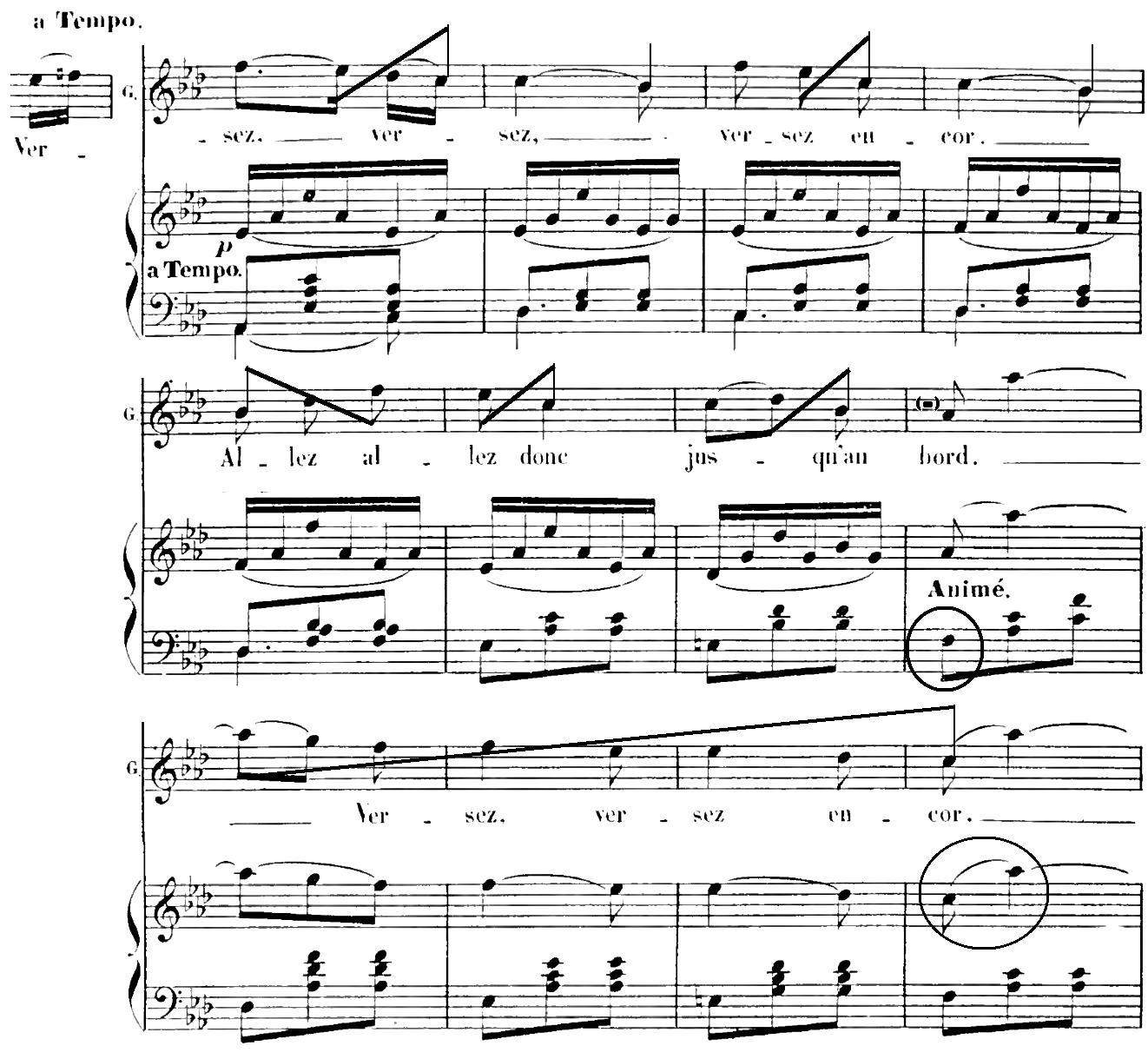
The Trio (no. 6, in the operetta's Scene 12 [of 14]) opens with a short theme "A table! A table!"—(as 8+ bars), followed by Gustave's chanson "Versez, versez"; then a scena follows, "Ah! maintenant cela va mieux," and Catherine's rondeau "J’en prendrai un, deux, trois." The rondeau will be discussed in the next post. For number list and synopsis see the introduction: link.

"Versez, versez" is a small ternary form. Catherine joins Gustave during the B-section, and all three players sing the reprise. In the A-section, the cadence is a turn to the dominant, from which the B-section follows directly.

Here is the reprise, showing in the first three systems only Gustave's part, the principal melody. Catherine is singing a simple mid-range accompaniment and Rabastens follows the bass line.


For the final bars, I show all parts below. Note especially that Catherine and Gustave trade scale degrees (voice exchange) and thus Gustave is able to go one-note-too-far to Bb4 (concert or actual pitch).


Tuesday, August 14, 2018

Offenbach, Pomme d'api (1873), nos. 2 & 4

Gustave acknowledges Rabasten's demand that he abandon his unsatisfactory girlfriend in "Mon oncle ne vous fâchez pas" (no. 2). The design is ABABA, the text's three quatrains presented as 1 2 1 3 1. The strong focus on the melody's outer notes invites hearing a proto-background ^5/^8, as Ab4-Eb5 (written) -- see the opening period below.


In the first reprise, the frame is temporarily expanded upward to include Ab5--see the final bars of the example below--but the fifth frame is not disturbed.


In the final reprise, on the other hand, the frame is again expanded upward to include Ab5, firmly now thanks to Gustave's final note. (In Neumeyer 2009, I call this device ADDINV; here the result is a tonal frame of three pitches, Ab4-Eb5-Ab5, after the fifth is inverted and its fourth added on top.) The change happens quite directly, as you can see, without the inclusion of a line -- see the reprise below -- and a proto-background is the most musically satisfying large-scale figure for the number.


Number 4 is a trio about cooking dinner: "Va donc, chercher le gril!" (in the operetta's Scene 7). A traditional multi-section form, the trio begins with an Allegro vivo for all three singers. "Mais, que ferez-vous de ce gril?" follows, a brief scena/recit between Gustave and Catherine. "Nous mettrons le gril sur le feu" is much longer, beginning as a Moderato 16-bar period (between Rabastens and Catherine), after that a contrasting B-section for Catherine and Gustave, who then repeat the 16-bar period, but—as the example below indicates—without completing it, as Catherine gives comic emphasis to "grilled lamb chops." The presto coda that follows is the point of interest here. It consists of an eight-bar theme (period) that is repeated (plus a short orchestral codetta). Both statements of the theme include a rising line in the cadence -- these are boxed in the score below. Gustave sings the figure the first time, then all three offer it in the high-spirited finish.

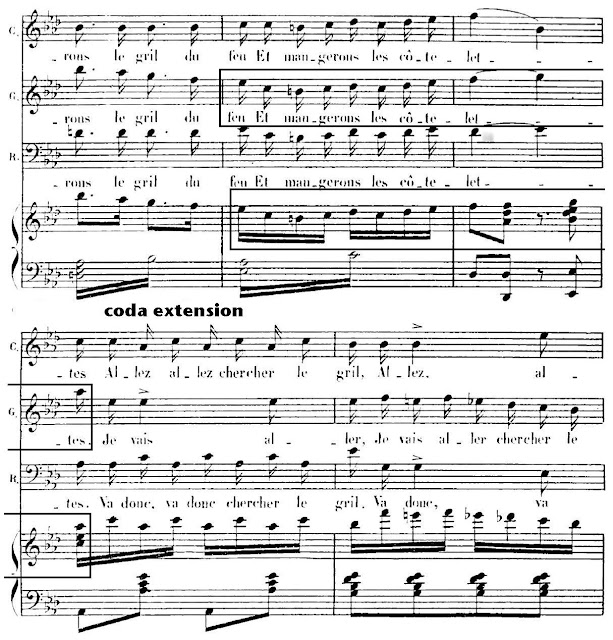


As it happens, the presto may have the expressive effect of a coda, but in form-functional terms it is not a coda. William Caplin distinguishes between expansion and extension: essentially, the former happens within a theme, the latter after the theme's cadence. Codas are properly extensions, "added on" after the structural cadence. But in this case the presto expands the consequent of the 16-bar theme and only then provides the structural cadence itself.

To show how this works, here is the initial presentation of "Nous mettrons le gril sur le feu." Note that the closing cadence is to the dominant -- and coincidentally features an internal rising line as well.


Here is an abbreviated scheme that shows the design of the reprise consequent + presto first phrase.


The structural cadence, of course, happens on the repetition of the presto's 8-bar theme: