The Trio (no. 6, in the operetta's Scene 12 [of 14]) opens with a short theme "A table! A table!"—(as 8+ bars), followed by Gustave's chanson "Versez, versez"; then a scena follows, "Ah! maintenant cela va mieux," and Catherine's rondeau "J’en prendrai un, deux, trois." The rondeau will be discussed in the next post. For number list and synopsis see the introduction: link.
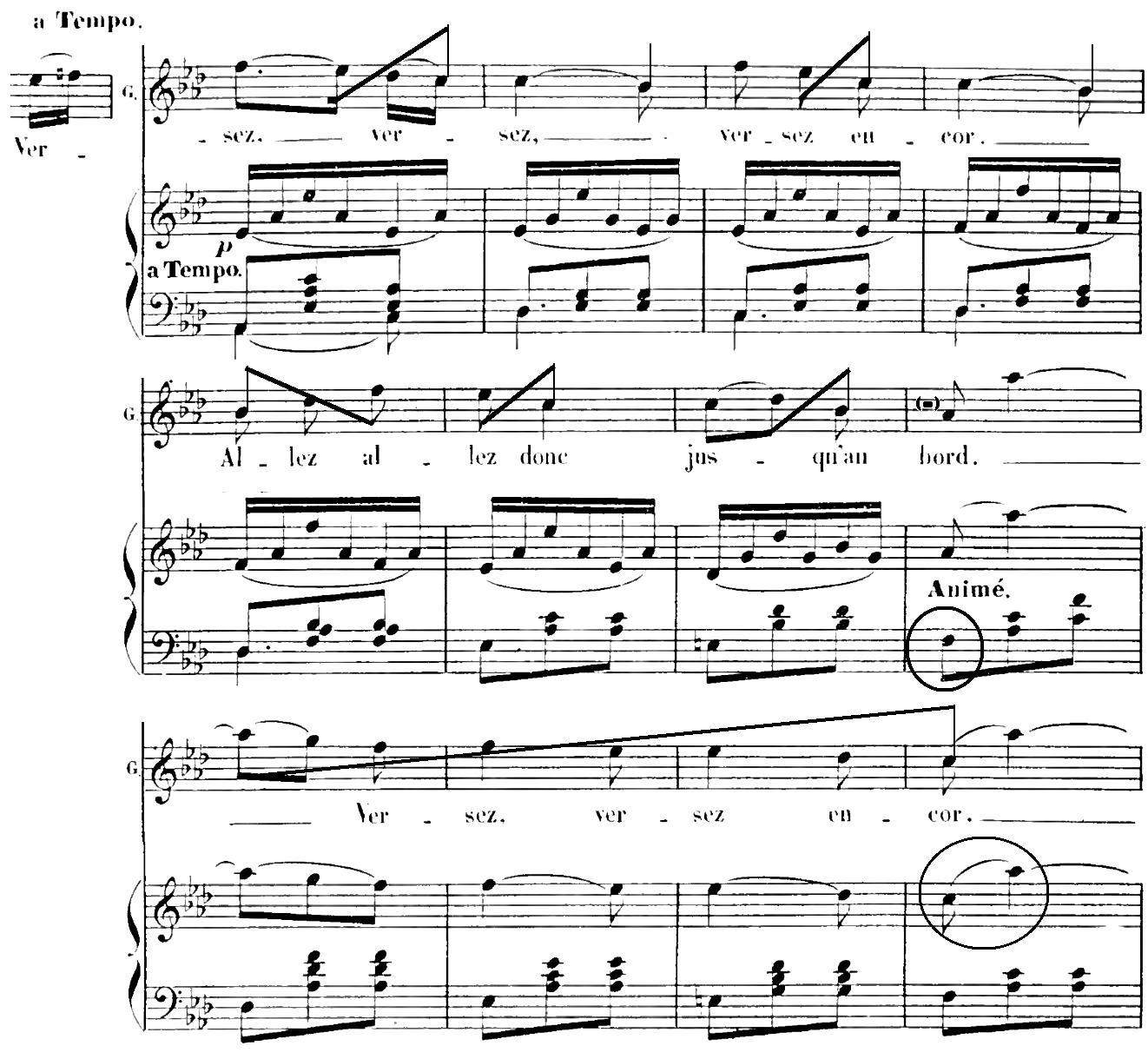
"Versez, versez" is a small ternary form. Catherine joins Gustave during the B-section, and all three players sing the reprise. In the A-section, the cadence is a turn to the dominant, from which the B-section follows directly.
Here is the reprise, showing in the first three systems only Gustave's part, the principal melody. Catherine is singing a simple mid-range accompaniment and Rabastens follows the bass line.
For the final bars, I show all parts below. Note especially that Catherine and Gustave trade scale degrees (voice exchange) and thus Gustave is able to go one-note-too-far to Bb4 (concert or actual pitch).
Wednesday, August 15, 2018
Tuesday, August 14, 2018
Offenbach, Pomme d'api (1873), nos. 2 & 4
Gustave acknowledges Rabasten's demand that he abandon his unsatisfactory girlfriend in "Mon oncle ne vous fâchez pas" (no. 2). The design is ABABA, the text's three quatrains presented as 1 2 1 3 1. The strong focus on the melody's outer notes invites hearing a proto-background ^5/^8, as Ab4-Eb5 (written) -- see the opening period below.
In the first reprise, the frame is temporarily expanded upward to include Ab5--see the final bars of the example below--but the fifth frame is not disturbed.
In the final reprise, on the other hand, the frame is again expanded upward to include Ab5, firmly now thanks to Gustave's final note. (In Neumeyer 2009, I call this device ADDINV; here the result is a tonal frame of three pitches, Ab4-Eb5-Ab5, after the fifth is inverted and its fourth added on top.) The change happens quite directly, as you can see, without the inclusion of a line -- see the reprise below -- and a proto-background is the most musically satisfying large-scale figure for the number.
Number 4 is a trio about cooking dinner: "Va donc, chercher le gril!" (in the operetta's Scene 7). A traditional multi-section form, the trio begins with an Allegro vivo for all three singers. "Mais, que ferez-vous de ce gril?" follows, a brief scena/recit between Gustave and Catherine. "Nous mettrons le gril sur le feu" is much longer, beginning as a Moderato 16-bar period (between Rabastens and Catherine), after that a contrasting B-section for Catherine and Gustave, who then repeat the 16-bar period, but—as the example below indicates—without completing it, as Catherine gives comic emphasis to "grilled lamb chops." The presto coda that follows is the point of interest here. It consists of an eight-bar theme (period) that is repeated (plus a short orchestral codetta). Both statements of the theme include a rising line in the cadence -- these are boxed in the score below. Gustave sings the figure the first time, then all three offer it in the high-spirited finish.
In the first reprise, the frame is temporarily expanded upward to include Ab5--see the final bars of the example below--but the fifth frame is not disturbed.
In the final reprise, on the other hand, the frame is again expanded upward to include Ab5, firmly now thanks to Gustave's final note. (In Neumeyer 2009, I call this device ADDINV; here the result is a tonal frame of three pitches, Ab4-Eb5-Ab5, after the fifth is inverted and its fourth added on top.) The change happens quite directly, as you can see, without the inclusion of a line -- see the reprise below -- and a proto-background is the most musically satisfying large-scale figure for the number.
Number 4 is a trio about cooking dinner: "Va donc, chercher le gril!" (in the operetta's Scene 7). A traditional multi-section form, the trio begins with an Allegro vivo for all three singers. "Mais, que ferez-vous de ce gril?" follows, a brief scena/recit between Gustave and Catherine. "Nous mettrons le gril sur le feu" is much longer, beginning as a Moderato 16-bar period (between Rabastens and Catherine), after that a contrasting B-section for Catherine and Gustave, who then repeat the 16-bar period, but—as the example below indicates—without completing it, as Catherine gives comic emphasis to "grilled lamb chops." The presto coda that follows is the point of interest here. It consists of an eight-bar theme (period) that is repeated (plus a short orchestral codetta). Both statements of the theme include a rising line in the cadence -- these are boxed in the score below. Gustave sings the figure the first time, then all three offer it in the high-spirited finish.
As it happens, the presto may have the expressive effect of a coda, but in form-functional terms it is not a coda. William Caplin distinguishes between expansion and extension: essentially, the former happens within a theme, the latter after the theme's cadence. Codas are properly extensions, "added on" after the structural cadence. But in this case the presto expands the consequent of the 16-bar theme and only then provides the structural cadence itself.
To show how this works, here is the initial presentation of "Nous mettrons le gril sur le feu." Note that the closing cadence is to the dominant -- and coincidentally features an internal rising line as well.
Here is an abbreviated scheme that shows the design of the reprise consequent + presto first phrase.
The structural cadence, of course, happens on the repetition of the presto's 8-bar theme:
Friday, August 3, 2018
Offenbach, Pomme d'api
A one-act operetta written specifically for one of Offenbach's discoveries, the soprano Louise Théo, Pomme d'api was premiered in Paris in September 1873. The production was a success, and the composer promptly wrote for her the full-length La jolie parfumeuse, which was premiered in November of the same year. Although successful, too, just three months later La jolie parfumeuse was left in the shadow of the remarkable run of Offenbach's four-act version of Orphée aux enfers (originally two acts, 1858).
The music of Pomme d'api consists of the overture and eight numbers:
The plot is simple enough, as these entangled romances go: An older man, Rabastens, disapproves of his nephew Gustave's current girlfriend and cuts off the young man's allowance. Gustave reluctantly goes along with the demand and rejects her. Having fired his maidservant, Rabastens awaits the arrival of her replacement, who is Catherine, (of course) Gustave's now ex-girlfriend. She plays up to Rabastens in order to rebuke Gustave, who is disconsolate and decides to go away, at which point Catherine realizes that he still loves her, Rabastens is reconciled to them, and all ends well (Gustave's allowance is even increased!). Much of the action revolves about dinner, which explains the title: the pomme d'api is one of the earliest named apple varieties, already mentioned in botanical volumes in the early 17th century.
Information about design:
1. Couplets (Rabastens) "L’employé m’a dit, de quel âge" (in Scene 1)
(a) Chanson (Gustave) "Versez, versez"
The music of Pomme d'api consists of the overture and eight numbers:
1. Couplets (Rabastens) "L’employé m’a dit, de quel âge" (in Scene 1)Of these, only numbers 1 & 3 lack prominent rising lines in their cadences. As we will see, the character and significance of the ascending cadence gestures varies considerably.
2. Romance (Gustave) "Mon oncle ne vous fâchez pas" (in Scene 2)
3. Couplets (Catherine) "Bonjour monsieur je suis la bonne" (in Scene 3)
4. Trio "Va donc, chercher le gril!" (in Scene 7)
5. Duo (Catherine, Gustave) "C’est un dimanche, un matin" (in Scene 11)
6. Trio "A table! A table!" (in Scene 12)
(a) Chanson (Gustave) "Versez, versez"
(b) Rondeau (Catherine) "J’en prendrai un, deux, trois"
7. Romance (Gustave) "Consultez votre coeur" (in Scene 14)
8. Finale "J’en prendrai un, deux, trois" (in Scene 14)
The plot is simple enough, as these entangled romances go: An older man, Rabastens, disapproves of his nephew Gustave's current girlfriend and cuts off the young man's allowance. Gustave reluctantly goes along with the demand and rejects her. Having fired his maidservant, Rabastens awaits the arrival of her replacement, who is Catherine, (of course) Gustave's now ex-girlfriend. She plays up to Rabastens in order to rebuke Gustave, who is disconsolate and decides to go away, at which point Catherine realizes that he still loves her, Rabastens is reconciled to them, and all ends well (Gustave's allowance is even increased!). Much of the action revolves about dinner, which explains the title: the pomme d'api is one of the earliest named apple varieties, already mentioned in botanical volumes in the early 17th century.
Information about design:
1. Couplets (Rabastens) "L’employé m’a dit, de quel âge" (in Scene 1)
Two strophes (different text, same music); in the voice, proto-background ^1/^5.2. Romance (Gustave) "Mon oncle ne vous fâchez pas" (in Scene 2)
--ABABA design; proto-background ^5/^8. The text is also in a couplets design, its three quatrains presented as 1 2 1 3 1.3. Couplets (Catherine) "Bonjour monsieur je suis la bonne" (in Scene 3)
Two strophes, with acceleration near the end of each.4. Trio "Va donc, chercher le gril!" (in Scene 7)
Three sections: Allegro vivo; scena/recit; Moderato. (1) "Va donc, va donc, chercher le gril!" The opening Allegro, for all three singers, is in AB design, where A is an eight-bar period, B is considerably longer and closes on V. (2) "Mais, que ferez-vous de ce gril?" The brief scena/recit is between Gustave and Catherine. (3) "Nous mettrons le gril sur le feu" The much longer Moderato is more complex: a 16-bar period opens (between Rabastens and Catherine), a B-section follows for Catherine and Gustave, and they then repeat the 16-bar period, which, however, is broken off by Catherine, who gives comic emphasis to "grilled lamb chops," and a presto coda for all three follows.5. Duo (Catherine, Gustave) "C’est un dimanche, un matin" (in Scene 11)
An extended number. (1) "C'est un Dimanche." Duo. Pastorale, small ternary form. (2) "A deux pas du chien savant" scena, varied tempi and styles, including a reprise of the pastorale's opening theme in the middle. (3) "Et je vois l'un près de l'autre" Allegretto presqu' Andantino. Solo for Catherine, ABACA. (4) "De grace écoule-moi ma bonne!" scena. (5) "Pomme d'Api" Allegretto. Duo. Small ternary form with presto coda.6. Trio "A table! A table!" (in Scene 12)
(a) Chanson (Gustave) "Versez, versez"
The trio theme—"A table! A table!"—(as 8+ bars) precedes. "Versez, versez" is a small ternary form; Catherine joins in during the B-section, and all three sing the reprise. A scena follows: "Ah! maintenant cela va mieux."(b) Rondeau (Catherine) "J’en prendrai un, deux, trois"
Allegro vivo, follows on the scena above. As with (a), the others join in during the B-section and all three sing the reprise, which is extended through a coda, after which the entire rondeau is repeated.7. Romance (Gustave) "Consultez votre coeur" (in Scene 14)
Strophic, two verses, a 12-bar theme.8. Finale "J’en prendrai un, deux, trois" (in Scene 14)
"J'en prendrai un, deux, trois" Reprise of the rondeau from no. 6In the next post, I will start the analytical observations about rising cadence gestures.
Wednesday, August 1, 2018
Schubert, "Ruhe, schönstes Glück der Erde"
Schubert, "Ruhe, schönstes Glück der Erde," D657 (1819) is for four-part men's chorus. It is a part-song of images. At the beginning, the hushed opening apostrophe to Rest is followed by a short phrase that does indeed "rest" with a perfect authentic cadence (boxed).
Then, though it begins higher (A4 in the tenor at [b]), Rest is quietly enjoined to sink below, with a blessing, so that quiet can fill us (repeated notes at (c). An A major triad is reached as V of D minor, but then an evocative phrase entirely in A major expresses "as a grave rests in flowers."
Continuing and turning more chromatic, the music reaches Ab major (at [d]), and then a sudden return to the opening at (e) is filled out to a PAC and drooping melodic figures (first box in the second system). A codetta extension repeats the descents in chromatic form over a sustained tonic bass.
The harsh interruption at (f)—"Let the stormy heart be quieted" (pianissimo for "quieted"/"schweigen")—initiates the second half. At (g), a determined chromatic ascent for "as they grow, as they rise, grows and rises the Soul's pain" ends with stark octaves for the repetition of "Seele Pein" at (h).
Rest is then enjoined again to bring peace to the earth, so that the Soul can be healed and rise from the grave: at (j) and (k) dramatically, then following another quiet "codetta" with bass pedal at (m), dramatically again in repetition at (n). Note that is there is no PAC: the tenor rises by step from ^1 to ^3 (and all the lower voices also rise).
Rising figures that close a composition in such dramatic, expressive mode are very rare, but then the ending here is clearly at one with everything that precedes it.
Then, though it begins higher (A4 in the tenor at [b]), Rest is quietly enjoined to sink below, with a blessing, so that quiet can fill us (repeated notes at (c). An A major triad is reached as V of D minor, but then an evocative phrase entirely in A major expresses "as a grave rests in flowers."
Continuing and turning more chromatic, the music reaches Ab major (at [d]), and then a sudden return to the opening at (e) is filled out to a PAC and drooping melodic figures (first box in the second system). A codetta extension repeats the descents in chromatic form over a sustained tonic bass.
The harsh interruption at (f)—"Let the stormy heart be quieted" (pianissimo for "quieted"/"schweigen")—initiates the second half. At (g), a determined chromatic ascent for "as they grow, as they rise, grows and rises the Soul's pain" ends with stark octaves for the repetition of "Seele Pein" at (h).
Rest is then enjoined again to bring peace to the earth, so that the Soul can be healed and rise from the grave: at (j) and (k) dramatically, then following another quiet "codetta" with bass pedal at (m), dramatically again in repetition at (n). Note that is there is no PAC: the tenor rises by step from ^1 to ^3 (and all the lower voices also rise).
Rising figures that close a composition in such dramatic, expressive mode are very rare, but then the ending here is clearly at one with everything that precedes it.
Tuesday, July 31, 2018
Czerny, Album Elegant des Dames Pianistes, op. 804 (continued)
"Helene" is another number in Carl Czerny's Album Elegant des Dames Pianistes, op. 804.
In the first phrase, M is main melody, C is cover tone. M centers on ^1, C on ^5. In the second phrase the two trade places, with the result that ^5 is heard as the focal tone throughout (in the upper voice from 1-4, then the inner voice from 5-8). The leap upward in bar 6 is replicated in bar14, from which a simple rising line to ^8 follows in bars 15-16.
The design of the piece is ternary, with a small ternary form as the A-section. In the reprise ending the A-section, Czerny alters the consequent phase such that the upper tetrachord is starkly foregrounded throughout.
In the final cadence of the larger reprise, Czerny introduces another set of changes, now such that the rising line and upper-tetrachord emphasis disappear, replaced by a descent from ^3. (Presumably we would locate an imagined ^4 in the preceding bar in order to complete an Urlinie from ^5.)
In the first phrase, M is main melody, C is cover tone. M centers on ^1, C on ^5. In the second phrase the two trade places, with the result that ^5 is heard as the focal tone throughout (in the upper voice from 1-4, then the inner voice from 5-8). The leap upward in bar 6 is replicated in bar14, from which a simple rising line to ^8 follows in bars 15-16.
The design of the piece is ternary, with a small ternary form as the A-section. In the reprise ending the A-section, Czerny alters the consequent phase such that the upper tetrachord is starkly foregrounded throughout.
In the final cadence of the larger reprise, Czerny introduces another set of changes, now such that the rising line and upper-tetrachord emphasis disappear, replaced by a descent from ^3. (Presumably we would locate an imagined ^4 in the preceding bar in order to complete an Urlinie from ^5.)
Monday, July 30, 2018
Czerny, Album Elegant des Dames Pianistes, op. 804
Carl Czerny's Album Elegant des Dames Pianistes, Op. 804, is subtitled "24 Morceaux melodieux." Each of the pieces is assigned a woman's first name (these are character types, rather than actual individuals). I had volume 1 (nos. 1-12) available to me. Of those, two are of interest.
"Arabella," in Ab major, is a nocturne in the familiar Field/Chopin manner. The design fits the genre also: ternary where A is a 16-bar period with a sentence as the antecedent phase and with an embellished consequent, B is a 16-bar sentence, and the reprise of A is complete, but varied. A five-bar coda ends.
The structural cadence, ending the reprise, complicates the voice-leading in the right hand, but the motions are clear enough as outlined below. From IV6, an augmented sixth resolves outward to the octave—with Eb4 at the top—and then the parallel sixths that carry Eb4 up to G4 through the chromatic F#4 (which "might have been" ^6 otherwise), the octave doubling of C & Db (circled notes), and the traditional 6-8 close—the cantus-tenor formula—that amplifies ^7-^8 (as G4-Ab4).
"Arabella," in Ab major, is a nocturne in the familiar Field/Chopin manner. The design fits the genre also: ternary where A is a 16-bar period with a sentence as the antecedent phase and with an embellished consequent, B is a 16-bar sentence, and the reprise of A is complete, but varied. A five-bar coda ends.
The structural cadence, ending the reprise, complicates the voice-leading in the right hand, but the motions are clear enough as outlined below. From IV6, an augmented sixth resolves outward to the octave—with Eb4 at the top—and then the parallel sixths that carry Eb4 up to G4 through the chromatic F#4 (which "might have been" ^6 otherwise), the octave doubling of C & Db (circled notes), and the traditional 6-8 close—the cantus-tenor formula—that amplifies ^7-^8 (as G4-Ab4).
Here is a slightly simplified version of the right hand tracing structural soprano and alto:
Here is the passage, simplified a bit more, with scale degrees for a primitive ascending Urlinie and structural soprano and alto.
And here is a final simplification, to remove the register changes in the alto voice and also the chromatic note, suggesting that a simple rising line abstractly underlies the passage.
Wednesday, July 25, 2018
Priorities and methods
Since recent posts have made liberal use of Schenkerian linear analysis tools, it will be useful to remind readers that this is not a blog limited to those tools. In connection with a briefly displayed subtitle, I discussed the several methods I am employing in this long-range study of ascending cadence gestures in traditional tonal music for concert and dance: link.
Subscribe to:
Posts (Atom)


