Wednesday, November 9, 2016

Minor key series, part 12 (Beethoven)

Beethoven's 32 Variations in C minor, WoO80, were composed in 1806 and published in 1807. The lack of an opus number might be related to the composer's rejection of the work later in his life. Certainly, its evocation of the Baroque chromatic chaconne bass and continuous variation design seems out of place among the large-scale, heroic music of Beethoven's middle period (he also wrote the Third Symphony and the Violin Concerto in 1806, for example). And not only is WoO80 rather old-fashioned for the first decade of the 19th century, but it also is not up to the standard of the "Eroica" variations written earlier (1802) or the Diabelli Variations written much later (1819/1823).

To the point here, the theme offers an obvious opportunity for a rising line in the minor, an opportunity that Beethoven does not exploit, however, as we shall see below. There is one rising line among the 32 variations, but it is in the maggiore variation 14.

The chromatic chaconne bass in bars 1-6 moves against a rising line in the right hand, the overall result being to move both bass and melody from ^1 to ^5, but of course in opposite directions. The wedge goes one step further in the sforzando subdominant chord but then the simple octaves fall sharply (and quietly). The potential for a variant of an ascending Urlinie, however, is introduced by that subdominant chord -- I have marked how it might be realized in scale degrees. As it stands, the clearest implicit figure is a displaced neighbor G5-Ab5-G4 (bars 6 and 7).


In the variations, Beethoven makes much of the dramatic contrast between the first six bars and the cadence. Since he includes the rise-and-fall gesture in many cases, the clear expression of a rising line is not possible. Variation 5 is typical. The arrows at (a) chart the wedge in the melody, which does reach ^6, but then the convoluted drop-off leaves one assuming an implied completion of the neighbor figure, so, G6-Ab6-(G6).

The primary impediment to an ascending Urlinie in the variations is Beethoven's abandonment of the subdominant supporting ^6 for an expanded dominant, as in Variation 6, where bars 6-7 are a dominant seventh or ninth.


Variation 12 is the first of five maggiore variations. The arrow points to the sixth scale degree that ought to make a continued ascent in the cadence easy to manage.


Variation 14, finally, does realize a rising line. An initial ascent brings ^3 (at "x") up to ^5 (at "y"). A first attempt at the line from ^5 to ^8 follows (see "z"), and bars 7-8 do the work with clarity and resolve (thus, ^5 in bar 3 moves to ^6 in bar 7 and the line then finishes the ascent).


Minor key series, part 11 (progressions k-n)

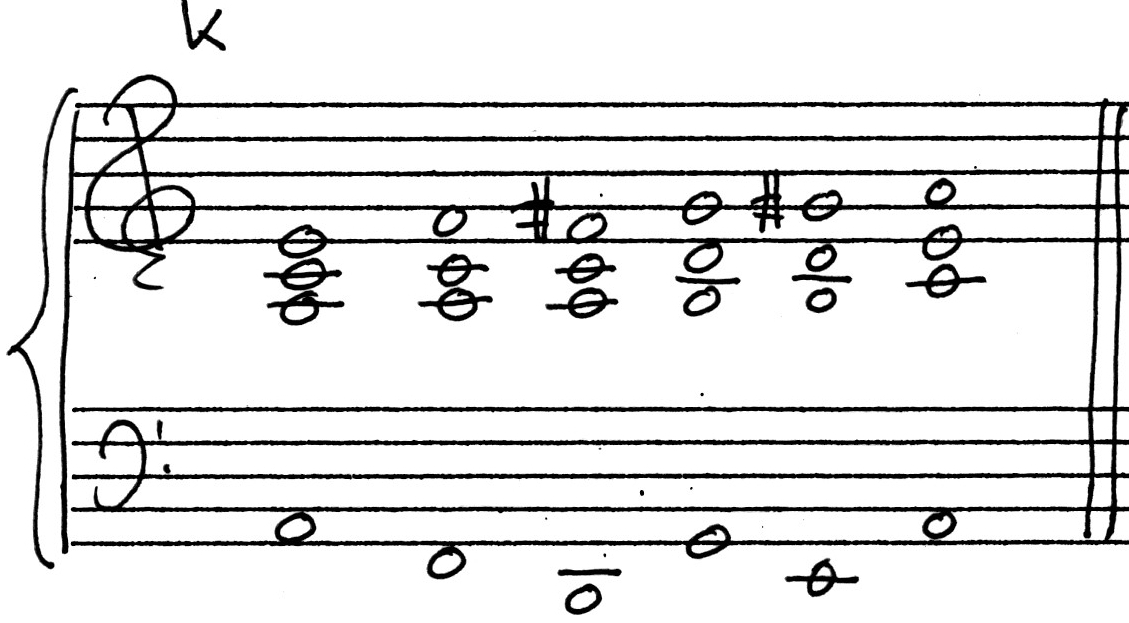
Here are examples of more complex ascending figures, this time shown in four part textures. All of these are hypothetical in the sense that, although they are possible "mechanically," I have not yet found examples in the repertoire.

In figures k and l, the melodic line is completely chromatic. The underlying harmony in figure k is relatively simple, in figure l rather less so.


Figures m and n are variants of the fully chromatic line. In figure m, the chromatic ascent is interrupted for the sake of introducing a cadential 6/4 chord. Figure n varies figure k but at the cost of undermining the fully chromatic line (the first five chords prolong i and support a neighbor-note figure, ^5-^6-^5).


Minor key series, part 10 (Wagner)

The opening of the Prelude to Tristan und Isolde comes close to following figure i, in which ^#6 is supported by either a minor ii or major II. I say "close" with some caution, as three of the five elements are not represented as clearly as one would like. Tones of the tonic chord (for element 1) are minimally represented (some music scholars don't accept these tones as confirming the tonic at all). Element 2 is an unresolved dominant seventh chord in the middle of a sequence. Worst of all, element 5 is not the tonic to support ^8, but VI.


The reduced score below shows the opening's version of this progression, which returns in varied form as the ending.


Here is that "structural close." The passage from the beginning is reworked in the first 12 bars. I have boxed the ending to show the cadence. The end result is an abandonment of figure i for figure c (where ^5, ^6, and ^7 are all over V), but still with the deceptive ending. By the time the opening figure is repeated (second box below), the bass is G and the prevailing key has changed to C minor.

Sunday, November 6, 2016

Minor key series, part 9 (Wolf; Brahms; Duparc) continued

Brahms, Op. 69n7, consists of two musically identical verses. The first is reproduced here.


The pairing of a simple rising line with a descending alto from ^5 is reminiscent of the Couperin passacaille, but here the alto descends more quickly. For much more on this song, possible analyses, and the text, see my essay Rising Gestures, Text Expression, and the Background as Theme: link. The section for which Op69n7 serves as the principal example begins on page 17.


Henri Duparc's "Lamento" was written in 1868, while the twenty-year old was a student of Cesar Franck, whose influence shows. Walter Everett (2004, 52) reads the pitch design in very nearly the way I do below, with ^5 prolonged for quite some time. then the line rising through A#4 to ^6 (B-nat4) and through C-nat5 to ^7 (C#5) and finally to ^8 (D5). The bass support is the tonic for ^5, nat-VI for ^6 (!), V7 for ^7, and the tonic again for ^8.   (Score notation is by Pierre Gouin and is available on IMSLP. My apologies for artifacts I've introduced in the first section below through compressing the width and moving measure 7 up a system.)


Reference: Everett, Walter. 2004. "Deep-Level Portrayals of Directed and Misdirected Motions in Nineteenth-Century Lyric Song." Journal of Music Theory 48/1 (2004): 25-58.


Saturday, November 5, 2016

Minor key series, part 9 (Wolf; Brahms; Duparc)

I had intended this post to show a later 19th century treatment of figure g in Hugo Wolf's setting of Goethe's satirical "peasant" poem "Der Schäfer." Two things happened, however. First, I realized on examining the piece more closely that figure g is not the model; instead, it is a convoluted or distorted version of figure c. More on that below. Second, I remembered that I had just written about a minor-key Brahms song in the essay Rising Gestures, Text Expression, and the Background as Theme (published on Texas Scholar Works: link). Then, looking at the work materials for that essay, I found another Brahms song and also one by Henri Duparc (both are mentioned in Walter Everett's article that was the starting point for my Rising Gestures essay).

Neither Brahms song (they are, btw, Op59n1 and Op69n7) nor the Duparc "Lamento" uses figure g, so the end result is that this post may perhaps be best regarded as an excursus in the minor key series. The nineteenth-century theme will continue, however, in the following post, where I look at the opening of the Tristan Prelude in connection with figure i. After that, I'll finally introduce figures k-n, which as it happens lack examples in the repertoire, and two interesting cases—Beethoven's 32 Variations in C minor, WoO80, which ought to have a rising line based on its harmonic plan, but doesn't—and a movement-length partimento by Durante. The last entries in the series will form a longish appendix on 17th century Dorian-mode pieces.

In brief, Goethe's poem "Der Schäfer" is about a shepherd who is lazy and neglects his work but who suddenly perks up and becomes energetic and responsible when a woman accepts him. This turn happens in the final lines, and is set by Wolf with a rising line.  The first structural tone of the melody is unclear, largely because of the contortions in line and harmony—see the score below—but also because neither ^8 nor ^5 is confirmed in the subsequent passage.

At the end, on the other hand, the motion from ^5 is very clear, if also very chromatic in the voice and oddly chromatic in the harmony:

I have removed the text and isolated the harmonies in this reduction. Also note the labeling of local harmonies and functions.
A further reduction shows more plainly that the entire passage, excepting the final tonic, involves prolongation of the dominant.

The end result, then, is that "Der Schäfer" uses figure c (below), not figure g.


Brahms, op. 59n1, is another Goethe setting, "Dämmrung senkt sich von oben," a nature poem that Brahms sets in four verses, the first two in G minor, where the second is a slight variant of the first, the third is a "B-section" contrast that begins in Eb major, and the fourth in G major builds on material of the second half of verse 1. It is the last verse that concerns us here.

The ^5 I have marked at the beginning is without reference to anything earlier in the song. Whether the whole piece should be read from an abstract ^3 (Bb) or ^5 is an open question: I would favor the former in the early verses but the latter in the final two. Regardless, the motion from ^5 and the elongated dominant are unmistakable in verse 4.


Considerable attention is given the subdominant throughout the verse, including the approach to the cadence (see both IV and iv below). The close, then, uses figure c, where ^5, ^6, and ^7 are all over V -- but note that the alternatives for the voice lay bare the simple and ancient opening wedge of counterpoint where the ascent ^5-^6-^7-^8 is balanced by a descent from ^3 to ^1.
Nevertheless, Brahms does here what Schubert did in pieces we examined early in this series (link): he actually avoids the problem of the minor key by switching at the end to the major.

Part 9 continues in the next post: Brahms, Op. 69n7, and Duparc "Lamento."

Reference: Everett, Walter. 2004. "Deep-Level Portrayals of Directed and Misdirected Motions in Nineteenth-Century Lyric Song." Journal of Music Theory 48/1 (2004): 25-58.

Thursday, November 3, 2016

Minor key series, part 8b, addendum (Le Roux)

The G minor suite also contains a movement labeled "Piece sans titre." It is marked "gayement" and to my ear, at least, bears traits of the bourrée and, in some moments, the gavotte, but without maintaining the characteristic figures or even a four-bar phrase unit. Eight phrases are distributed across a small binary form, 1-2 in the A-section, 3-8 in the B-section.

The three-bar first phrase focuses on the upper fourth of the tonic octave, or D5-G5. The latter is the first note of a traditional Urlinie of the mirror form, ^8 down to ^5, then rising again to ^8. I have reproduced a figure from the introduction to this series; the form LeRoux uses for his "Piece sans titre" is boxed. To date, this is the only piece I have found using this Urlinie in the minor key. (It is actually fairly common in the major key.)


At (a) is ^8 of the Urlinie; a line will descend from it in section B. At (b) is the middleground line that covers section A, up to the PAC in the dominant. At (c) is an internal third-line that reaches D5 "early" and helps to expand the phrase to 6 bars.


The upper voice in phrases 3, 4, and 5—the first half of the B section—traverses a fifth-line from a superimposed inner voice at the beginning (A4 becomes A5 in phrase 3) eventually back to ^5 (by the middle of phrase 5).


Phrase 6 takes the line back up from D5 to G5 with a PAC as close. (The harmonies might suggest the F# on beat 1 as ^#7 better than beat 4, as I have it now.)  

But the piece is not finished. A firm, apparently conclusive PAC on the tonic before the end is common in French harpsichord music because of the performance tradition of the petit reprise, in which the final phrase of a piece was repeated, presumably with additional embellishments or textural changes. In several pieces for the 1705 collection, LeRoux takes advantage of this tradition to add new music after the tonic close. In this case, he adds two phrases, the first of which picks up the figure of phrase 2—see phrase 7, where the figure is put into sequence. Phrase 8, then, starts from Bb5 as ^3 and brings the piece to a close with another firm cadence. I am not particularly fond of those Schenkerian readings that only reach their supposedly principal melodic tone near the end, and in this case it would make little sense anyway, as phrases 7 & 8 are in the petit reprise or coda-like region of the piece.


Wednesday, November 2, 2016

Minor key series, part 8b (Bacquoy-Guedon, LeRoux, Böhm)

Alexis Bacquoy-Guedon published a dance treatise in the 1780s. I have written about his musical examples before, on my dance music blog: link; and also twice on this blog: link, link,

The last of the posts linked to above shows his 4th Menuet in G major, with its trio, which is the item of interest here.


The underlying figure g (simple ascent with ^#6 and i-IV-V-i) is revealed by adding a likely bass below the Urlinie:


I discussed a two-harpsichord gigue and a courante with an added contra partie by Gaspard LeRoux in the continuation post of part 3: link. Here is another piece from the same collection (1705), this time a sarabande with 11 variations. To avoid confusion in case you look at the score yourself, I will follow the numbering Fuller uses, where the sarabande (theme) is called couplet 1, the first variation couplet 2, etc. (The 1705 edition has no labels.)

In one common French design for a published suite, a larger scale piece, usually a chaconne, ends the suite of dances and character pieces. Here the design is almost that: (unmeasured) Prelude, Allemande, Courante, "La Bel-abat," Piece sans titre, Gigue, Sarabande [with variations], Menuet. As elsewhere in the collection, the sarabande itself is provided with an alternative trio arrangement, but the variations are given just a continuo bass. I am uncertain what that signifies for an actual performance option.

The first phrase of the sarabande is reproduced below in Alfred Fuller's edition. I will not cite any more of it in order to respect copyright. In the 1705 edition, however, the left hand part is written in baritone clef (like the bass clef but a third higher), and so I will present the alternate trio version of the theme instead.


The six phrases of the theme are distributed in the common asymmetrical design where A has two and B has the other 4. Section A ends in III, and midway through section B we reach V in a half cadence. What is remarkable is that in the solo version, Le Roux uses the dully repetitive figure of the first treble part in the entire B-section, not the considerably more interesting melody of the second treble part.


Phrases 5 & 6 in couplet 2 (that is, the first variation) are shown below. I have "transposed" the left hand part to the common bass clef. The cadence in the upper register is striking, but from a traditional Schenkerian viewpoint, we have to call the uppermost voice boundary play growing out of two cover tones--see the graph below the score.


Four other couplets use rising lines, three of them at the end, as in couplet 2 above. In couplet 6, almost continuous 16th-note arpeggios in the right hand are all set in the upper octave. In couplets 4 & 10, a clear descending cadence is placed in phrase 5, to which the upper octave in phrase 6 sounds like a coda flourish. The most interesting use of the rising line is the opening, not the end, of couplet 2 -- see below, where phrases 1 & 2 chart the octave from Bb4 to Bb5, step by step. (Note that I have not moved the left hand to bass clef this time.)   Below the score I have marked the sources of all these steps in the trio version of the sarabande theme, demonstrating again Le Roux's quite free attitude toward his theme (these are *not* simple figural variations).

The last example comes from one of the many German composers who imitated French keyboard styles and genres in the 17th and early 18th centuries: Georg Böhm, whose Suite in F minor contains a courante with an ascending Urlinie. Volume 1 of the Sämtliche Werke edition (published in 1952) includes eleven suites, two of them in F minor. This courante is from the second of those suites. Note that it uses the Dorian signature (three flats rather than the four we would expect for F minor).


Here is an analysis showing the background..


Finally, a background/first middleground graph, with the inner voice. I chose to show the bass for i6 with a closed note rather than an open note, but the outline of figure g is still clear.